No. MORTENSEN1970-001
Shimshara pierced rib strip
Iraq · Rania plain, Lesser Zab, Sulaymaniyah Governorate (Kurdistan Region); Hassuna period · Near East · Mesopotamia
Function not recorded Candidate only
Source term: spatula
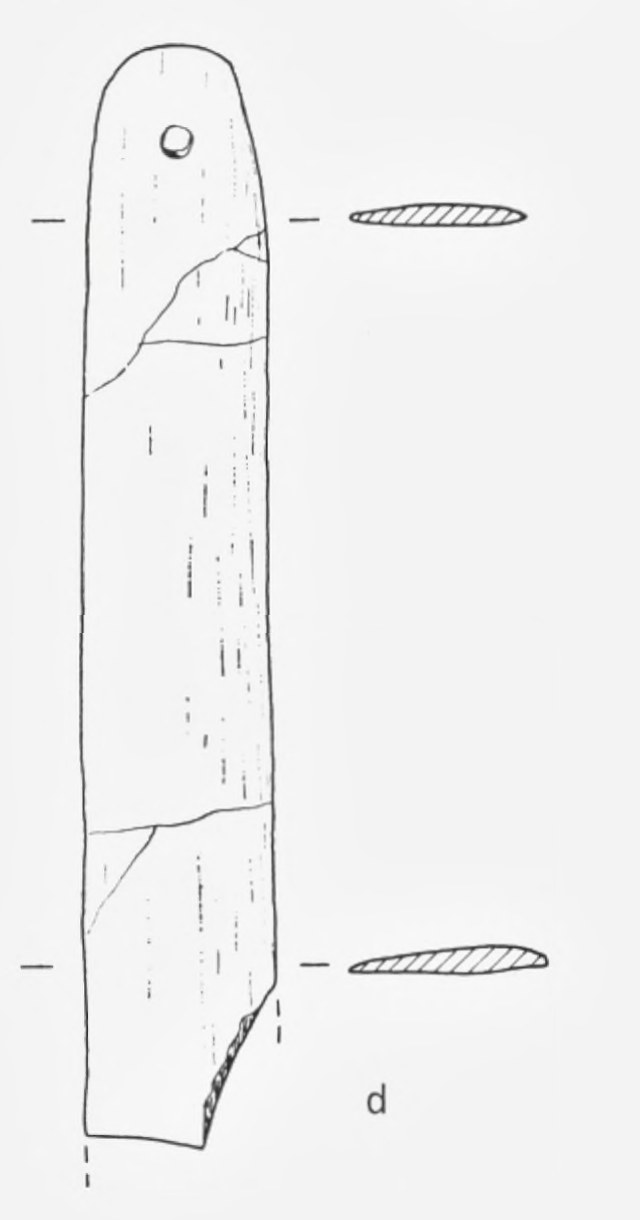
Only eleven worked bones survive from the Hassuna-period village at Tell Shimshara, a mound beside the Lesser Zab in the Rania plain, and four of them lay together on one floor. Three were long knife handles cut from red-deer foot bones, grooved at each end to hold blades of flint or obsidian, and badly scorched by fire. The fourth is this strip, cut from the rib of an ox or a big red deer: flat and straight-sided, rounded at the top and drilled with a single hole, its far end broken away. Obsidian from the same level came from the volcanoes of eastern Anatolia.
Particulars
- Object
- Flat strip cut from the lower part of a rib of an ox or a large red deer, with parallel sides, a thin lens-shaped section and one rounded end pierced by a single hole; the other end is broken. Preserved length 13.8 cm.
- Function
- Not recorded.
Sources
- Peder Mortensen, Tell Shimshara: The Hassuna Period, Historisk-filosofiske Skrifter 5(2) (1970), pp. 58–59, fig. 49d; Colin Renfrew, 'Tell Shimshara and the traffic in obsidian', pp. 139–140 View
- Pascal Flohr et al., 'Radiocarbon dating of Bestansur and Shimshara', in The Early Neolithic of the Eastern Fertile Crescent (2020), pp. 187–196 View