No. MNAURUGUAY2017-001
Arroyo de la Tuna slate blade
Uruguay · Canelones coast, Río de la Plata · South America
Function not recorded Candidate only
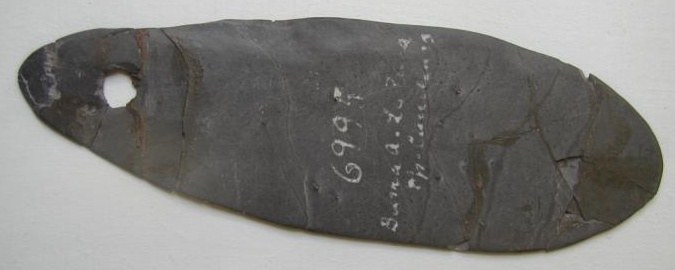
Source term: colgante lítico (stone pendant)
Someone on the Canelones shore of the Río de la Plata took a piece of dark slate, chipped it into a long leaf, then smoothed, polished and burnished it down to a single millimetre, and drilled one small hole through the narrower end. It turned up in 1933 on the bar where the Arroyo de la Tuna runs into the estuary, left by one of the coastal peoples who lived along this shore. Its age is unknown. Similar slate pieces have come from Punta del Este and from the mouth of the Río Negro.
Si bien desconocemos su función original, se ha identificado tradicionalmente a este tipo de objeto como un colgante lítico, relacionado al adorno personal.
Although we do not know its original function, this kind of object has traditionally been identified as a stone pendant, related to personal adornment.
Museo Nacional de Antropología, Montevideo, specimen sheet for Francisco Oliveras collection 6.995
Particulars
- Object
- Elongated elliptical blade of dark grey slate, 107 × 37 × 1 mm, shaped, smoothed, polished and burnished, with one small hole near its narrower end. Several old breaks across the body and the pierced end have been joined.
- Function
- Not recorded.