No. MUS2026-066
Pume calabash disc on nylon string
Llanos, Venezuela · South America
Function not recorded
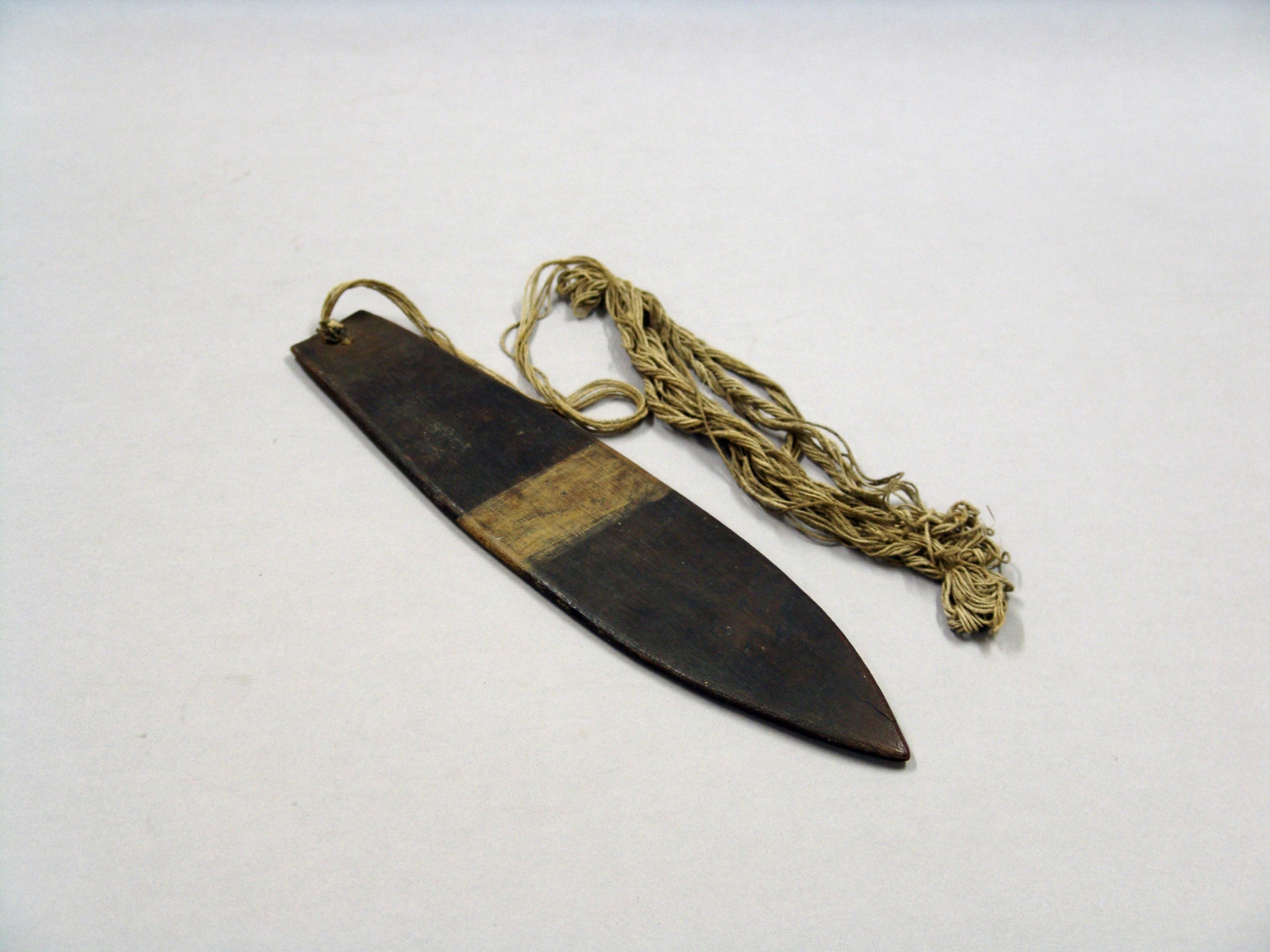
Source term: bull-roarer
A thin calabash disc about five centimeters across, its rim notched and a single hole drilled near the edge for a length of commercial nylon string: a Pume bull-roarer in the Penn Museum, collected by the ethnoarchaeologist Russell Greaves, who has worked among the Pume of the Venezuelan llanos since 1990. It was made at Doro Ana between 1980 and 1993, by a man remembered as Gonzalo. What the Pume did with it went unrecorded. Vincent Petrullo's foundational 1939 ethnography of this people mentions no bull-roarer at all, reporting the shaman's gourd rattle as the sole instrument and women's song as unaccompanied, and later observers likewise know the Pume only for the rattle and the all-night tohe ceremony.
A thin, circular object with notches on its outer edge. A small hole for commercial nylon string is located near the outer edge.
Penn Museum, object record 96-1-654 (Bull-Roarer, Pume | Yaruro, Venezuela)
Particulars
- Object
- Bull-roarer of the Pume, Penn Museum (acc. 96-1-654).
- Function
- Not recorded.
Source
Penn Museum, acc. 96-1-654 (made at Doro Ana, 1980-1993; gift of Russell D. Greaves, 1996); cf. Vincent Petrullo, "The Yaruros of the Capanaparo River, Venezuela," BAE Bulletin 123, 1939