The Bullroarer Atlas

LOEB1929-035 - ethnographic attestation

Paiute

United States - Great Basin - North America

Play / practical

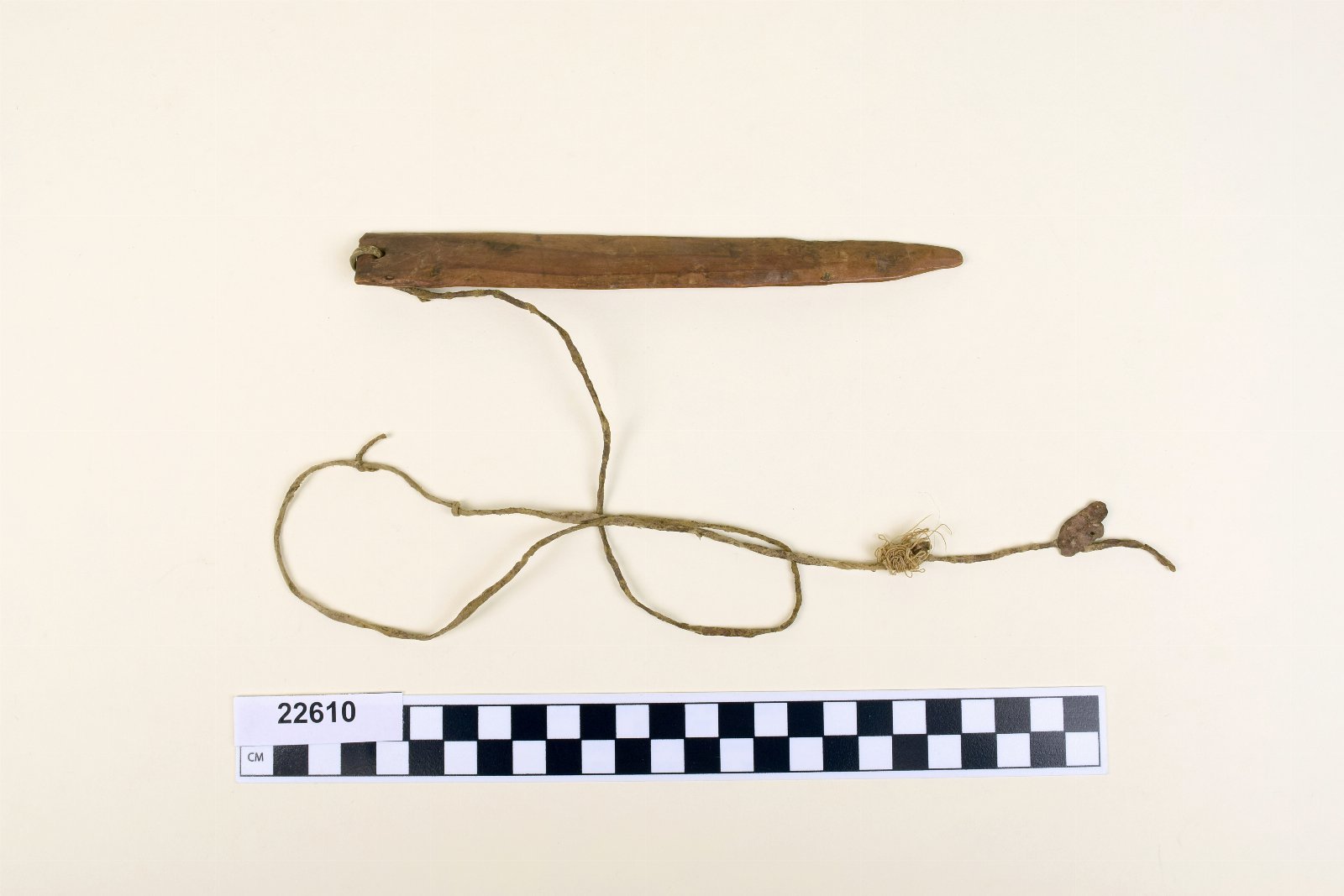
An old engraved figure of a single bull-roarer — a dark tapering blade, cord wound in tight turns below its drilled top and trailing off in a...
Representative image. An old engraved figure of a single bull-roarer — a dark tapering blade, cord wound in tight turns below its drilled top and trailing off in a loop — printed over the caption 'Bull-roarer'; the Paiute tupununoin documented here is a distinct instrument with no photograph of its own. The Franciscan Fathers, St Michaels, Arizona (1910) Public domain Image source

tupununoin Northern Paiute (Numic; Honey Lake / Wadatkut band)

to whirl

Etymology. The Honey Lake Northern Paiute name, tupununoin, means 'to whirl' — the instrument named directly for its whirling motion. It was whirled to call the wind, and mothers and grandfathers warned children not to use it for that reason. (high confidence)

Among the Paiute the bullroarer was only a child's toy. Edwin Loeb placed it that way in his 1929 survey of initiation rites, drawing on Leslie Spier's data from western North America: where neighboring peoples whirled the instrument as a charm — the Havasupai, San Carlos Apache, and Papago to bring rain, the Arapaho and Klamath to raise wind — the Paiute and the Gros Ventre kept it as a plaything, with no secret rite attached.

Among the Gros Ventre and Paiute it is only a toy.

Loeb 1929, Tribal Initiations and Secret Societies (UCPAAE 25:3), p. 284
Function
Loeb cites Spier that the instrument is only a toy among the Paiute.
Map confidence
low_medium - representative coordinate for named people, place, or region in Loeb
Source location
p. 284

View source Open this point on the interactive map