No. NAMER-013
Haida bull-roarer, Haida Gwaii (Dawson, 1878)
Canada · Haida Gwaii (Queen Charlotte Islands), British Columbia · North America · Northwest Coast
Function not recorded
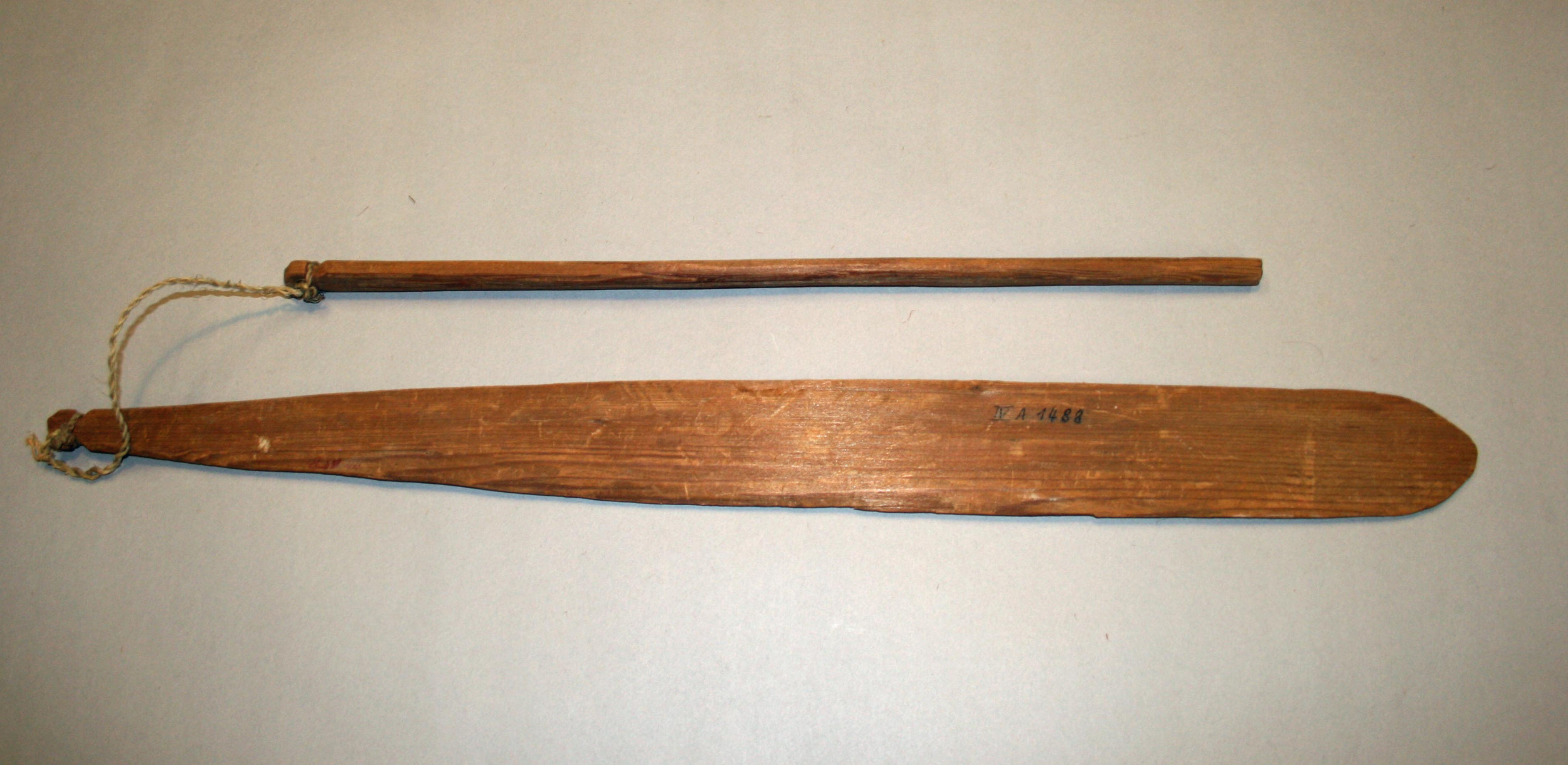
Source term: Bull-roarer
Somewhere in Haida Gwaii, in the first half of the nineteenth century, someone made a bullroarer: a painted wooden blade a little over a foot long, in three parts — blade, cord and handle — that came south in the geologist George Mercer Dawson's Haida collection and now sits, unphotographed, in a Montreal storeroom. Its village, its name and its purpose are lost. What a Haida bullroarer did depended on where you asked. At Skedans it was a ceremonial voice, sounded out of sight behind the painted screen of the potlatch house; at Masset, at the archipelago's other end, it was a child's toy.
Particulars
- Object
- A flat wooden bull-roarer, about 38 by 7 cm, of a length-to-width proportion typical of a whirled blade. Its medium is wood, bark, fibre, paint and metal, and it survives in three parts (ME892.21.1-3), consistent with a blade with cord and handle. It dates to ca. 1800-1850 and came into the collection with George Mercer Dawson's 1878 Haida Gwaii expedition.
- Function
- Function not recorded. The museum places it among ceremonial / religious objects but documents no specific use.
Source
McCord Stewart Museum, Montreal, object ME892.21.1-3: Bull-roarer, Haida, Haida Gwaii (Queen Charlotte Islands), British Columbia, ca. 1800-1850, gift of George Mercer Dawson; Philip Drucker, Culture Element Distributions: XXVI, Northwest Coast, University of California Anthropological Records 9:3 (Berkeley, 1950), pp. 199, 268