No. NAMER-015
Chemehuevi (Southern Paiute)
United States · Eastern Mojave Desert and Chemehuevi Valley along the lower Colorado River (southeastern California · western Arizona) · North America
Weather / fertility magic
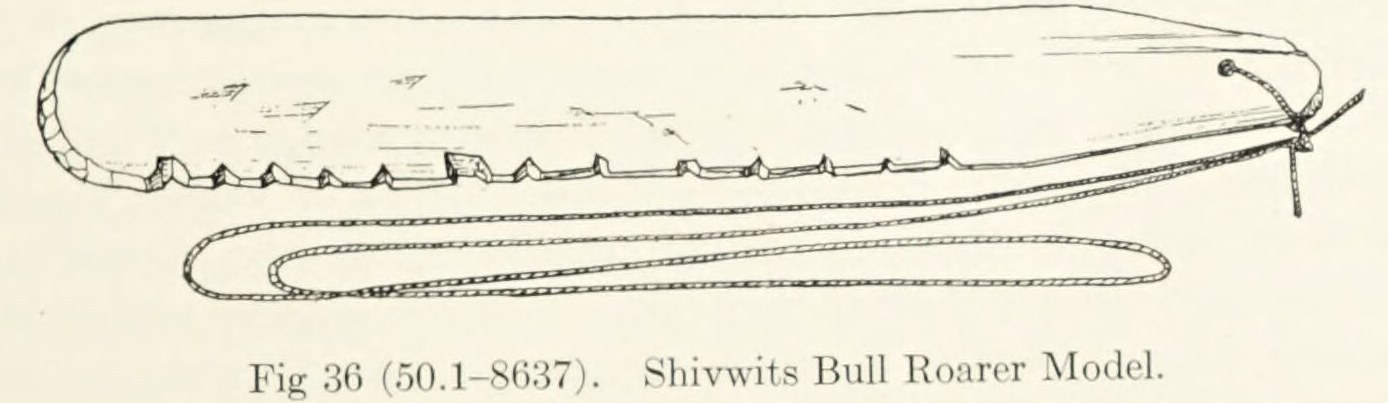
Among the Chemehuevi of the eastern Mojave Desert and the Chemehuevi Valley of the lower Colorado River, the bullroarer came in two registers. Plain wooden slats were whirled by children as toys; a second form, cut from mountain-sheep horn and notched along its edge, was swung for rain-making, to call down water on the desert. The instrument belonged to a broader Great Basin world of "sheep dreamers" - hunt-and-rain shamans whose visions ran to bighorn, rain, and the bullroarer itself. The detail comes from Isabel Kelly's 1936 fieldwork on Chemehuevi shamanism, where the contrast between the toy of softwood and the rain-charm of horn is stated plainly.
wooden bull-roarers were used as toys, while those of mountain sheep horn (notched) were for rain-making (Kelly, 1936, p. 138)
A. B. Elsasser, "Archaeological Evidence of Shamanism in California and Nevada," UCAS Reports (kas024-005), p. 38, quoting Kelly 1936:138.
Particulars
- Object
- Two forms of bullroarer are reported: plain wooden slats whirled by children as toys, and notched slats of mountain-sheep horn whirled for rain-making.
Source
Isabel T. Kelly, 'Chemehuevi Shamanism,' in Essays in Anthropology Presented to A. L. Kroeber (University of California Press, 1936), pp. 129-172, at p. 138; A. B. Elsasser, 'Archaeological Evidence of Shamanism in California and Nevada,' Reports of the University of California Archaeological Survey, p. 38