GERRITSEN2013-001 - archaeological find
Schellinkhout half-drilled snorrebot
Netherlands - North Holland - Drechterland - Europe - Low Countries
Play / practical Candidate only
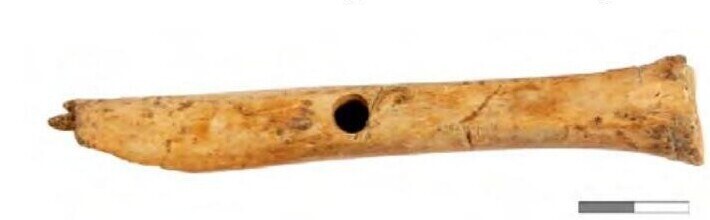
snorrebot
snorrebot: Dutch for a 'whirring bone,' a cord-swung humming toy; half doorboord: 'drilled only halfway through.'
A child in seventeenth-century Schellinkhout may have turned a sheep or goat's lower-leg bone into a humming toy. A cord would be tied to the bone and the toy swung in a circle until it made the whirring sound that gave the Dutch snorrebot — literally a 'whirring bone' — its name. But this one was never finished in the usual way: its only hole stops halfway through the bone, leaving its intended use uncertain.
Mogelijk is het bot gebruikt als snorrebot, een soort kinderspeelgoed. Een snorrebot is stuk bot, metaal of leisteen waaraan een touw werd bevestigd. Door het object aan het touw rond te slingeren ontstond door resonantie een zoemend of 'snorrend' geluid.
The bone may have been used as a snorrebot, a kind of children's toy. A snorrebot is a piece of bone, metal, or slate to which a cord was attached. By swinging the object around on the cord, resonance produced a humming or 'whirring' sound.
Gerritsen et al. 2013, p. 73
- Object
- A 12 cm sheep-or-goat lower-leg bone, broken at one end and cut beside a blind hole drilled only halfway through the shaft, found in the remains of a seventeenth-century dike house at Schellinkhout.
- Function
- Possibly a children's humming toy, per the excavation report; the hole was never drilled all the way through, so it may never have sounded as intended.
- Source
- Gerritsen et al. 2013, p. 73
- Source location
- fig. 5.3.33
- Source confidence
- low Village-centre anchor for Schellinkhout, Drechterland; the report gives an RD centre coordinate for findspot 3.2 (136.820/516.473) that was not converted in the evidence packet, so this row carries a village-level approximation rather than that plot-level figure.