No. BERG2018-001
Utrecht Wittevrouwenstraat rib snorrebot pair
Netherlands · Utrecht · city centre · Europe · Low Countries
Play / practical
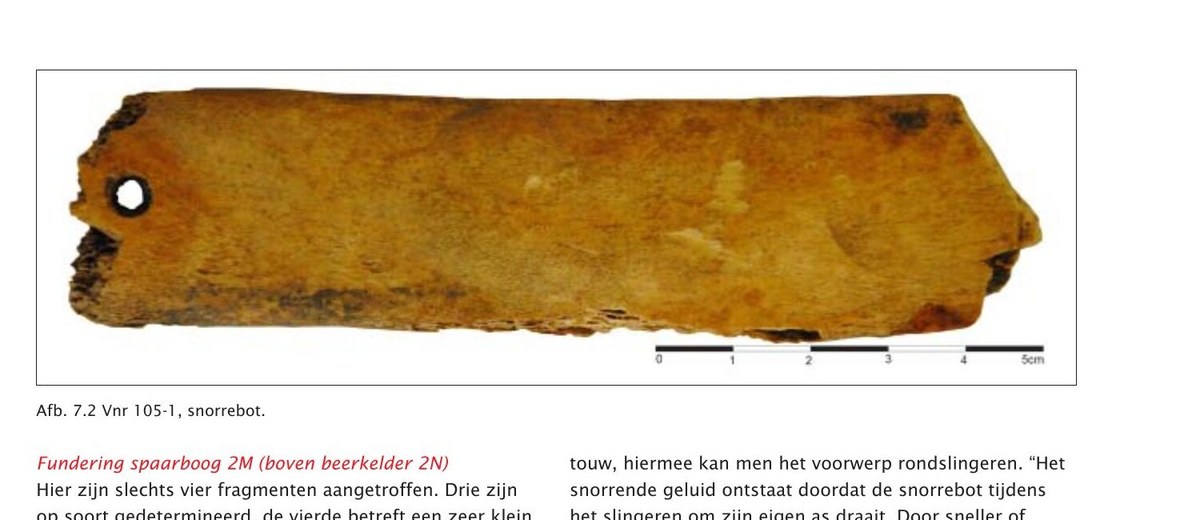
snorrebot
snorrebot = Dutch, 'whirring bone' (snorren, to whirr + bot, bone), the standing Dutch name for the whirled blade toy.
Twice, centuries apart, a bone whirler was lost on the same Utrecht plot. A cattle rib, pierced at one end, lay in a cesspit whose fill closed before the mid-sixteenth century; a second rib, cut and pierced the same way, sank into the brick rain gutters behind a house lived in from the 1640s until 1914. Children knew what the hole was for: knot in a cord, swing the blade in a circle, and the spinning bone whirrs — faster for a higher note, slower for a lower.
Het snorrende geluid ontstaat doordat de snorrebot tijdens het slingeren om zijn eigen as draait. Door sneller of langzamer rondslingeren verandert de toonhoogte.
The whirring sound arises because the snorrebot spins on its own axis as it is swung around. Swinging faster or slower changes the pitch.
Van den Berg, Wonen aan de Wittevrouwenstraat (2018), p. 71
Particulars
- Object
- Two rib blades, each with one perforation at an end: a cattle rib, and a cut cattle-or-horse rib.
- Function
- A children's toy: swung on a cord through the end hole until the blade spins and whirrs.
Source
G.T.C. van den Berg, Wonen aan de Wittevrouwenstraat: Definitief archeologisch onderzoek aan de Wittevrouwenstraat 8-10, gemeente Utrecht (Basisrapportage Archeologie 58, 2018), pp. 71 and 73, figs. 7.2 and 7.5