No. HAKVOORT2013-001
Middenbeemster Keyserkerk bone snorrebot
Netherlands · North Holland · Beemster polder · Europe · Low Countries
Play / practical
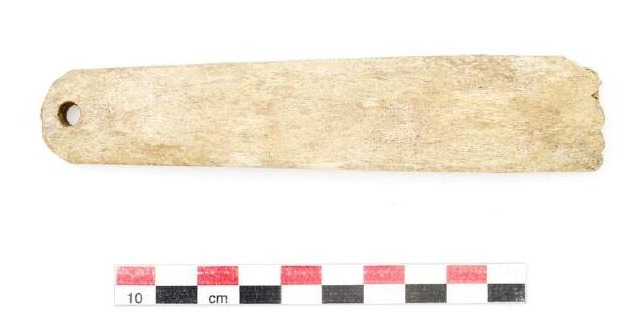
snorrebot
Source term: snorrebot (zoemhout/snorhout)
snorrebot = Dutch, 'whirring bone' (snorren, to whirr + bot, bone); the report also gives the synonyms zoemhout and snorhout, 'humming-wood' and 'whirring-wood'.
Five uneven teeth bite into one end of a bone blade found beside the Keyserkerk in the Beemster polder. At the other end a single hole once carried the cord. Swung in a circle, the 13.5-centimetre slat spun on its own axis and gave a humming, whirring voice — a typical children's toy of the Dutch Middle Ages and the centuries after. It surfaced in a charnel pit, among bones cleared from older graves as the churchyard was reworked; the excavators suggest it was first buried with a child.
Door luchtwervelingen gaat het plaatje om zijn as tollen waarbij het een zoemend of snorrend geluid voortbrengt.
Air turbulence sets the little plate spinning on its axis, producing a humming or whirring sound.
Hakvoort, De begravingen bij de Keyserkerk te Middenbeemster (2013), p. 66
Particulars
- Object
- Bone blade 13.5 cm long, 2.4-2.8 cm wide, 0.4 cm thick: rounded top with a 0.5 cm cord hole, bevelled sides, five notches of differing depth at the lower end.
- Function
- A children's toy: swung in a circle on a cord through the terminal hole; airflow spins the blade on its axis for a humming, whirring sound.
Source
A. Hakvoort, De begravingen bij de Keyserkerk te Middenbeemster (Hollandia reeks 464, 2013), section 7.1.3 and fig. 34; report dataset deposited at DANS, , licensed CC BY 4.0