No. GABAIL2012-001Africa
Bokoré night roarers
Bokoré village group, Koundara prefecture (Guingan and Termessè sub-prefectures), Guinea–Senegal border hills · West Africa
Restricted
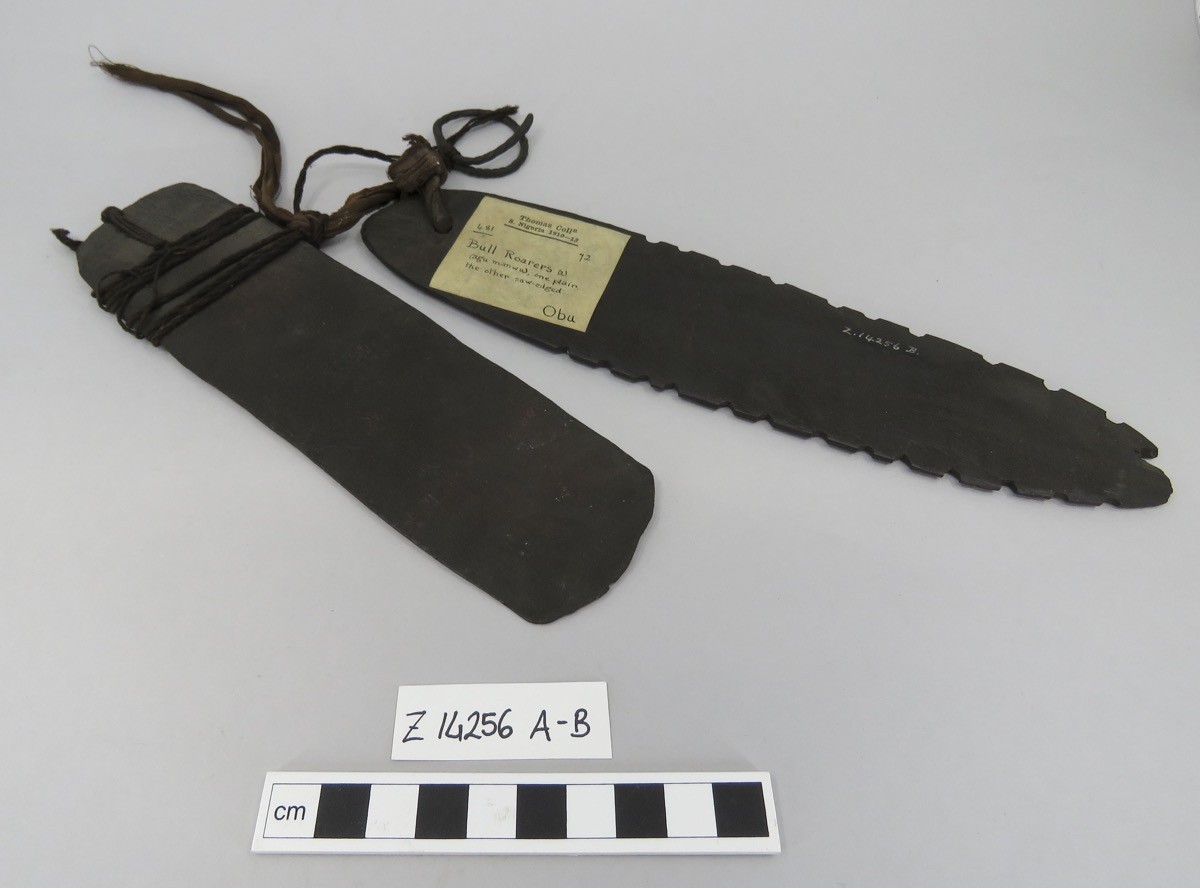
Source term: bullroarers
Bokoré: "Those of Koré," the village group named for Koré, the Bassari male initiation. endaw: the initiatory being, thought of as a chameleon.
At about fifteen, Bassari boys of the Bokoré villages in the hills of northern Guinea are taken from their families, symbolically killed and reborn by endaw, the initiatory being: a chameleon, present as a man’s guttural cry or as a shapeless heap of leaves with men moving inside it. At night the bullroarers sound. They are whirled by the youngest initiators, the young men of the first age grade, who also crawl together under the leaves to become endaw. Every evening, after the beatings, the same young men walk the novices back to the communal house, holding them up when the boys pretend they cannot walk. They keep out of the violence in the camp: these novices will soon join their own age set.
they are the ones who whirl the bullroarers at night, and who simulate the initiatory entity endaw by collectively covering themselves with a heap of leaves.
Laurent Gabail, "Performing opacity," HAU 2(2) (2012), p. 146
Particulars
- Object
- Bullroarers whirled at night during Bassari boys’ initiation; material, form and local name unrecorded.
- Function
- Whirled at night during the boys’ initiation by the first age grade of initiators, the same young men who make the initiatory being endaw appear under a heap of leaves.
Source
Laurent Gabail, “Performing opacity: Initiation and ritual interactions across the ages among the Bassari of Guinea,” HAU: Journal of Ethnographic Theory 2(2) (2012): 138–162, pp. 141, 146.