No. EXH2026-031
Argyllshire srannair
United Kingdom (Scotland) · Argyllshire (W Highlands); also seen in use in Edinburgh · Europe · British Isles
Play / practical
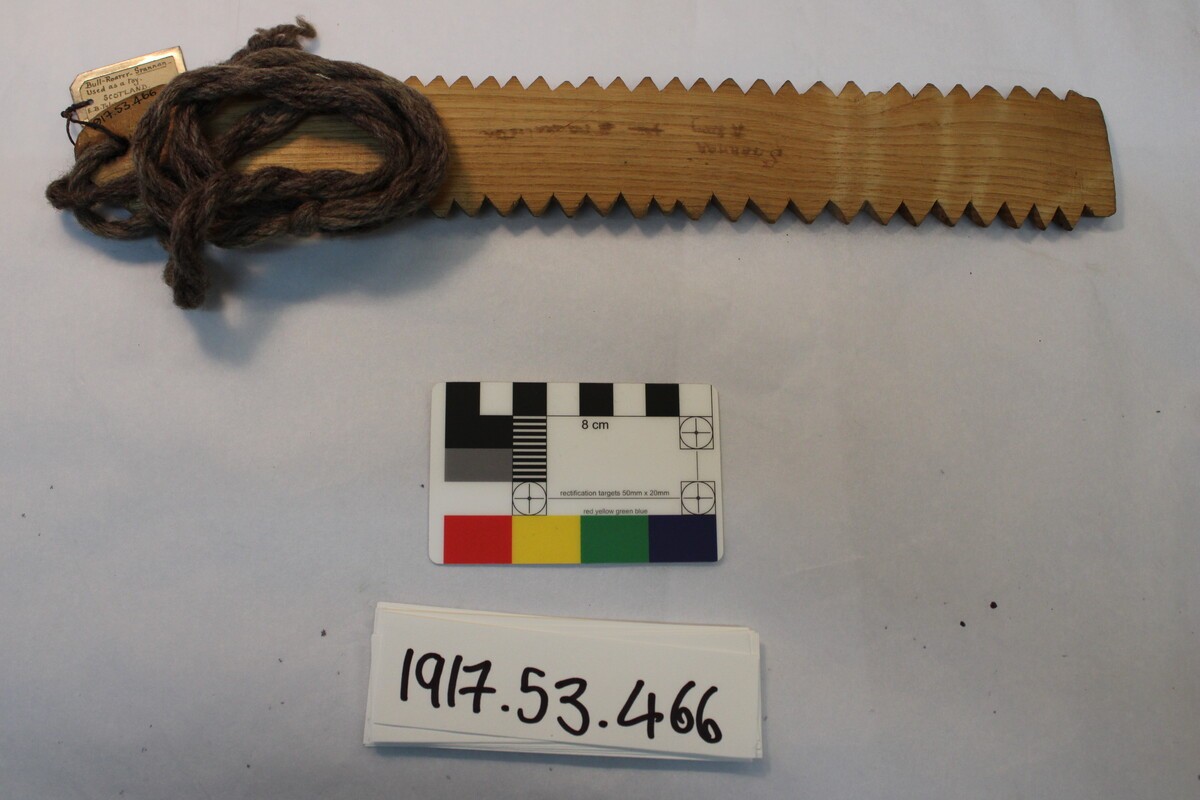
srannair
Source term: srannair / Bull Roarer
srannair: Scottish Gaelic name for the whirled blade, from srann ("to snore, drone"), naming the instrument by the droning sound it makes.
Etymology. Scottish Gaelic sound-word naming the instrument by its droning or moaning noise.
In Argyllshire the bull-roarer was called the srannair, and a correspondent to the Glasgow Evening News of 14 October 1901 recalled the one he had known. When the note was reprinted in the journal Folk-Lore in 1905, its editors remarked that none of their own collectors had recorded the toy, though they had seen it in use in Edinburgh, and they were glad to have proof that it had been used in the Highlands too.
The "srannair" we had was made of a piece of builder's lath, eight or nine inches long, notched at the edges with a string at one end by which it was rapidly whirled round the player's head to give a sonorous moan.
Glasgow Evening News, 14 Oct. 1901, quoted in Folk-Lore 16 (1905), Collectanea, "Noise Machines," p. 440
Particulars
- Object
- Notched strip of builder's lath, eight or nine inches long, whirled on a string tied at one end.
- Function
- Boys' noise toy, whirled round the head for its moan.
Sources
- Glasgow Evening News (14 October 1901), via “Noise Machines,” Collectanea, Folk-Lore 16 (1905), p. 440 View
- Pitt Rivers Museum, accession 1917.53.466, Scottish Srannan