No. EA-USUKUBO-PENDANTS-001
Usukubo stone pendant group
Chigasaki, Kanagawa, Japan; Usukubo site pendant group · East Asia
Function not recorded Candidate only
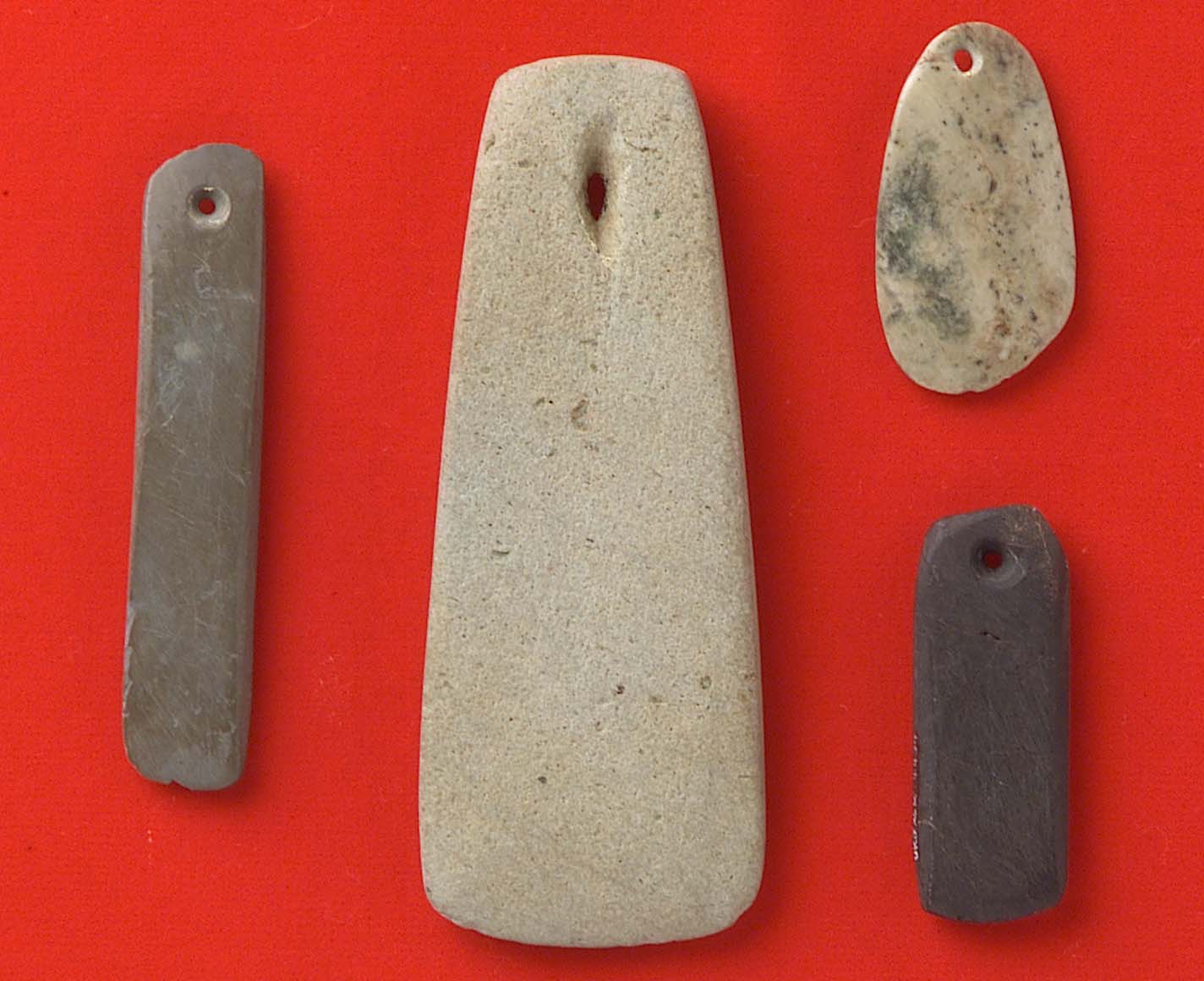
垂飾
Source term: 垂飾; stone pendant; serpentinite/tuff polished pendant; top-holed slat/broad pendant group
垂飾 (suishoku): 'pendant'
The Usukubo find from Chigasaki survives as a group: at least four stone pendants photographed together in the Kanagawa Buried Cultural Properties Center's public gallery, in tuff and serpentinite, the central piece 7.5 centimetres long. What makes the group useful is the contrast inside the frame — a narrow slat with a round hole at the top beside broader tear- and plate-shaped pieces with holes of their own, one of them elongated. One photograph, one findspot, one 'pendant' label; several quite different things to hang from a cord. The find may derive from a grave-related area but was recovered outside any feature.
Particulars
- Object
- At least four polished stone pendants in tuff and serpentinite: a narrow slat with a round hole at the top; a broad, tapering plate, 7.5 cm long, with an elongated upper hole; a tear-shaped piece and a small rectangular one, each pierced near the top.
- Function
- Catalogued as a group of Jōmon pendants; the narrow top-holed slat sets blade-form against the plate-form of its broader companions in a single frame.
Source
Kanagawa Prefecture Buried Cultural Properties Center, online gallery item 1799796 (Usukubo site pendants)