BRODAR1999-001 - archaeological find
Divje Babe perforated jaw fragment
Cerkno - Idrijca valley, western Slovenia - Europe
Function not recorded Candidate only
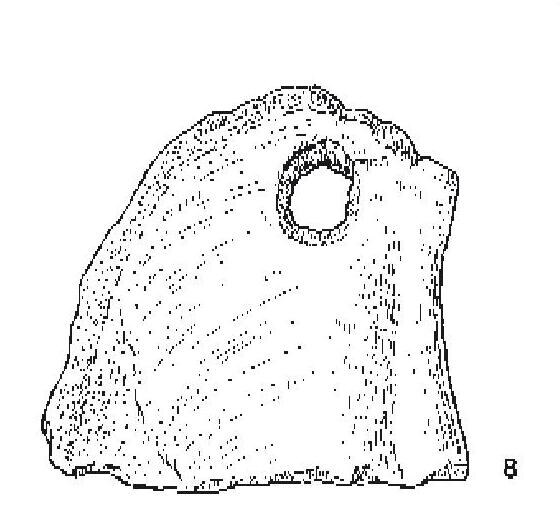
brnivka
Source term: Schwirrholz / brnivka
brnivka: Slovenian bullroarer or whirring sound-maker; Schwirrholz: German 'whirring wood', Brodar's term.
The age is the solid part of this story. Layer 14 belongs to a deposit formed roughly 90,000–70,000 years ago—deep in Neanderthal time. The interpretation came first, under a different chronology. Mira Omerzel Terlep called the perforated cave-bear fragment seemingly made for a prehistoric brnivka and compatible with an amulet; Mitja Brodar adopted that possibility while arguing that Divje Babe I belonged with the Aurignacian. Later ESR dating removed that cultural setting without proving what the object was. If its hole is human-made, the fragment could be an extraordinary Neanderthal symbolic object. But a hole alone cannot distinguish ornament from tool, and no cord, use-wear study, measurement, or sounding test shows that it ever hung from a body or turned through the air.
Ploščat rogelj jamskega medveda z luknjo je kot ustvarjen za prazgodovinsko brnivko, ki seveda uporabe roglja kot amuleta ne izključuje, temveč le potrjuje.
The flat cave-bear coronoid process with a hole is as if made for a prehistoric bullroarer; this of course does not exclude use of the process as an amulet, but rather confirms it.
Omerzel Terlep 1998:171
- Object
- A broad, broken cave-bear jaw fragment with a single perforation near one edge, excavated from Layer 14 in 1982.
- Function
- Not recorded.
- Source
- Mitja Brodar, 'Die Kultur aus der Höhle Divje babe I / Kultura iz jame Divje babe I', Arheološki vestnik 50 (1999), 9-57, CC BY-NC-ND 4.0; human-made perforation at printed p. 20, find context at printed p. 31, the bullroarer statement at printed pp. 34-35, and the exact 1:1 drawing plate 6 no. 8 at printed p. 57; the article page states CC BY-NC-ND 4.0…
- Source location
Page references
Brodar 1999, printed pp. 20, 31 and 34-35, plate 6 no. 8 at printed p. 57; Omerzel Terlep 1998, printed p. 171
- Source confidence
- high Published public coordinate for the Divje Babe I cave above the Idrijca valley, municipality of Cerkno; a cave anchor, not a layer or findspot coordinate.