BERDICHEWSKY1964-001 - archaeological find
Concón copper-and-slate plate pendants
Site ENAP-3, Concón, on low hills behind the ENAP oil refinery, bordering the Aconcagua Valley, central Chile - South America
Function not recorded
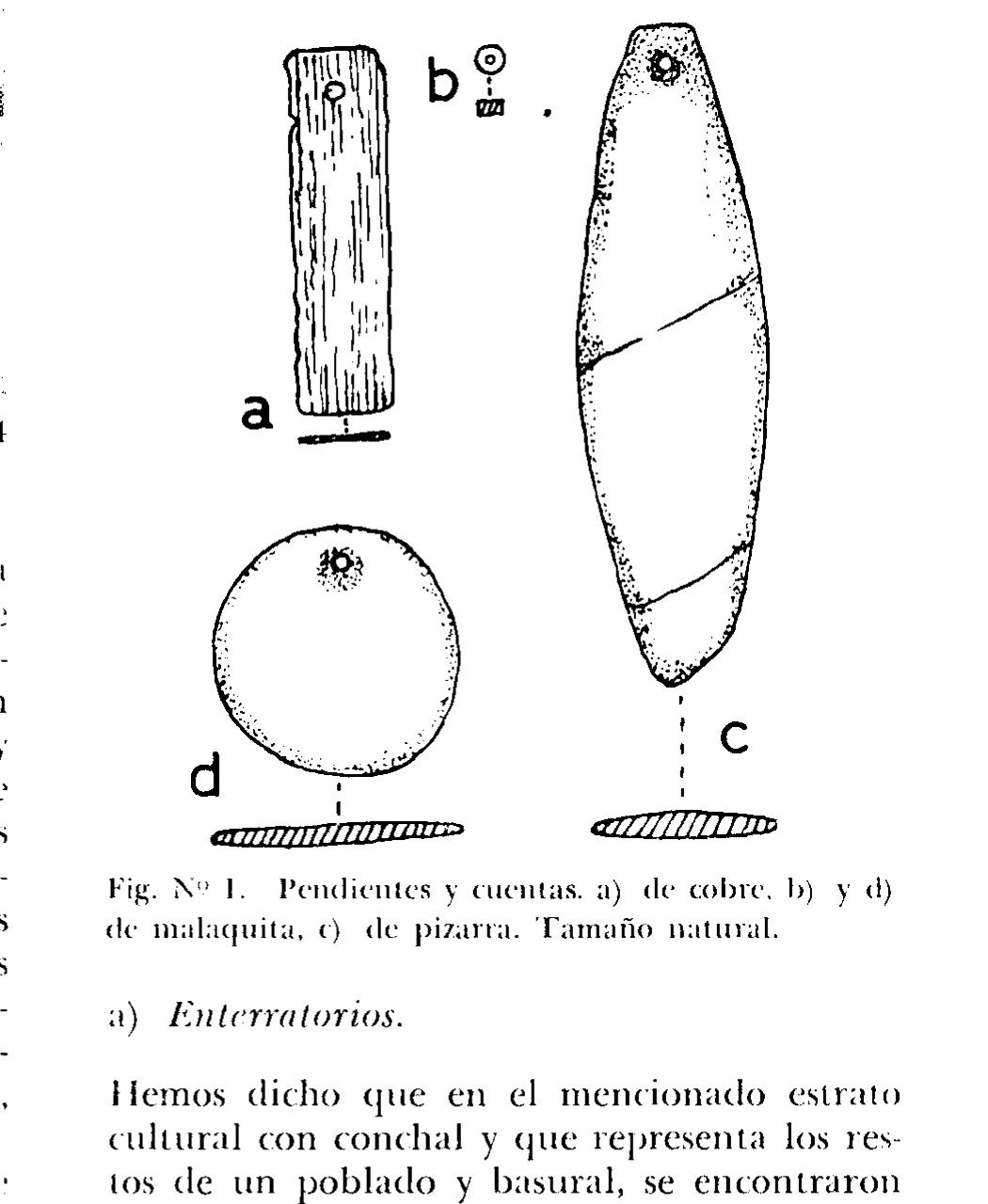
pendiente (original identification); placa o látigo zumbador (later proposed use)
Source term: pendientes (Berdichewsky 1964); Placa o látigo zumbador (Pérez de Arce 1986 section heading)
pendiente (Spanish): "pendant," Berdichewsky's own 1964 classification of both pieces. placa o látigo zumbador (Spanish): "buzzing plate/whip," Pérez de Arce's 1986 tentative alternative reading.
A thin rectangle of copper and a flat, lozenge-shaped sliver of slate, each pierced once near an end, came from Layer IV of a shell-midden settlement behind the old ENAP refinery tanks at Concón, on Chile's central coast, during Bernardo Berdichewsky's 1962-1963 excavations. He read both, at the time, as pendants — the copper piece the only metal object in its layer, the slate one lying near a house floor beside two arrowheads. Writing more than twenty years later, organologist José Pérez de Arce wondered whether pieces like these, thin metal or stone plates with a hole near one edge, might instead have been plate-type whizzers, spun on a cord for their sound, as some Chaco and Amazonian instruments are — and said so only as a possibility, adding that the evidence on hand is too thin to settle it. Berdichewsky compared the layer that produced them to a Molle-related horizon and placed it, broadly, in roughly the second half of the first millennium AD; no radiocarbon result was ever published to confirm it.
La única pieza de metal en este estrato fue una pequeña lámina rectangular de cobre con una perforación en un extremo, como un pendiente (Fig. 1,a). ... un pendiente de pizarra plano y alargado de forma más o menos losángica con un agujerito en un extremo (Fig. 1,c).
The only piece of metal in this stratum was a small rectangular copper sheet with a perforation at one end, like a pendant (Fig. 1,a). ... a flat and elongated slate pendant, more or less lozenge-shaped, with a small hole at one end (Fig. 1,c).
Berdichewsky 1964, pp. 75, 77
- Object
- Two excavated objects illustrated at natural size with edge profiles in Berdichewsky's fig. 1: (a) a very thin, rectangular copper plate, perforated near one short end, described by the excavator as the only metal object in its stratum; (c) a flat, elongated, roughly lozenge-shaped slate plate with a small hole near one tapered end, found at about 0.80 m depth near a probable house (ruca) floor, alongside two triangular arrow points. (Small malachite beads b and d appear in the same figure but are not counted here.) Both objects were recovered from stratigraphic layer IV, a thick shell-midden settlement/burial horizon with ceramics, hearths, probable house floors, and flexed human burials.
- Function
- Excavator Bernardo Berdichewsky identified both pieces as pendants (pendientes) in his 1964 preliminary report. Organologist José Pérez de Arce later proposed, explicitly tentatively, that copper, malachite, and slate pieces from this excavation — including this terminally perforated copper plate — might instead be plate-type whizzers (placas o látigos zumbadores) comparable to instruments known from the Chaco and Amazonia (1986, revisited 2025); he states directly that the evidence is too sparse to be more precise. No spin test, cord-wear study, or experimental reproduction is published for either object.
- Source
- Bernardo Berdichewsky Scher, "Informe preliminar de las excavaciones arqueológicas en Concón," Antropología 2 (Centro de Estudios Antropológicos, Universidad de Chile, 1964), pp. 65-86, esp. printed pp. 75, 77, 85, fig. 1. Later functional proposal: José Pérez de Arce, "Cronología de los instrumentos sonoros del Área Extremo Sur Andina," Revista Musical…
- Source location
Page references
Berdichewsky 1964, fig. 1 and pp. 75, 77, 85; Pérez de Arce 1986, pp. 101-102; Pérez de Arce 2025, p. 1821
- Source confidence
- low Concón town/coast anchor, central Chile, for Site ENAP-3, described only as "behind the last tanks of the ENAP refinery" on the low hills bordering the Aconcagua Valley; no excavation-unit coordinate is published, so this is a town-level anchor, not a site coordinate.