Atlas Essay —
Wati
On the south coast of New Guinea, the men who swing the bullroarer drink kava in the same rites
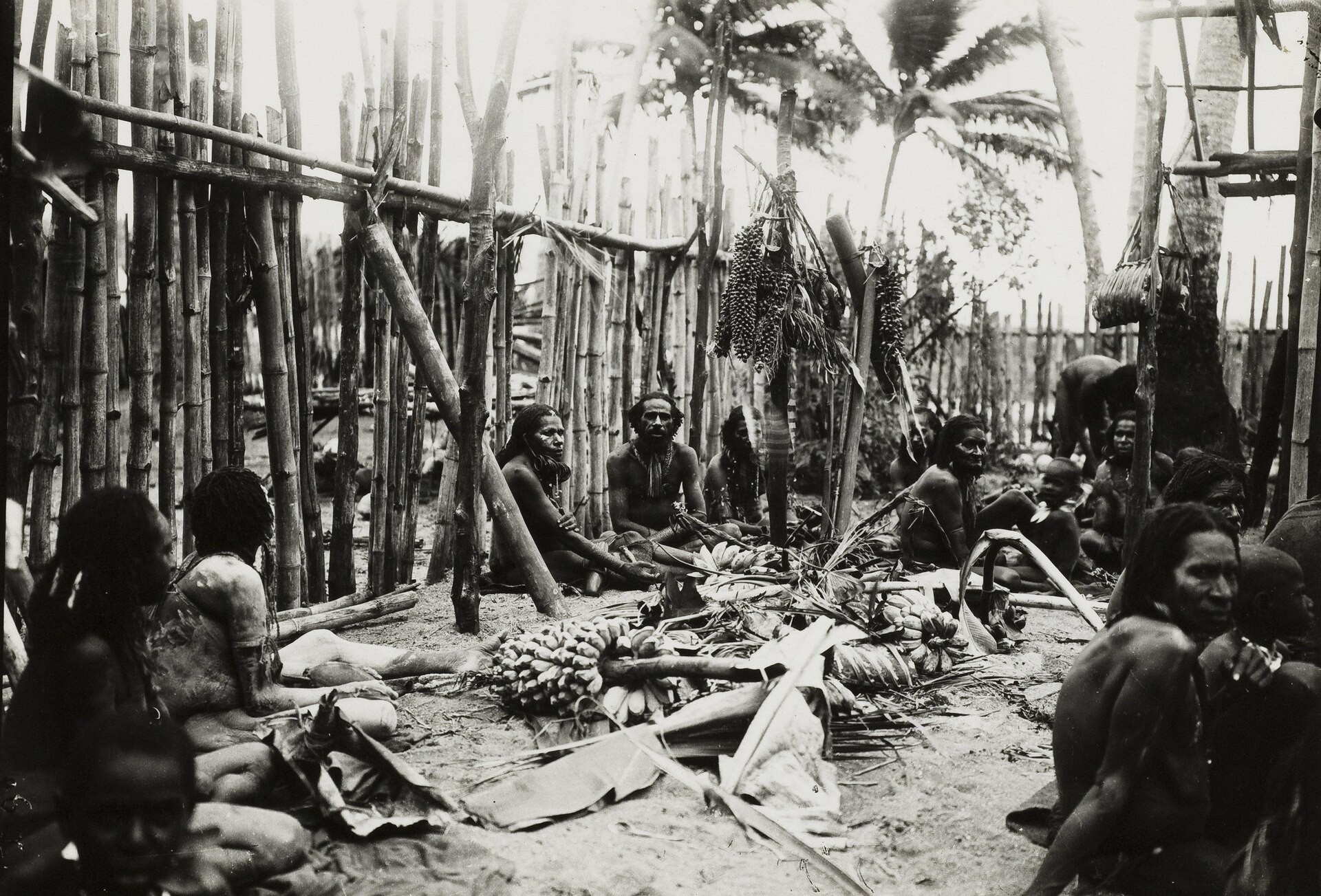
The men of the Kumbe River, west of Merauke in Indonesia’s Papua province, come onto the ceremonial ground naked but for their crowns of cassowary plumes. Sosom, the giant whose voice is the bullroarer, lies curled round the post like a dog. While he is given his meal and his wati, the men sing; when the singing flags, the bullroarers are swung to put zest into the singers again. Then Sosom swallows the boys.
Along the south coast of New Guinea, wati, the kava root, belongs to the same men and the same rites as the bullroarer. The roarers hang over the kava cups, the giant who is the roarer is served his wati, and one hero brings both.
In brief
- The Yéi-nan of the upper Maro River, inland from Merauke, hung their bullroarers on an arch above a row of kava cups, one for each man. After the kava the men “swallow” the roarers and bring them up “covered with blood.”
- The Marind-anim serve Sosom, the giant who is their bullroarer, “his meal and his wati” before he swallows the novices and disgorges them “through his posterior parts.”
- The Kiwai of the Fly River estuary in Papua New Guinea’s Western Province laid their bullroarers beside a shell of kava for the yam initiation. Their kava grew from a kangaroo’s semen, “the first garden plant in the world.”
- The Keraki of the Trans-Fly say their hero Kambel took the first bullroarer from his wife’s vagina, and also brought kava to the west.
- On the upper Bian a war over the bullroarer secret was explained to the police as “a theft of wati.”

The root that is chewed
Wati is the Marind name for kava, Piper methysticum, the pepper shrub whose root is drunk across the Pacific. On the south coast of New Guinea the root is chewed. The Kiwai of the Fly estuary call it gamoda; the Yéi-nan of the upper Maro call it samai, bikwai or kidemi. The Marind-anim, whose villages run along the coast either side of Merauke and up the Bian and Kumbe rivers inland, drink it stronger than anyone. Jan van Baal, the Dutch ethnographer who wrote their great monograph, described the brew:
“Wati is a highly appreciated narcotic and many of the older men use it every day, or nearly so. … The beverage is prepared by chewing small pieces of the stalk or the main root of the plant and spitting the bitter extract into a coconut bowl until there is enough to make a good drink. The liquid is strong and distasteful and often it is poured down to the accompaniment of loud belching noises. Having swallowed his beverage, the drinker takes some food and shortly afterwards he enjoys a deep and long sleep.”
J. van Baal, Dema (1966), p. 21.
It is a man’s drink. The Marind believe “that the use of wati by women is conducive to infertility,” and the Yéi forbade it “to women and youngsters.” “Conversation does not start until wati has been brought,” and for an old guest it is chewed first. Among the Marind wati-drinking “is not a ritual,” van Baal wrote, but “it is closely associated with every ceremony, the male guests having to be presented with a liberal dose.”
The sleep it brings is a road to the spirits. The Marind medicine-men meet the dema, the ancestral beings, in their dreams, and to that end they “drink an exceptionally large quantity of wati.” When a death was laid to sorcery, a relative opened the grave and slept in it or beside it to dream the killer’s name, “after having drunk some of the cadaveric fluid mixed with wati.”
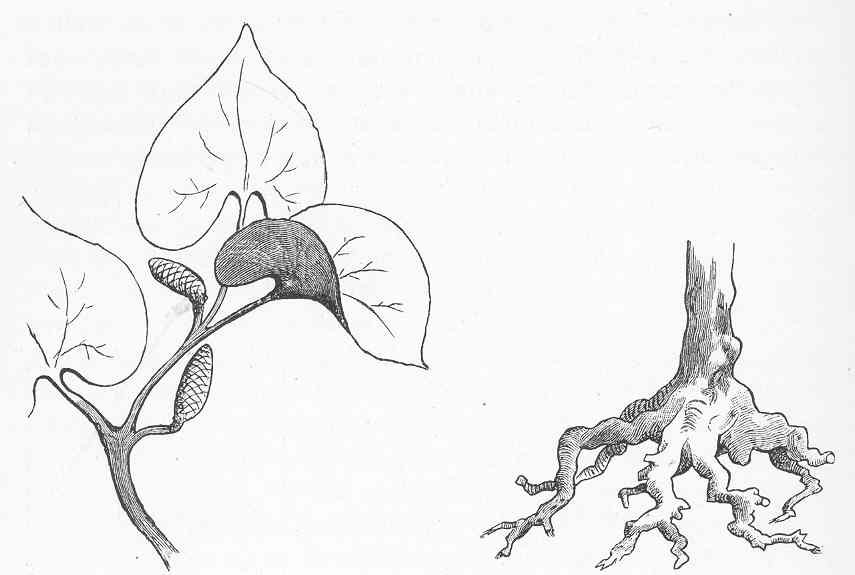
The Marind say wati came with Wonatai, the stork. He landed on the site of present-day Merauke as a young man “engaged in chewing wati, a drug unknown at the time,” and for his first cuttings “he used hairs from his armpits.” The Marind see the stork in the plant itself: the swollen nodes of the wati stem are “the heavy joints in the long legs of the stork.” When Wokabu stole his wati, Wonatai struck the thief with a stem grown from his own hair, and Wokabu reeled, possessed by “Ugug, the wati-déma who resided in the plants.” Wonatai, van Baal concludes, “is the mythical wati-bringer and as such he is inseparably connected with all feasts and ceremonies.”
Sosom’s meal and his wati
The Marind bullroarer is Sosom, a giant who came “from the far east, from the Fly river,” and returns each year to swallow the boys. In his myth he was killed in the west, went back underground, and “unnoticed, Sosom entered into the vagina of an iwag (in effect a married woman) called Wanumb.” She bore him again as a son, who “was a very noisy boy, always singing to himself mu-u, mu-u: a nuisance to the older people when they had had their wati.” He grew up and pestered the girls, until “the older people lost their patience; they cut off Sosom’s penis and chased him from the village.” The penis fell into the river and became a water snake.
In the rite he is fed and given his drink. The Kumbe River account came to van Baal from the German ethnologist Hans Nevermann:
“While Sosom, who is decorated in the Marind-anim fashion, is having his meal and his wati, bandra is sung, as well as various other songs. When the singing flags, the bullroarers are swung to put zest into the singers again … Finally, Sosom devours all the neophytes and adolescents (in Okaba the older men, too), each time he swallows one, disgorging another through his posterior parts.”
Van Baal (1966), p. 480.
The Catholic missionary Jan Boelaars described a public sosom at Wendu, on the coast east of Merauke, in 1951. Each clan staged a scene from its own dema: one brought sago, one a coconut, and “the Kai-zé bring wati.” Then came the boys’ meal and the roarers:
“The boys are given food by each clan in turn, but this is no longer (as in the old days) mixed with sperma. When the meal is finished, the boys lie down in two rows. An old man passes between them. He has two bullroarers, one in each hand, which he holds to the navel of each of the boys.”
Van Baal (1966), p. 484.
Semen was the Marind fertilizer, and wati was one of the plants it fed. Of sperma van Baal wrote: “It promotes the fertility of the crops and must be applied to the buds and the eyes. It is frequently applied to the wati.”
The kupör over the cups
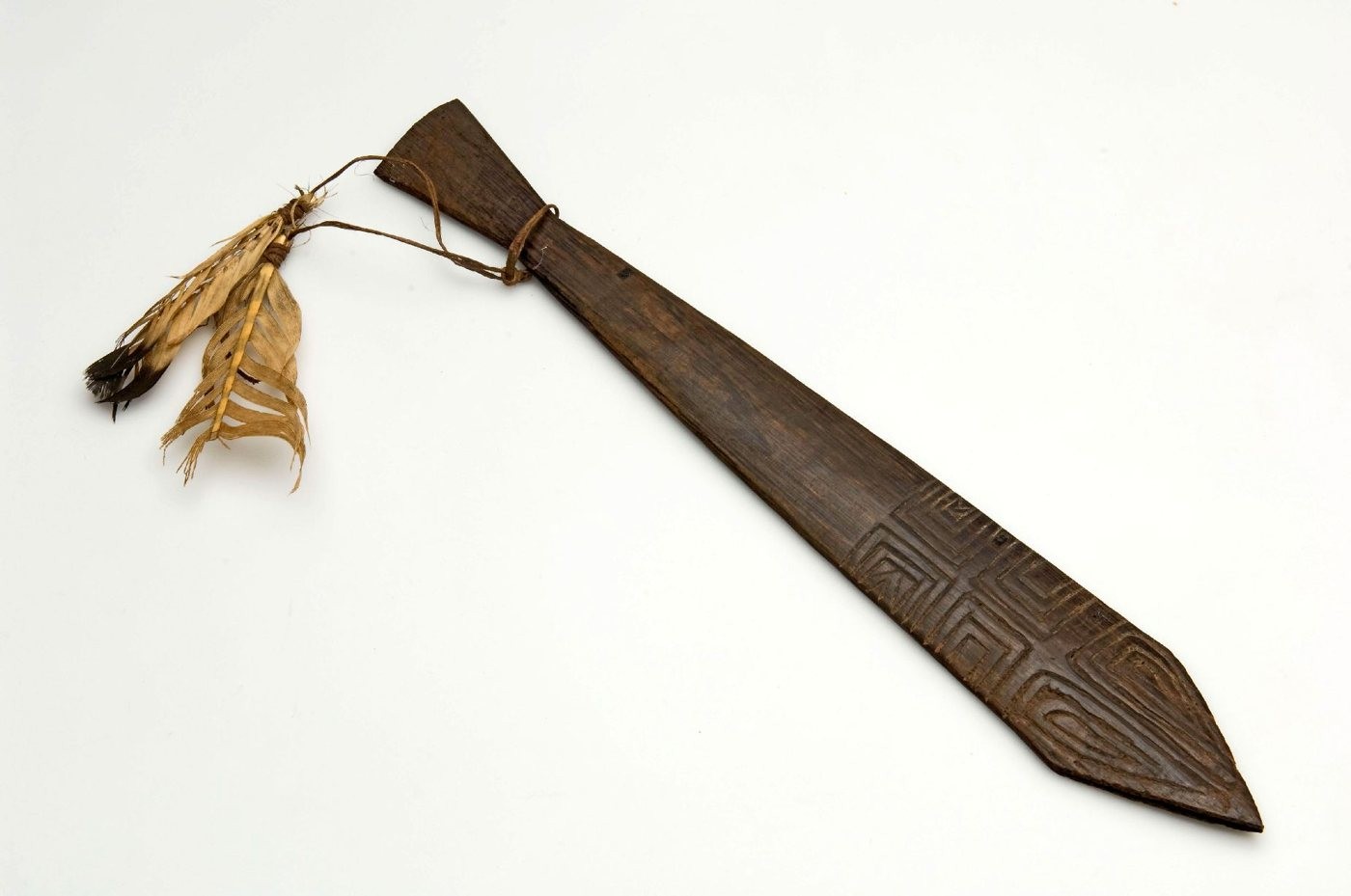
Inland from the Marind, on the upper Maro River near the border with Papua New Guinea, live the Yéi-nan. Their bullroarer is the kupör, the chip of the ancestral orei tree that every initiated man holds. The Dutch missionary Jan Verschueren described their great rite, held when a girl first menstruates. For weeks the men fast in the forest, “sing and swing the bullroarers,” and work themselves into a trance until they are possessed by Orei. Then they come down toward the hut where the girl sits with her mother:
“At this spot the men have constructed a kind of arch, on which the trance-struck men hang their kupör. Under the arch, placed in the earth, are a number of kava cups, one for each of the participants. The young men chew kava, which is spat into the cups … After taking a little food [and, of course, the kava, but this is not mentioned in the text], the men stand up, take their kupör from the arch, and form into a line. Now they all strike up the köllu-köllu song. The performers, stirring up their spirits by leaping and shouting, swallow their kupör (under the tongue, as usual).
“When the performers have arrived at the hut, they suddenly re-produce their kupör from their bodies, but now the implements are covered with blood. Blood also gushes from their mouth and nose. They sprinkle the blood of the kupör over the hut as they dance around it.”
J. van Baal, Jan Verschueren’s Description of Yéi-nan Culture (1982), pp. 61–62. The bracket is van Baal’s.
Asked why the rite had to wait for a girl’s first blood, the men said that only “when the blood of a virgin flows for the first time” can the kupör, which is Orei, “glide smoothly into the body of an orei-man.”
The first garden plant in the world
Farther east, across the border in Papua New Guinea, the Kiwai live on the islands of the Fly River estuary and the coast to the west of it. The Finnish anthropologist Gunnar Landtman found them growing “a plant called by them gamoda, which apparently is the Piper methysticum, the kava of the Polynesians.” They drank it, and they also sprinkled it: “in order to ensure success in some enterprise an old man will dip a twig into the bowl of gamoda and sprinkle the beverage” over the men, a rite called karea. At Mawata on the coast a man named Amuura told Landtman where gamoda came from:
“A male kangaroo at Kuru once cleared a spot of ground by eating off all the grass there. Playing about, the animal caused its semen to run out on the ground, where it became a gamoda-plant which struck root and began to grow. The first kind of gamoda which grew there is called wesapia, it was the first garden plant in the world, taro, yam, and all the others being much later.”
Gunnar Landtman, The Folk-Tales of the Kiwai Papuans (1917), p. 329.
When the missionaries asked the people to give it up, Amuura answered:
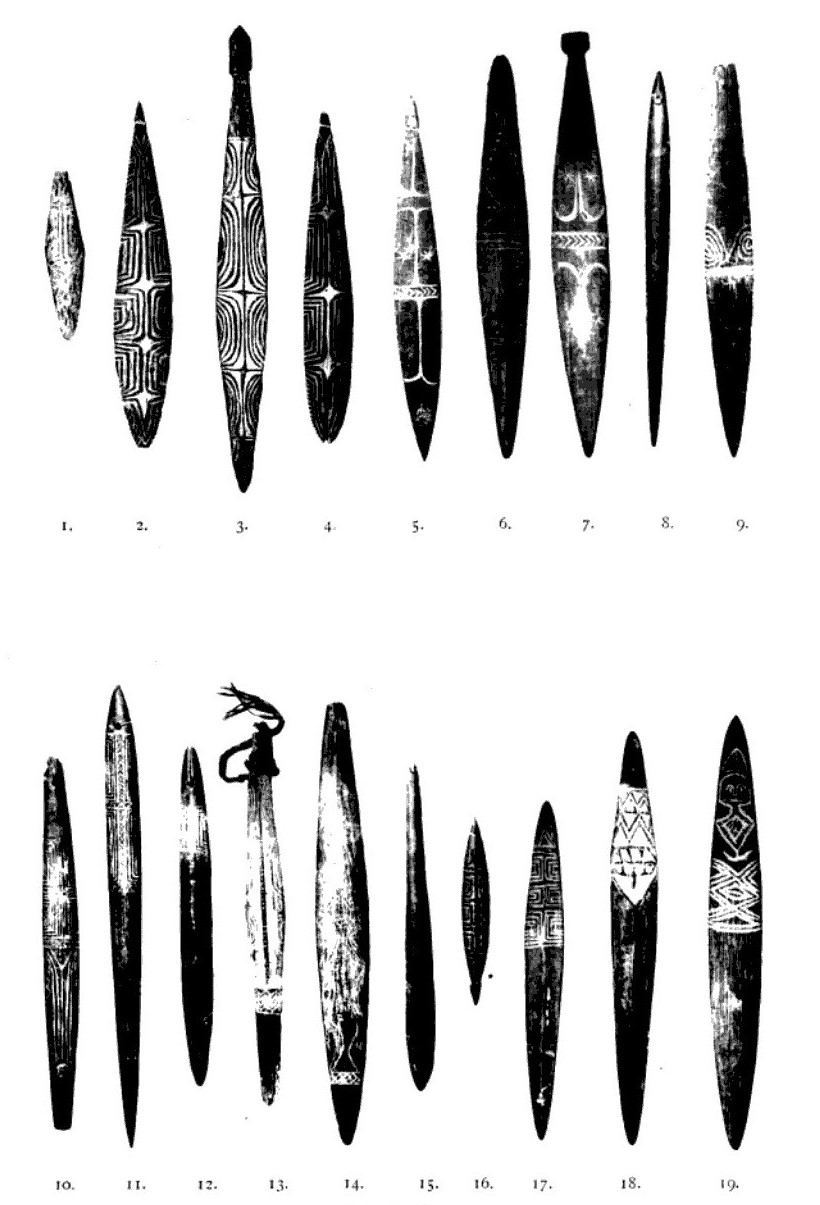
The Kiwai yam bullroarer is the madubu. Its spirit came to a man in a dream and said, “My name is madubu I am the father and mother of all yams.” At the madubu initiation described by the missionary E. Baxter Riley, armed men threatened the novices until they “howled and called for their mothers,” then showed them the roarers and gave them one each. That afternoon the boys were taken into the men’s house, the darimo:
“The bullroarers are laid on mats ranged in the centre of the hall; the lines represent all kinds of dance ornaments and accoutrements, outside these are two half coconut shells, one contains water and the other gamada, between them is a bund of gamada leaves.”
A. C. Haddon, Reports of the Cambridge Anthropological Expedition to Torres Straits I (1935), p. 220, after Riley (1925).
With the leaves they sprinkled the four quarters and called the spirits of the forest and the dead “to come and produce a great yam harvest.” The drink was the reward of the roarer’s secret. At the mouth of the Fly the missionary James Chalmers found that young men “chew kava, gamoda, at feasts, but only those who have passed through all the stages of initiation may drink it.”
Kambel brings both
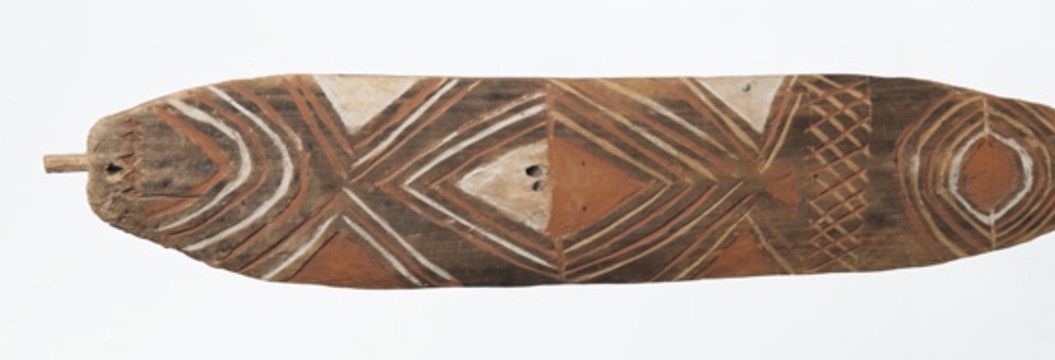
Between the Kiwai and the Marind lies the Trans-Fly, the grass and swamp country south-west of the Fly River. The Keraki of the Morehead River there trace their world to Kambel, who heard a sound inside a black palm, cut it down, and watched the first peoples swarm out. He gave them their roarer too. In Williams’s accounts, as Alphonse Riesenfeld summarized them, “the first bull-roarer was introduced by Kambel who obtained it from his wife’s vagina,” and he “started the practice of sodomy,” on his undersized son Gufa, who then “increased miraculously in growth.” The same hero carried the drink: “Kambel brought kava to the west when he left Kuramangu for the west.”
Back on the upper Bian, among the inland Marind, the two were close enough to stand in for each other. The old men there told van Baal that nearly all the fighting between villages came from breaches of the bullroarer’s secret. They named a big fight in which five villages had gone against Muting: “to the police the fighting had been explained as resulting from a theft of wati, but the true cause was said to have been that the Muting people had informed the administration on details of the cult.”
One cup for each man
From the Fly estuary to Merauke the men who swing the roarer are the men who drink the root. The Kiwai set the madubu beside the gamoda, the Marind serve Sosom his wati, the Yéi hang the kupör over the cups, and the Keraki hero brings both. Alfred Cort Haddon in 1920 and Riesenfeld in 1950 both held that kava came to this coast together with the cult of the monster who swallows the boys, though they drew its road differently.
Women do not drink it, and boys chew it for the men until they have been through the rites themselves. Then the cup is theirs, and the sleep after it. Marind children are told to make no noise “during the time when the men, having taken their wati, want to enjoy a nap.”
Key sources
- J. van Baal, Dema: Description and Analysis of Marind-anim Culture (South New Guinea) (The Hague: Nijhoff, 1966), pp. 21 (wati), 95 (hospitality), 138 (women and infertility), 271 (the Sosom myth), 302–303 (Wonatai and Ugug), 480 (Sosom’s meal and his wati, after Nevermann), 484 (Wendu, after Boelaars), 548 (sperma), 574 (the upper Bian war), 772 (cadaveric fluid), 800 (the yamu), 894 (medicine-men’s dreams).
- J. van Baal, Jan Verschueren’s Description of Yéi-nan Culture, Verhandelingen KITLV 99 (The Hague: Nijhoff, 1982), pp. 7–8 (kava), 61–62 (the köllu-köllu rite).
- Gunnar Landtman, The Folk-Tales of the Kiwai Papuans, Acta Societatis Scientiarum Fennicae 47 (Helsingfors, 1917), pp. 14 (gamoda and karea), 329 (the origin of gamoda).
- A. C. Haddon, “Migrations of Cultures in British New Guinea,” Journal of the Royal Anthropological Institute 50 (1920): 237–280, pp. 238–242 (kava, Sosom and the devouring monster; Chalmers at the Fly mouth).
- A. C. Haddon, Reports of the Cambridge Anthropological Expedition to Torres Straits, vol. I, General Ethnography (Cambridge, 1935), pp. 219–220 (the madubu initiation, after E. Baxter Riley, Among Papuan Headhunters, 1925, pp. 201–207), 253.
- Alphonse Riesenfeld, The Megalithic Culture of Melanesia (Leiden: Brill, 1950), pp. 490–491 (Kambel), 494–500 (kava and the devouring monster).
- F. E. Williams, Papuans of the Trans-Fly (Oxford: Clarendon Press, 1936), pp. 308–309.
- Paul Wirz, Die Marind-anim von Holländisch-Süd-Neu-Guinea, vol. II, part III (Hamburg, 1925), plate 6.