No. MUS2026-084
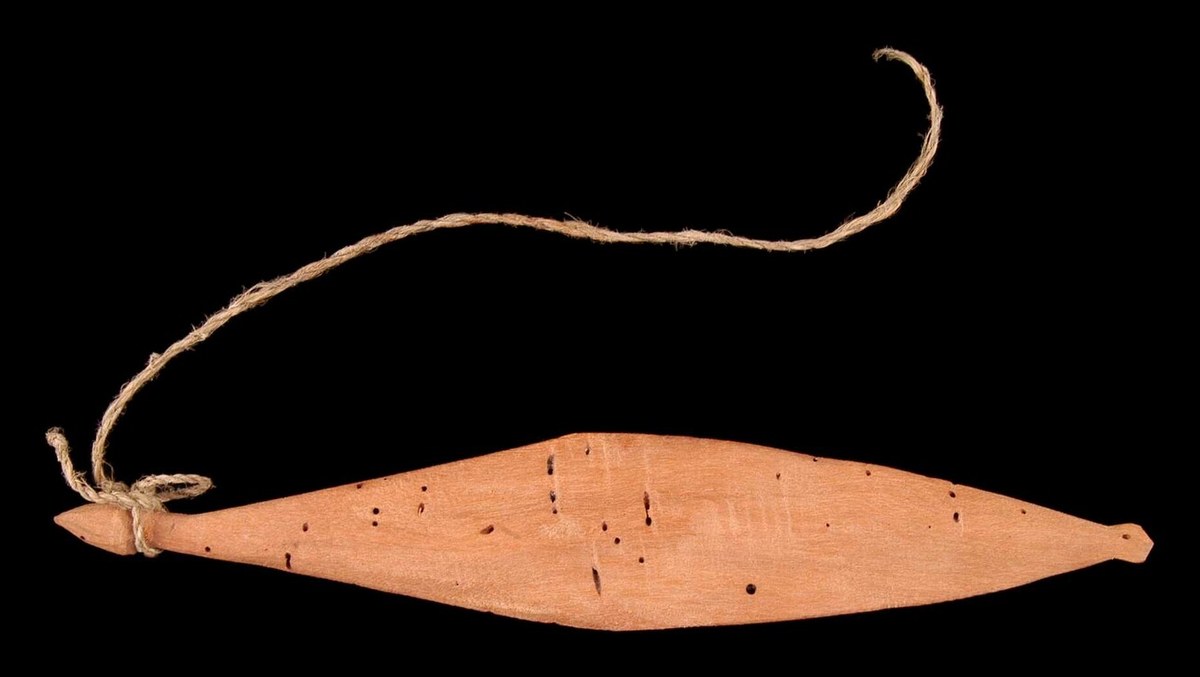
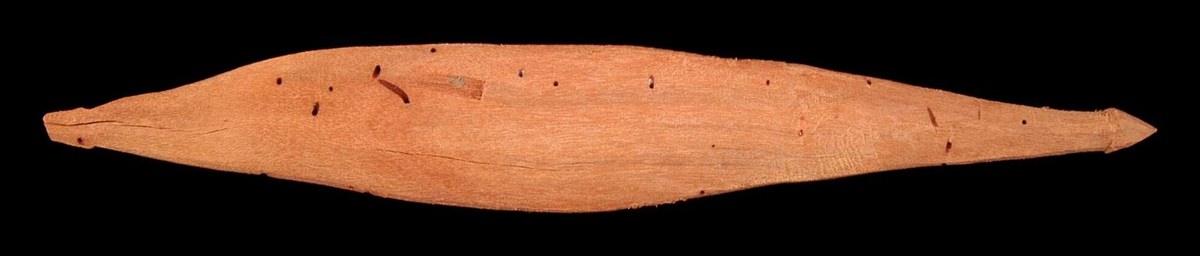
Matsigenka roarers made for children
Peru · Urubamba River, Ucayali · South America
Sacred / spirit
Source term: bull-roarer
rhombe (French): bullroarer.
Pour enfant - 'for a child': two of the small red-stained rhombes that came out of Matsigenka country on the Rio Urubamba carry that bare note, one still trailing its long knotted cord. The ethnographer who collected them, France-Marie Renard-Casevitz, supplies the other half of the story: children's roarers belong to the daytime. The sacred ones are nocturnal - engraved with signs taught by the Master of Thunder and his creature the jaguar, they swell in the dark until the great ocellated cats come running to fight beside the shaman. One word, sangenari, names both the engraved signs and the jaguar whose coat wears them.
...de grands fauves ocelés qui accourent aider le chaman allié quand les grondements du rhombe, semblables à la voix du maître du tonnerre, s'enflent dans la nuit. Et ce rhombe à l'appel puissant incarne lui aussi sa voix dans les signes gravés sur son corps.
...great ocellated beasts that come running to help the allied shaman when the rumblings of the rhombe, like the voice of the Master of Thunder, swell in the night. And this rhombe of the mighty call likewise embodies his voice in the signs engraved on its body.
France-Marie Renard-Casevitz, 'Inscriptions. Un aspect du symbolisme matsiguenga,' Journal de la Société des Américanistes 67 (1980), p. 263
Particulars
- Object
- Rhombe of the Matsigenka, Rio Urubamba, in red wood (Quai Branly 71.1980.61.48). Two companion rhombes from the same accession, 71.1980.61.49 (21 × 4 × 1.5 cm) and 71.1980.61.50 (22.5 × 3.5 × 1.5 cm), are slender red-stained blades cataloged pour enfant — made for a child; .49 keeps its long single cord.
- Function
- The roarer's rumble is the voice of the Master of Thunder: swelling in the night, it summons the great ocellated jaguars to the aid of the allied shaman in his fight against the powers of evil. The instrument carries incised signs that embody that same voice - sangenari names at once the sign repertoire and the ocellated jaguar itself. Sacred roarers are nocturnal; there are others that are children's daytime toys, which is exactly what the two companion pieces in this accession are.
Source
Musée du quai Branly - Jacques Chirac, 71.1980.61.48 (Matsigenka, Río Urubamba; F.-M. Casevitz mission); companions 71.1980.61.49-50