No. SA-Z1953-020
Panobo reo reo toy
Northeastern Peru · South America
Play / practical
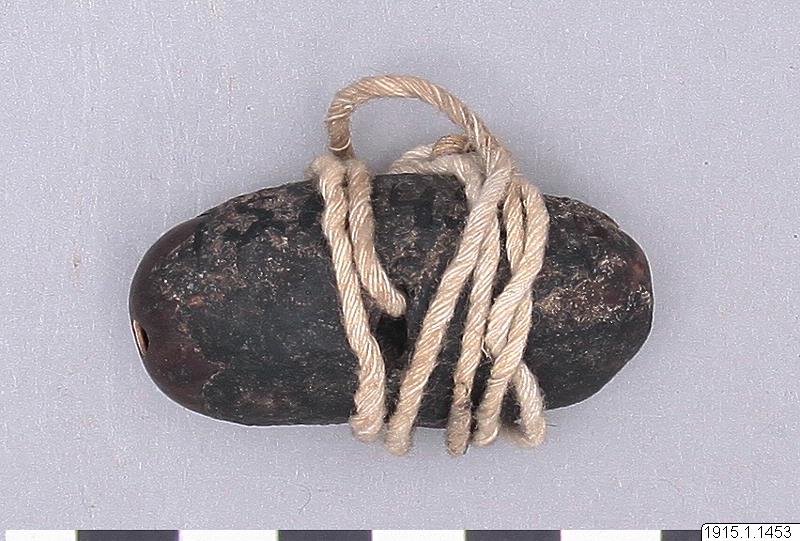
rę̄òrę̄ò
Source term: rę̄òrę̄ò (Zerries: "reo reo")
Among the Panobo, a Panoan people of northeastern Peru, the bullroarer was a children's toy called rę̄òrę̄ò — a wooden blade tapering to a point, on a cord. For some of their neighbors the instrument did double duty: the Kampa whirled their "mero mero" not only as a plaything but to frighten naughty children, telling them the jaguar would come and carry them off. Not so the Panobo: among them, Günter Tessmann wrote, there was "no child-frightener, neither bullroarer nor disguise." Here the blade was a plaything and nothing else.
Schwirrholz = rę̄òrę̄ò, spitz auslaufende Holzplatte mit Schnur. Ein zweiter B. kannte dies Gerät nicht.
Bullroarer = rę̄òrę̄ò, a wooden blade running out to a point, with a cord. A second informant did not know this device.
Tessmann 1930:115 (Panobo, rubric 47)
Particulars
- Object
- Pointed, tapering wooden blade on a cord.
- Function
- Bullroarer known as a children's toy; the same chapter explicitly denies its use as a child-frightening device.
Source
Günter Tessmann, Die Indianer Nordost-Perus: Grundlegende Forschungen für eine systematische Kulturkunde (Hamburg: Friederichsen, de Gruyter, 1930), p. 115; Otto Zerries, 'The Bull-roarer among South American Indians,' Revista do Museu Paulista n.s. 7 (1953), p. 287