No. SASIA-007
Santal Monghyr-Singhbhum children's bull-roarer
Bihar and Orissa · Chota Nagpur · South Asia · East India
Sacred / spirit
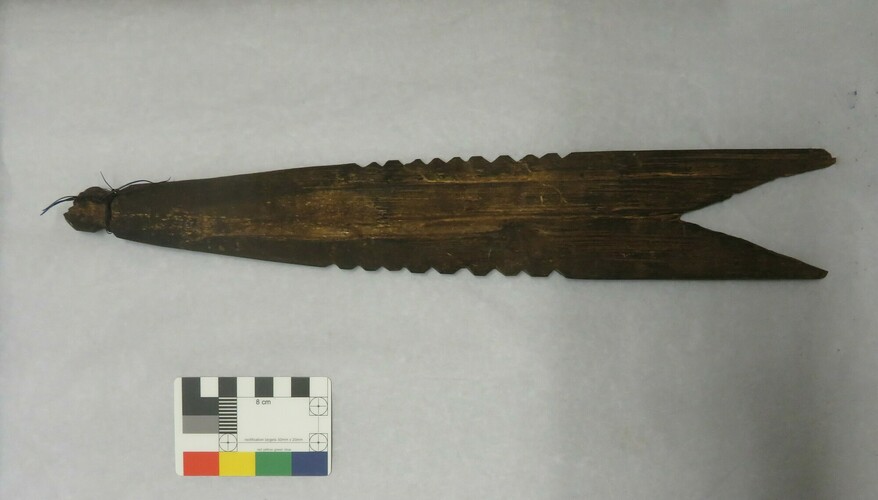
Source term: Bull-roarer
At Baha Parab, spirit-possessed participants rushed toward the sacred grove while boys followed with bullroarers, drums, cymbals, and a bugle. The roaring toy entered the festival as part of a dense moving wall of sound, then survived beyond the rite in children's hands.
The Santal Bull-roarer that the author discovered in a village in the Monghyr District in Bihar is not perforated but notched to form a neck for tying the string on.
Roy, "The Bull-Roarer in India," Man in India vol. 7 (1927), p. 63
Particulars
- Object
- Roy reports Santal bull-roarer use in Singhbhum and Monghyr Districts, including a Monghyr village specimen that was notched for tying the string rather than perforated.
- Function
- Carried by boys in the Baha Parab procession; otherwise a children's toy.
Source
Sarat Chandra Roy, 'The Bull-Roarer in India,' Journal of the Bihar and Orissa Research Society 13(1) (1927): 54-61; summarized in Man in India 7 (1927), p. 63; Biswas 1956, p. 141