No. SASIA-006
Munda Ranchi children's bull-roarer
Bihar and Orissa · Chota Nagpur · South Asia · East India
Play / practical
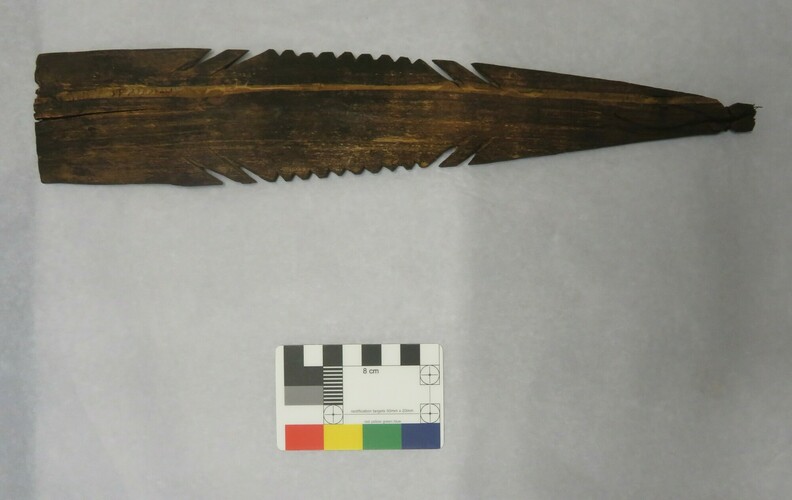
hur-hur
Source term: Bull-roarer
Etymology. hur-hur, the Munda name for the toy bull-roarer, imitates the instrument's whirring sound.
Among the Munda of the Ranchi District, the bull-roarer had dwindled to a boys' plaything — and the boys swung both kinds: the perforated sort, with a hole bored for the string, and the notched sort, cut with a neck to tie it on, the same form the Ranchi ethnographer Sarat Chandra Roy had found among the Santal in Monghyr. In his 1927 note "The Bull-Roarer in India," Roy held that it survived among the Munda, Ho, and Santal in only a very few villages, and there merely as a children's toy; it was among the neighboring Oraon, who kept perforated bull-roarers of semur-pod valves in the bachelors' dormitory that women were forbidden to enter, that the old ceremonial and magical use was still alive.
Munda boys have been found using Bull-roarers of both varieties, notched as well perforated.
S.C. Roy, "The Bull-Roarer in India," summarized in Man in India vol. 7 (1927), p. 63
Particulars
- Object
- Roy reports Munda boys in Ranchi District using both notched and perforated bull-roarers.
- Function
- A boys' toy, swung for its whirring noise.
Source
Sarat Chandra Roy, 'The Bull-Roarer in India,' Journal of the Bihar and Orissa Research Society 13(1) (1927): 54-61; summarized in Man in India 7 (1927), p. 63