No. RAJMALA1929-001
Tipra (Tripuri) Ker-puja bhemra bullroarer
Former Tripura State · Tripura ritual sphere · South Asia · Northeast India
Sacred / spirit
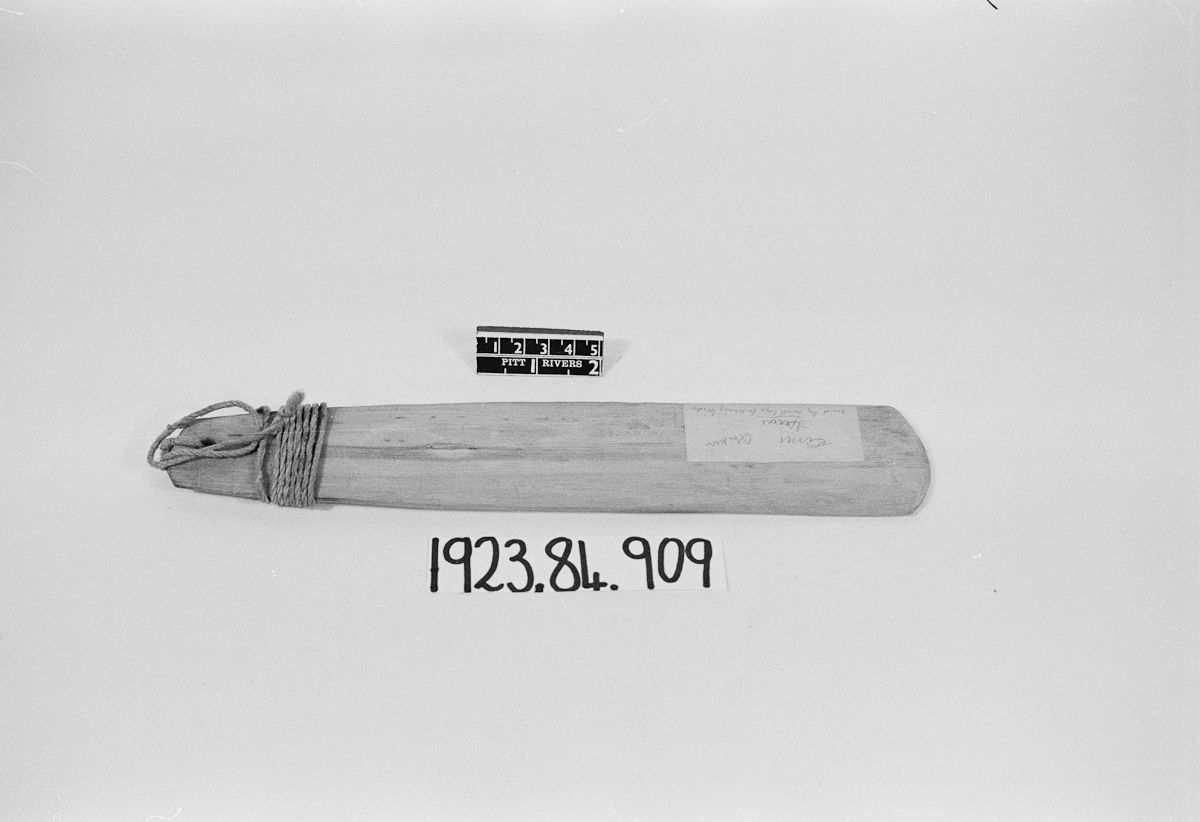
bhemra / bhamra
bhemra / bhamra: the bamboo slat whirled at Ker-puja; Sri Rajmala calls it bhemrai or bhomrai.
Once the boundary of Ker-puja was proclaimed, the rite became a religious lockdown: nobody could enter or leave, and inside the sealed ground no one — not even the king — might wear shoes, light a fire, dance or sing. A household overtaken by a birth or a death paid a fine to cross the line. Into that enforced hush broke the bhemra, a broad bamboo strip whirled on a cord until it boomed bho bho, loud, deep and far-carrying — a ritualistic use of bull-roarers, the philologist Suniti Kumar Chatterji noted, 'not known in any Brahmanical worship.' On the rite's success, people believed, hung the fortune of Tripura's realm for the year to come.
[Ker-puja] is a picture of that age when there was no light, no sound, no living thing, no birth or death... In the silence of Ker-puja, as when sound first broke the deep silence at the dawn of creation, the bho bho of the bhemrai seems now and then to be creating sound in a soundless universe.
Sri Rajmala, vol. 1 (1929), editorial commentary, p. 145; working translation from the Bengali.
Particulars
- Object
- Broad bamboo slat pierced at one end and corded through the perforation; whirled by holding the free end of the cord.
- Function
- Sounded at Ker-puja, held first at the capital and then in every hill village.
Source
Sri Rajmala, vol. 1 (1929), editorial commentary on Ker-puja, pp. 144-145; Suniti Kumar Chatterji, Kirata-Jana-Krti (1951), p. 137