No. MUS2026-054
Thadou roarer that calls up spirits
Nagaland · Manipur hills, NE India · South Asia · Northeast India
Sacred / spirit
Source term: bull-roarer
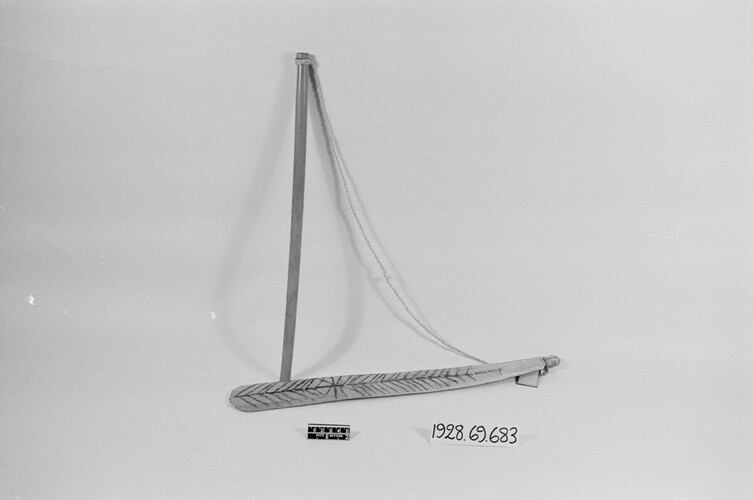
A bull-roarer of the Thadou (Kuki) of the Manipur hills, now in the Pitt Rivers Museum at Oxford. Their own ethnographer, William Shaw, found it a rare object, hung on its cord by a notch rather than a bored hole, and swung now and then to scare birds — but not merely a toy: in the Shingshuan clan the old men objected to sounding it at all, for its voice summoned the spirits. Shaw heard the same dread from the Khasi, but other hill peoples read the voice differently — the Southern Sangtam said it drew tigers, and the Sema turned it protective outright, hanging imitation bull-roarers in their doorways at Mishilimi to ward off sickness.
The Thado bull-roarer, rarely seen, is tied by a notch... It is sometimes used to scare birds, but in the Shingshuan clan, at [any] rate, the old men object to its use on the ground that it calls up the spirits.
William Shaw, Notes on the Thadou Kukis (1929), pp. 156-157
Particulars
- Object
- Bull-roarer of the Thadou (Kuki), Pitt Rivers Museum, Oxford (acc. 1928.69.683; J. P. Mills coll.).
- Function
- An occasional bird-scarer; to the old men of the Shingshuan clan, a summoner of spirits.
Source
Shaw, William. 1929. Notes on the Thadou Kukis, ed. J. H. Hutton; Calcutta: Asiatic Society of Bengal, pp. 156-157. Specimen: Pitt Rivers Museum, Oxford, acc. 1928.69.683