No. SA-Z1953-017
Omagua former child-frightening bullroarer
Peru; Brazil · Northeastern Peru · Upper Amazon · South America
Play / practical
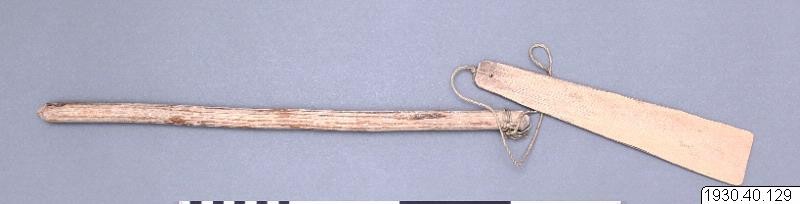
Source term: Schwirrgerät / Schwirrholz / bullroarer
Among the Omagua, a Tupi-speaking people of the upper Amazon whose old territory straddled the modern Peru-Brazil border, the bullroarer had dwindled to a means of frightening naughty children — Tessmann’s informant remembered it alongside the nettles and the liana whip that punished the older ones — and Günter Tessmann (Die Indianer Nordost-Perus, 1930, p. 64) already recorded the use only in the past tense. Otto Zerries took the Omagua note straight from that page when he surveyed the instrument across South America, and placed the people in a zone where, he judged, the bullroarer "has clearly the character of a 'survival'" — alongside neighbours such as the Kampa, who still whirled it at children with the warning that the jaguar would come and carry them off.
Nach Angabe eines B. gab es ein Schwirrholz als Kinderschreck.
According to one informant, there used to be a bullroarer as a child-frightener.
Günter Tessmann, Die Indianer Nordost-Perus (1930), p. 64 (Omagua §71).
Particulars
- Function
- Former bullroarer used to frighten children; Zerries treats Northeastern Peru as survival/depreciation zone
Source
Günter Tessmann, Die Indianer Nordost-Perus: Grundlegende Forschungen für eine systematische Kulturkunde (Hamburg: Friederichsen, de Gruyter, 1930), p. 64; Otto Zerries, 'The Bull-roarer among South American Indians,' Revista do Museu Paulista n.s. 7 (1953), p. 287