No. SA-Z1953-031
Mataco, Choroti and Ashluslay toy bullroarers
Argentina; Paraguay; Bolivia · Gran Chaco · South America
Play / practical
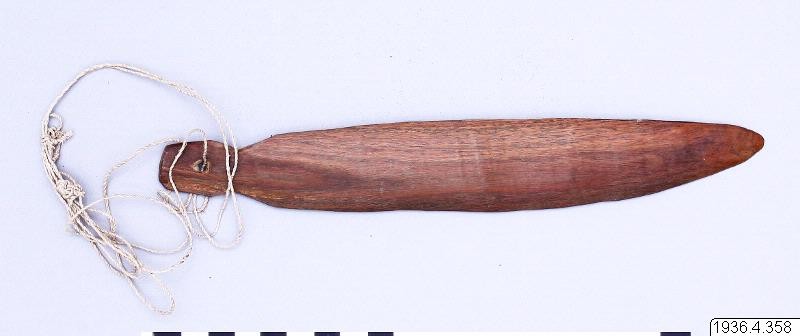
koyék (-quyeq)
Source term: koyék [-quyeq]
"the toy that repeats the song of Welán" (Welán = a shamanic divinity, name literally "metamorphosed"; Wichí gloss "moonstruck/mad/cannibal")
Etymology. The Wichí (Mataco) name for the bullroarer, koyék (-quyeq), belongs to the laquyeq ("toy/plaything") class — a derivative of the verb iquy, "to play."
In the Gran Chaco the bullroarer was mostly a child's plaything. Erland Nordenskiöld, living among the Chaco peoples around 1910, saw it whirled only as a rare toy by the Choroti and Ashluslay, two subtribes of the Mataco (Indianerleben, p. 70). Karl Gustav Izikowitz, sifting the South American sound-instruments in 1935, could place it among the true Chaco tribes only with the Mataco — known from Sten Rydén's field collection — and the Caduveo, whose specimen Manizer had recorded; whether they used it in ceremony was a question he declined to press. Ritual use was fixed to that one people, the Mbaya-Caduveo, whose roarers were carved with the elaborate designs that mark their work; Alfred Métraux reported they "are said to whirl them during funeral ceremonies, but like the Mataco, they give them to the children as playthings." A separate Toba device sat at the edge of the category — a forked stick that slung out a corded stick to spin and buzz in the air, used by the medicine man to keep too much rain from falling.
Selten sieht man das Schwirrholz als Spielzeug. Wie bekannt, verursacht es, wenn es schnell durch die Luft geschwungen wird, einen brummenden Laut.
Only rarely does one see the bullroarer as a toy. As is well known, when it is swung quickly through the air it makes a humming sound.
Erland Nordenskiöld, Indianerleben: El Gran Chaco (Leipzig, 1912), p. 70
Particulars
- Function
- Chiefly a toy: rare toy use among the Choroti and Ashluslay, the instrument also present among the Mataco and Caduveo.
Sources
- Erland Nordenskiöld, Indianerleben: El Gran Chaco (Leipzig, 1912), p. 70
- Karl Gustav Izikowitz, Musical and Other Sound Instruments of the South American Indians (Göteborg, 1935), pp. 211-212, citing Rydén field information and Manizer (1934), p. 329
- Alfred Métraux, "Ethnography of the Chaco," Handbook of South American Indians, vol. 1, BAE Bulletin 143 (1946), p. 343
- Otto Zerries, 'The Bull-roarer among South American Indians,' Revista do Museu Paulista n.s. 7 (1953), pp. 288-289 View · archived
- Erland Nordenskiöld, Comparative Ethnographical Studies 1 (1919), p. 162
- Manizer (1934), p. 329, via Izikowitz (1935), pp. 211-212