No. SA-Z1953-030
Chiriguano and Chané toy
Bolivia; Argentina; Paraguay · Gran Chaco · Eastern Bolivia · South America
Play / practical
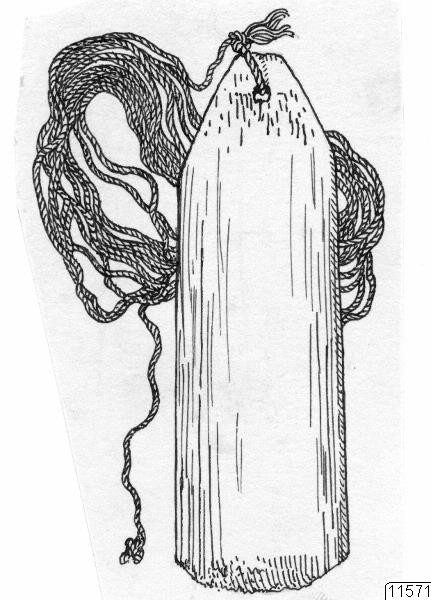
runrun
Source term: Schwirrgerät / Schwirrholz / bullroarer
Among the Chiriguano and their Chané neighbors, in the Andean foothills of eastern Bolivia, the bull-roarer was recorded only as a child's toy. Erland Nordenskiöld noted it as a plaything in 1919, and Karl Gustav Izikowitz judged that the instrument had reached these two peoples from northeastern Bolivia. Surveying the bull-roarer across the continent, Otto Zerries set the Chiriguano and Chané at the edge of that drift, traced to the scattered, linguistically isolated tribes of eastern Bolivia: a Tupi-Guaraní group and the Arawak-speaking people they had conquered and absorbed, both spinning a noisemaker that elsewhere in South America carried the voices of the dead. Late in the twentieth century the Bolivian charango master Ernesto Cavour found the toy still spinning in the Tarija country among the Chawancos — the Ava Guaraní, as the Chiriguano are known today: the runrun, the hard pod of the jarka tree, pierced, strung on a cord, and whirled for children.
It occurs among the Choco and in the lowlands to the east of the Andes, where it goes down to Chane-Chiriguano. ... In most parts of South America the bullroarer is nowadays only a plaything.
Izikowitz 1935:210, 212 (Musical and Other Sound Instruments of the South American Indians; bullroarer distribution to Chane-Chiriguano, after Nordenskiold 1919:162)
Particulars
- Function
- Bullroarer noted as toy; Zerries follows Izikowitz that it arrived from northeastern Bolivia
Source
Karl Gustav Izikowitz, Musical and Other Sound Instruments of the South American Indians (Göteborg, 1935), pp. 209-213; Erland Nordenskiöld, An Ethno-Geographical Analysis of the Material Culture of Two Indian Tribes in the Gran Chaco (Göteborg, 1919), p. 162