No. RIESTER1972-001
Guaraŝug'wä ivirapähĩm̃'ne bullroarer, Santa Anita
Bolivia · Campo Grande · Suvivuhu, northern Velasco Province, Santa Cruz Department · South America · Amazonia
Play / practical
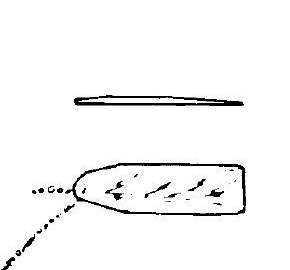
ivirapähĩm̃'ne
Source term: Schwirrholz, ivirapähĩm̃'ne
ivirapähĩm̃'ne: the Guaraŝug'wä (Pauserna) name for the bullroarer, recorded by Riester at Santa Anita, 1964-65
When Jürgen Riester came to live with the Guaraŝug'wä in 1964, the whole people fit into a single settlement: seven houses called Santa Anita, on a low rise in the Campo Grande grassland between the Paraguá and the Guaporé. The ivirapähĩm̃'ne still sounded there — a cedar blade barely a hand-span long on well over a metre of totaí-palm cord, whirled in circles overhead until its dull note carried far across the pampa. Making one remained the men's work; swinging one had become the business of boys, who kept the instrument alive as a toy.
Die Herstellung des „ivirapähĩm̃'ne" obliegt den Männern. Das Schwirrholz wird heute als Spielzeug der Knaben verwendet.
Making the ivirapähĩm̃'ne falls to the men. Today the bullroarer is used as a toy by the boys.
Riester 1972:171
Particulars
- Object
- Cedar blade 19 by 5.5 cm, pierced at the blunt end and knotted to a single 135 cm cord of totaí palm fibre.
- Function
- Made by the men; by Riester's 1964-1965 stay, swung by boys as a toy. Whirled in circles overhead on its cord, sounding a dull note audible at a distance as the blade spun on its axis.
Source
Jürgen Riester, Die Pauserna-Guaraŝug'wä: Monographie eines Tupí-Guaraní-Volkes in Ostbolivien (Collectanea Instituti Anthropos 3, 1972), pp. 1, 7, 14-15 (Karte III) and 170-171, fig. 98