PNG103 - ethnographic attestation
Fly River
Papua New Guinea - Western - Oceania - Sahul
Restricted
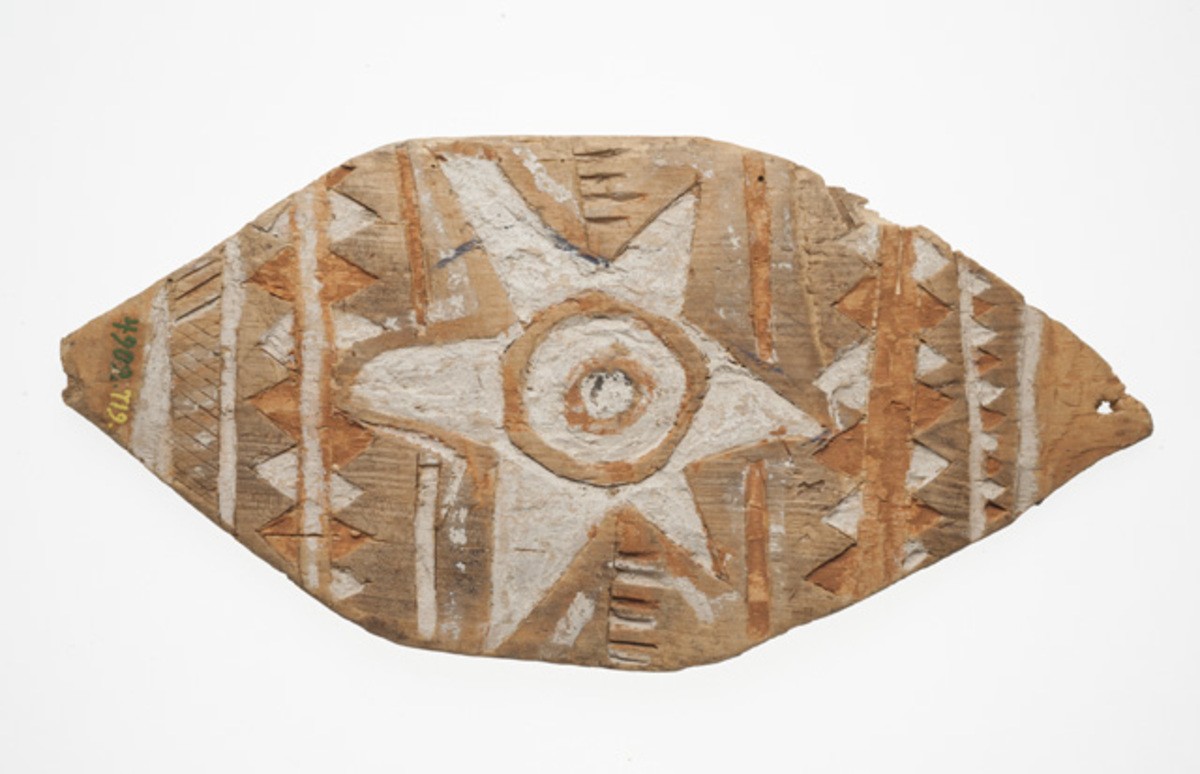
madubu Kiwai
Among the Kiwai of the lower Fly River, the Finnish ethnographer Gunnar Landtman recorded a cycle of secret men's ceremonies after living on Kiwai Island from 1910 to 1912. The moguru, held once or twice a year in the men's house, was the most secret rite of all, its two purposes the sexual instruction of boys and girls at puberty and the brewing of a magical concoction of herbs and semen. The mimia was a fire ordeal of male initiation in which the young men were burned, beaten, and given magical substances to make them strong. The horiomu, the cult of the dead, ran for several weeks each year at the start of the dry season, performed for a few hours before sunset. Women were excluded from public affairs and from the men's religious secrets, their myths and their rituals. The bullroarer sat among the Kiwai instruments Landtman catalogued: hourglass and cylindrical drums, seed-pod rattles, reed whistles, panpipes, bamboo and reed flutes, shell trumpets, and Jew's harps.
At Iasa, in Kiwai, I was informed there were two initiation ceremonies. At the first a madubu, or bull-roarer, is shown to each koiameri ... the whirling of the madubu insures a good crop of yams, sweet potatoes and bananas.
Haddon (ed.) 1908, Reports of the Cambridge Anthropological Expedition to Torres Straits, Vol. V, pp. 218-219 ("Notes on the Initiation Ceremonies in Kiwai").
- Object
- bullroarer occurrence; bullroarer use
- Function
- Gourlay source-catalog row with bullroarer use in PNG/Melanesia.
- Map confidence
- medium - alias_area
- Source location
- Table 1, row 103
- Snake-linked
- Forbidden to women
- Women-linked