No. NAAIN-012
Annoresiut, named for the wind
Canada · Nunavut · Kivalliq Region · North America · Arctic
Play / practical
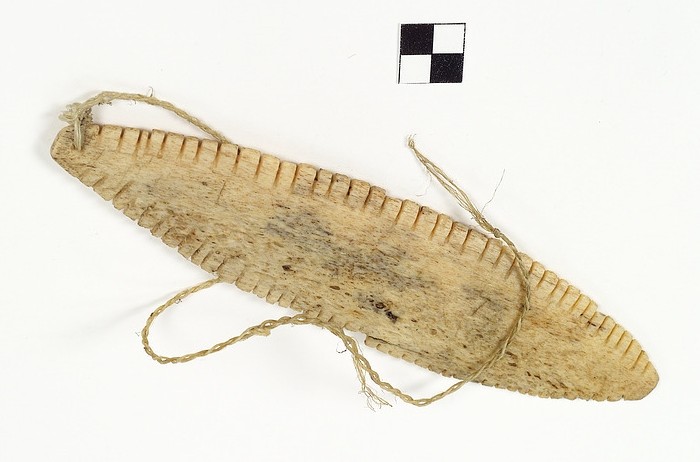
annoresiut
annoresiut — built on the root anore/anori, "wind." The name suits the instrument's airy roar, but no source ties this object to weather or wind magic.
A bullroarer of animal bone strung on a sinew cord, gathered on the south and west coasts of Southampton Island by the Norwegian ethnomusicologist Christian Leden during his 1913-1916 expedition across the Keewatin. Across the Inuit ethnographic record this is a children's toy rather than a cult object: a lozenge of bone or wood pierced at one end and whirled on a sinew line until it gave off a loud whirring drone. Collectors of Games of the North American Indians filed the bone and sandstone "buzzes" of the neighbouring Hudson Bay Eskimo under play, and later students of Inuit sound counted the bullroarer among the noisemakers, not the instruments of the angakok. Leden kept the Inuktitut name, annoresiut, a word built on the root for wind. The Sallirmiut he credited it to were already gone: in the winter of 1902-03 a disease carried by a sick sailor aboard the whaler Active swept the island, leaving one woman and four children alive. The piece now rests in the museum's Arctic holdings in Washington.
Two of these – the bullroarer and the buzz – are typically identified as toys rather than musical instruments... The Inuit bullroarer was a lozenge-shaped plate of bone or wood about 15-20 cm long, pierced at one end and suspended on a sinew cord... When spun rapidly it made a loud whirring sound.
Peter Whitridge, "The sound of contact: Historic Inuit music-making in northern Labrador," North Atlantic Archaeology 4 (2015), pp. 18-19
Particulars
- Object
- Animal bone and sinew bullroarer collected between 1913 and 1916
- Function
- A children's toy, whirled for its roar.
Sources
- Smithsonian National Museum of the American Indian, object 6/4624 / NMAI_69748 View · archived
- Peter Whitridge, “The sound of contact: Historic Inuit music-making in northern Labrador,” North Atlantic Archaeology 4 (2015), pp. 18-19
- Stewart Culin, Games of the North American Indians, 24th Annual Report of the Bureau of American Ethnology (1907), pp. 751-754, figs. 1011-1014
- Jenness (1946), p. 143, via Whitridge 2015, pp. 18-19
- Mathiassen (1927b), p. 120, via Whitridge 2015, pp. 18-19
- Murdoch (1892), pp. 378-379, via Whitridge 2015, pp. 18-19