No. MUS2026-141
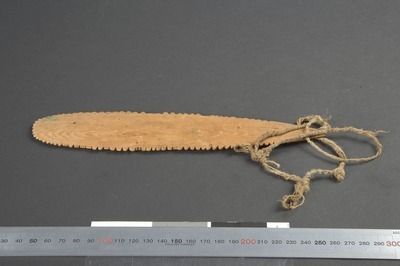
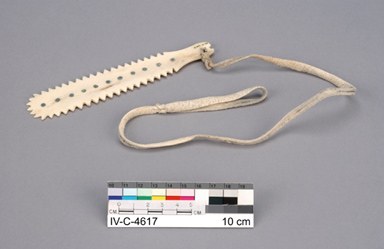
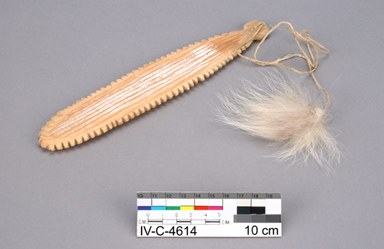
Netsilik brummer (bull-roarer), Amundsen Gjøa expedition (UEM16245)
Canada · King William Island (Qikiqtaq) · Netsilingmiut territory, Kitikmeot, Nunavut · North America · Arctic
Play / practical
Source term: brummer
brummer = Norwegian for a bull-roarer or buzzer (from brumme, to buzz or drone).
The Netsilingmiut—“people of the place of the ringed seal”—travelled in small communities across King William Island and the country northwest of Hudson Bay, hunting seals on the sea ice and moving inland for fish and caribou. Oslo’s museum attributes this striking bullroarer to them: a pointed wooden blade 23.7 centimetres long, pierced for its cord and cut like a saw along one edge. It reached Oslo in 1906 with Roald Amundsen’s Gjøa expedition collection. Among the Netsilik two decades later, Knud Rasmussen listed the imiklutAQ — a shaped slat whirled round to make a humming noise — among the games, and at Malerualik he dug a far older one, a Thule-era miniature in antler, out of a ruined winter house.
Particulars
- Object
- Pointed wooden bullroarer, 23.7 cm long, pierced for a cord and serrated along one edge.
- Function
- A child's game.
Source
Kulturhistorisk museum, Universitetet i Oslo, Etnografiske samlinger UEM16245 ("brummer"); collected by Roald Amundsen, Gjøa expedition 1903–1906, accessioned November 1906