No. ARCTIC-001
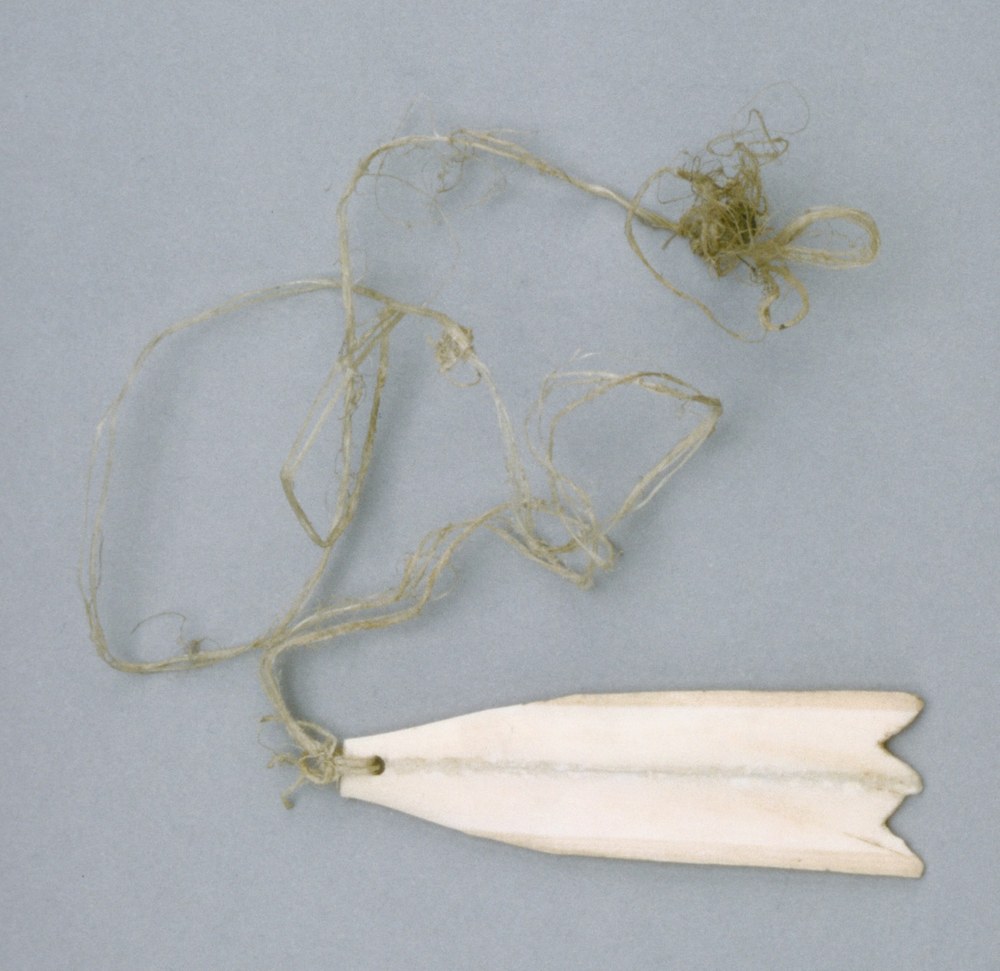
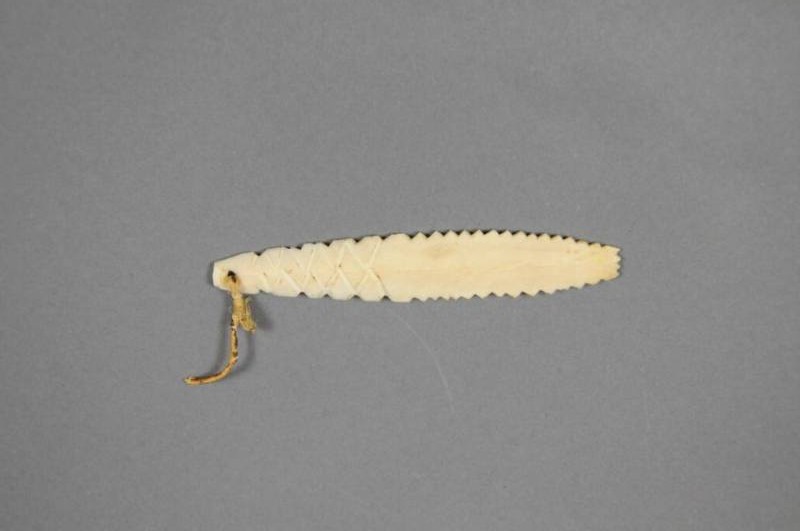
Sanikiluaq Belcher Islands ROM bullroarer sculpture
Canada · Nunavut · Belcher Islands · North America · Arctic
Play / practical
Source term: bullroarer sculpture
A sculpture of a bullroarer, worked in ivory with skin and sinew, made by a Qikiqtani (Belcher Islands Inuit) artist at Sanikiluaq in Hudson Bay and dated to 1936-1939, now in the Royal Ontario Museum and catalogued simply as "Sculpture, bullroarer." Among the Inuit the bullroarer was a lozenge-shaped plate of bone or wood, roughly 15 to 20 centimetres long, pierced at one end and hung from a sinew cord that could be tied to a wooden handle; spun rapidly, it gave off a loud whirring. The anthropological literature counts it a toy or noisemaker rather than a musical instrument, the skin drum being regarded as the only true Inuit instrument.
The Inuit bullroarer was a lozenge-shaped plate of bone or wood about 15-20 cm long, pierced at one end and suspended on a sinew cord which might in turn be attached to a wooden handle. When spun rapidly it made a loud whirring sound.
Whitridge 2015:19 (The sound of contact: Historic Inuit music-making in northern Labrador; citing Jenness 1946:143, Mathiassen 1927b:120, Murdoch 1988[1892]:378-379)
Particulars
- Object
- Ivory skin and sinew bullroarer sculpture dated 1936-1939
- Function
- Inuit bullroarer (ROM sculpture from Sanikiluaq); ethnographically reckoned a toy/noisemaker, not a ritual or musical object
Sources
- Royal Ontario Museum, “Sculpture, bullroarer,” object 2010.86.32 View
- Peter Whitridge, “The Sound of Contact: Historic Inuit Music-Making in Northern Labrador,” North Atlantic Archaeology 4 (2015):17–42, pp. 19–20 View · archived
- Diamond Jenness, Material Culture of the Copper Eskimo, Report of the Canadian Arctic Expedition 1913–18, XVI (Ottawa, 1946), p. 143, via Whitridge (2015), p. 20
- Therkel Mathiassen, Archaeology of the Central Eskimo, Report of the Fifth Thule Expedition 1921–24, vol. 4, part 2 (Copenhagen: Gyldendalske Boghandel, 1927b), p. 120, via Whitridge (2015), p. 20
- John Murdoch, Ethnological Results of the Point Barrow Expedition (Washington: Smithsonian Institution Press, 1988 [1892]), pp. 378–379, via Whitridge (2015), p. 20