No. MUS2026-356
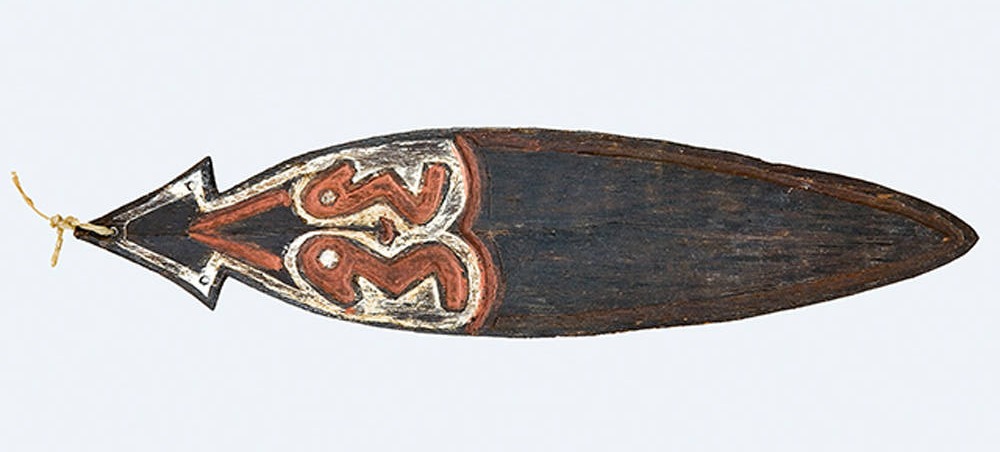
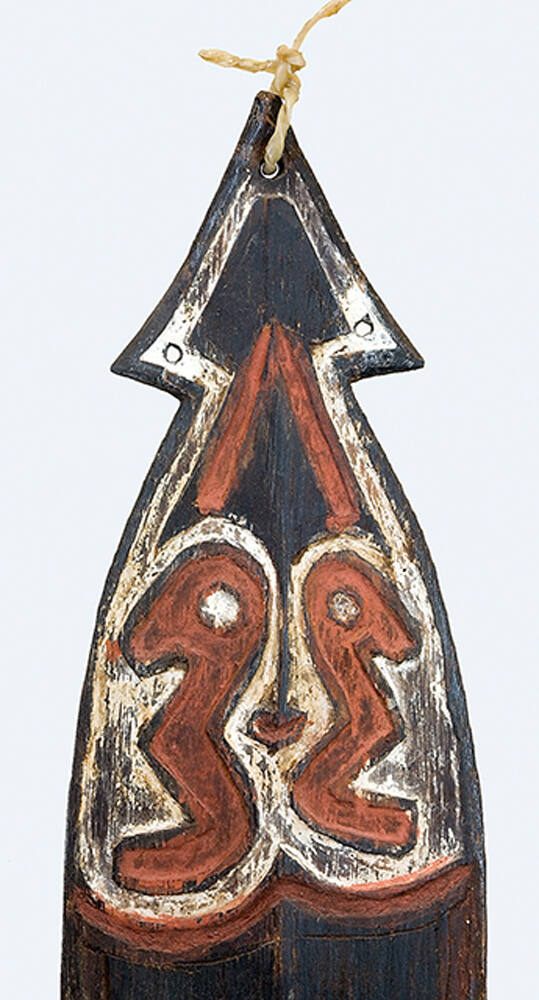
Arrow-headed blade with mirrored figure
Papua New Guinea, locality unrecorded · Oceania · Sahul
Function not recorded
Source term: bullroarer
No local term or cultural attribution recorded.
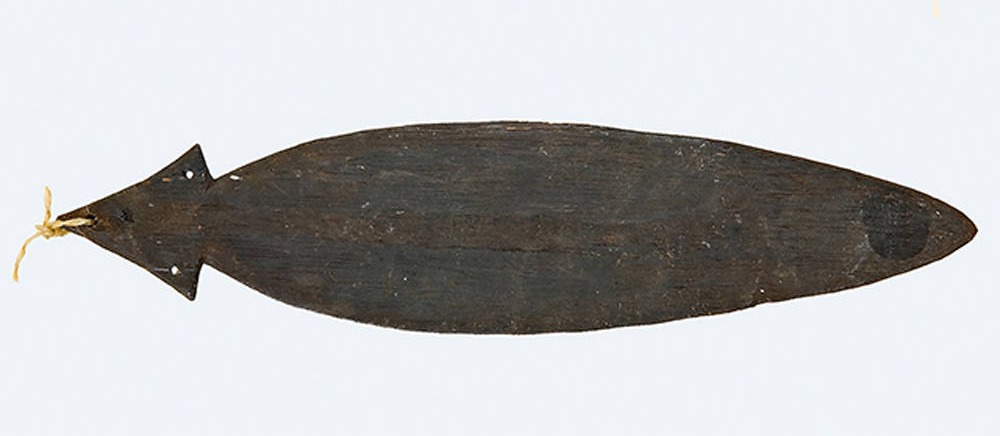
Red and white pigment runs across the upper half of this blade in a hooked, mirror-image figure that the museum reads, cautiously, as two heads — eyes, bodies and all — turned away from each other; a red outline carries on down the lower half, and the back is left bare. The wood is 35.5 centimetres long and 8.5 wide at the middle, drawn to a point at the bottom and flaring into an arrowhead at the top, with one small hole bored through the arrow for a very long string. Where in Papua New Guinea it was made, and what it was made for, went unrecorded. It is now in the National Music Museum in South Dakota.
Particulars
- Object
- A painted wooden blade 35.5 cm long and 8.5 cm across the middle, pointed at the lower end and cut into an arrowhead at the upper, with a red-and-white hook-like figure on its upper half and a single hole through the arrow for a long cord.
- Function
- Not recorded.
Source
National Music Museum, Vermillion, 02374 (purchased from H. M. Lissauer, 1978)