No. MUS2026-082
Seri hacaailc, paired ironwood blades
Mexico · Bahia de Kino (Kino Bay), Hermosillo Municipality, Sonora · North America
Sacred / spirit
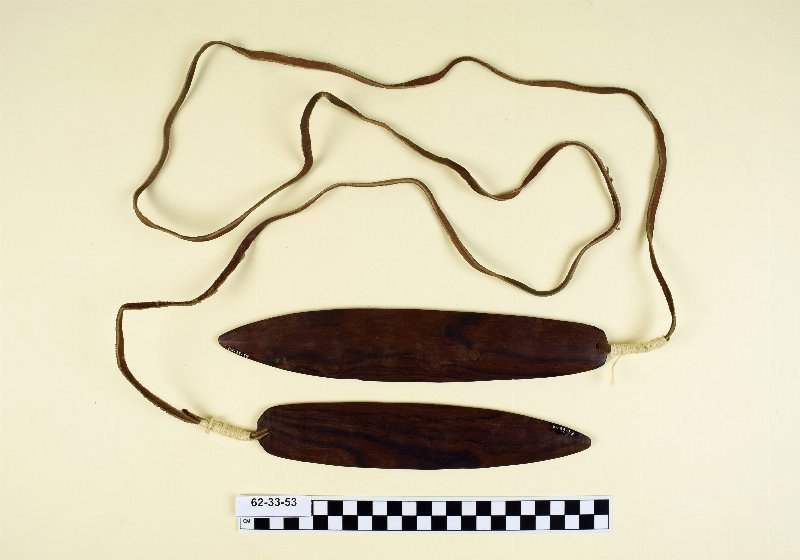
hacaaij / hacaailc (plural)
Source term: bull-roarer
hacaaij: Seri bullroarer used by a shaman; plural hacaailc (Moser–Marlett 2005, p.164).
A Seri bull-roarer of ironwood, made in 1959 — two oval blades, dark brown and black, smoothed thickest at the center and tapering to thin edges. A leather thong runs through holes at one end, doubled back on itself and lashed tight with white string; the whole piece runs 123 centimeters. It came from Edward Moser, the linguist who lived among the Seri of the Sonoran coast and Tiburón Island and whose work underlies their Seri-Spanish-English dictionary; the Penn Museum bought the object from him in 1962. What such a blade was for, the collectors of the NMAI pair learned from Buro Alazán in the same year they collected it. There is a cave the Seri witches go to. Manuel Encinas, who knew the witches well, took with him that thing that makes a loud noise, the bull-roarer, and when he got near he swung it and the spirits came; Jesús Feliz, Buro's grandson, who fasted four days before entering, swung it as he left so the spirits would not come out after him. The roar was not a spirit's voice here but the thing that ruled them.
When he goes to the cave he takes that thing that makes a loud noise, the bull-roarer -- and when he gets near he swings it and the spirits come.
Buro Alazán, in Dane and Mary Roberts Coolidge, The Last of the Seris (1939), p. 170
Particulars
- Object
- Two pointed wooden bullroarer blades with cordage attached at the blunt terminal ends, collected at Bahia de Kino in 1932 (NMAI 20/3236 / NMAI_216824); corroborated by the later Penn pair 62-33-53.
Source
Penn Museum, 62-33-53; Smithsonian National Museum of the American Indian, 20/3236 (collected by Dane and Mary Roberts Coolidge, Bahía de Kino, 1932); Dane Coolidge and Mary Roberts Coolidge, The Last of the Seris (New York: Dutton, 1939), p. 170; Mary B. Moser and Stephen A. Marlett, Comcaac quih yaza quih hant ihiip hac (2005), p. 164