MUS2026-080 - museum specimen
Inughuit
Greenland - Whale Sound, Inglefield Gulf, - North America
Play / practical
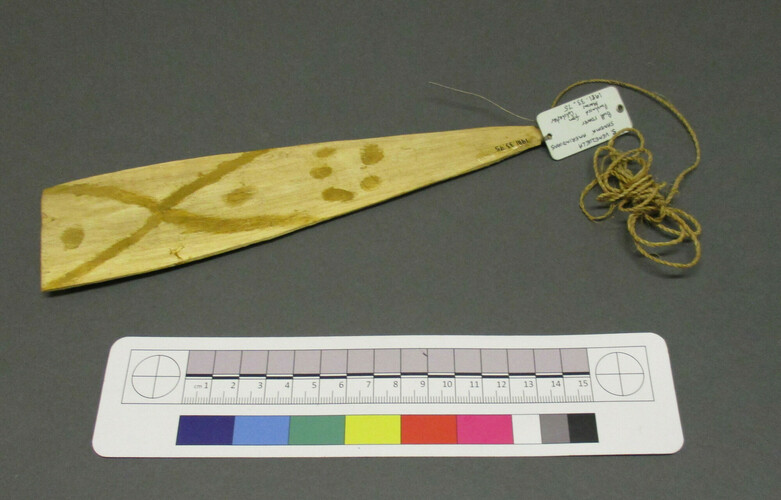
Source term: bull-roarer
hieqtaq (also Hiektak/hietak): the Polar Eskimo (Inughuit) name for the whirled bone or ivory noisemaker, recorded by Kroeber and glossed "bull-roarer."
An ivory bull-roarer of the Inughuit (Polar Eskimo) of northwest Greenland, collected at Netiulumi on Whale Sound by the Philadelphia geographer Henry G. Bryant, who sailed north in 1894 with the relief expedition sent to resupply Robert Peary. The Penn catalogue keeps its native name, Hiektak — the very word A. L. Kroeber recorded among the Smith Sound people as "hieqtaq, or bull-roarer," a flat figure-of-eight of bone or ivory whirled on a looped cord. Among the Inughuit, as across the Inuit world, this whirring noisemaker was a children's plaything, not a sacred voice: ethnographers from Kroeber to Jenness, Mathiassen and Murdoch class it with the toys, alongside the toothed "buzz" Bryant brought back from Cape York. What roars for spirits elsewhere here belonged to the games of the long Arctic dark.
A flat bone in the shape of an hourglass or figure 8, with a looped string passing through two holes in its middle, described by Dr A. L. Kroeber under the name of hieqtaq, or bull-roarer.
Stewart Culin, Games of the North American Indians (Twenty-Fourth Annual Report of the Bureau of American Ethnology, 1907), p. 753, on the Ita (Polar Eskimo) of Smith Sound, Greenland.
- Object
- Bull-roarer of the Inughuit, Penn Museum (acc. NA1642).
- Function
- A children's plaything: the Smith Sound hieqtaq belongs with the toys in every ethnography from Kroeber onward, not with sacred gear.
- Map confidence
- high - approximate culture/locality centroid
- Source location
- Culin 1907, p. 753; Penn Museum acc. NA1642
- Toy / secular survival