No. NAAIN-016
Clavering Island Site C blade
Northeast Greenland · Tunu · North America · Arctic
Function not recorded
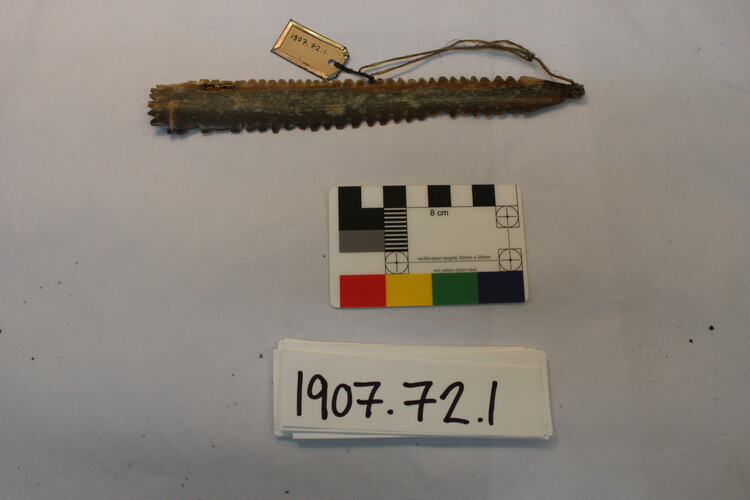
Source term: Bullroarer
A carved and drilled wooden bullroarer, dug from a stone house at Site C on Clavering Island in Northeast Greenland and dated by the museum to probably AD 1600–1800. It was excavated in 1930 by the archaeologist Junius Bird, who dug abandoned Eskimo ruins on Clavering and Shannon Islands during the Ford-Bartlett East Greenland Expedition — Captain Robert Bartlett's voyage on the schooner Effie M. Morrissey, sponsored by the Museum of the American Indian and its trustee James B. Ford. The Smithsonian attributes it to the ancestral Tunumiit of the Tunu (East Greenland) coast. Among Greenlandic Inuit the bullroarer is recorded chiefly as a child's spinning noise-toy rather than a ritual instrument, a lozenge of wood or bone pierced at one end, spun on a cord to whir.
Bullroarer. Wood. Stone house; Site C, Clavering Island; Northeast Greenland National Park; Tunu (East Greenland); Greenland. Date made: probably AD 1600–1800.
National Museum of the American Indian, object record 17/9504 (NMAI_191756)
Particulars
- Object
- Wood archaeological bullroarer from Stone house Site C
- Function
- Archaeological object probably AD 1600-1800 from Clavering Island Site C
Source
Smithsonian National Museum of the American Indian, 17/9504 (stone house, Site C, Clavering Island, Northeast Greenland)