No. ARCTIC-008
Tunumiit imitita, a child's toy
Ammassalik district, Groenland oriental (East Greenland) · North America · Arctic
Play / practical
imitita
Source term: rhombe
imitita — the vernacular name on the companion specimen's Quai Branly record (71.1934.175.52).
A worn wooden bullroarer collected among the Tunumiit of the Ammassalik district on the east coast of Greenland and now in the Musee du quai Branly. It is a rectangular slat about seventeen centimetres long, one end whittled into a plain handle and grooved for the cord that spins it: a flat blade whirled on a single string. It came back with the first French Greenland expedition, the mission led by the ethnologist Paul-Emile Victor with the anthropologist Robert Gessain, which was put ashore at Ammassalik by the Pourquoi Pas? in August 1934 to winter there; Victor afterwards gave some four thousand objects to the Musee de l'Homme. William Thalbitzer, who had catalogued the district's material culture a generation earlier, knew its bull-roarers "only as a toy for children" — noting in the same breath that among the Indians of North America the instrument could be sacred. Here the roar belonged to play.
Rhombe (palette) vieux, forme rectangulaire, une des extremites en forme de manche ou de poignee sans dents avec une gorge pour ficelle.
Old rhombe (palette), rectangular in form, one end shaped like a handle or grip without teeth, with a groove for the cord.
Musee du quai Branly object record 245543, inv. 71.1934.175.50
Particulars
- Object
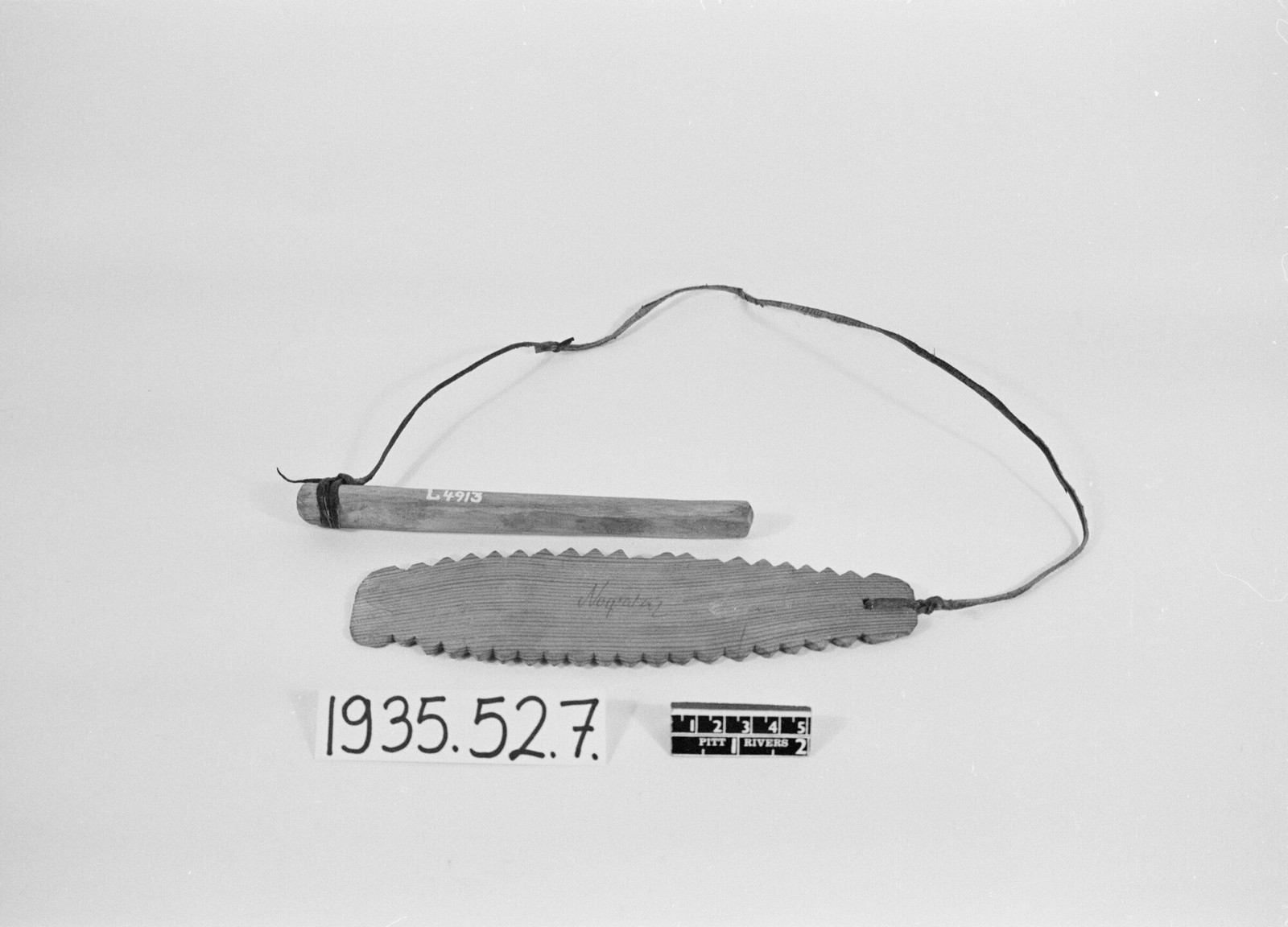
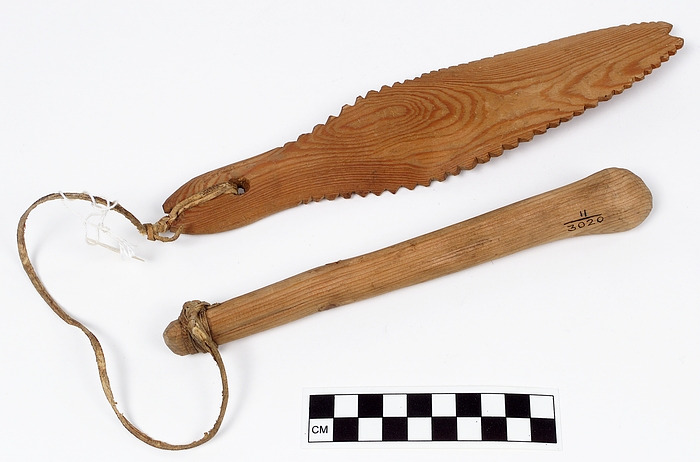
- A small, worn rectangular wooden slat in the musée du quai Branly, 17 cm long, 4 cm wide and 0.7 cm thick (about 13 g), one end shaped into a plain handle or grip (without teeth) and cut with a groove to take the cord: a free aerophone (rhombe / aerophone a air ambiant), a flat blade whirled on a single string. A second Greenland plate in the same collection, inv. 71.1934.0.33 X, is smaller and far lighter — 14.2 by 3 centimetres, two millimetres thick, three grams — an ellipse toothed all the way round its edge. A third Tunumiit piece, wood and hide from Tasiilaq, is in the National Museum of the American Indian, 11/3020, exchanged out of Copenhagen's Nationalmuseet in 1922.
- Function
- A child's toy.
Source
Musee du quai Branly - Jacques Chirac, object 245543, inv. 71.1934.175.50 (ex-Musee de l'Homme, collection Arctique). Rhombe (palette), wood, 17 x 4 x 0.7 cm, 13 g; ethnie Inuit, Ammassalik, Groenland; classed as a free aerophone (aerophone a air ambiant). Linked to the Expedition francaise au Groenland (collecting window 1930-1934), the first French Greenland mission led by Paul-Emile Victor with Robert Gessain, deposited at Ammassalik by the Pourquoi Pas? on 31 August 1934 and wintering 1934-35; Victor later donated some 4,000 ethnographic objects to the Musee de l'Homme; Donor recorded as "Personne inconnue."