No. MUS2026-014
Mohave bullroarer plaything
United States · Colorado River, Arizona · California · North America · Southwest
Play / practical
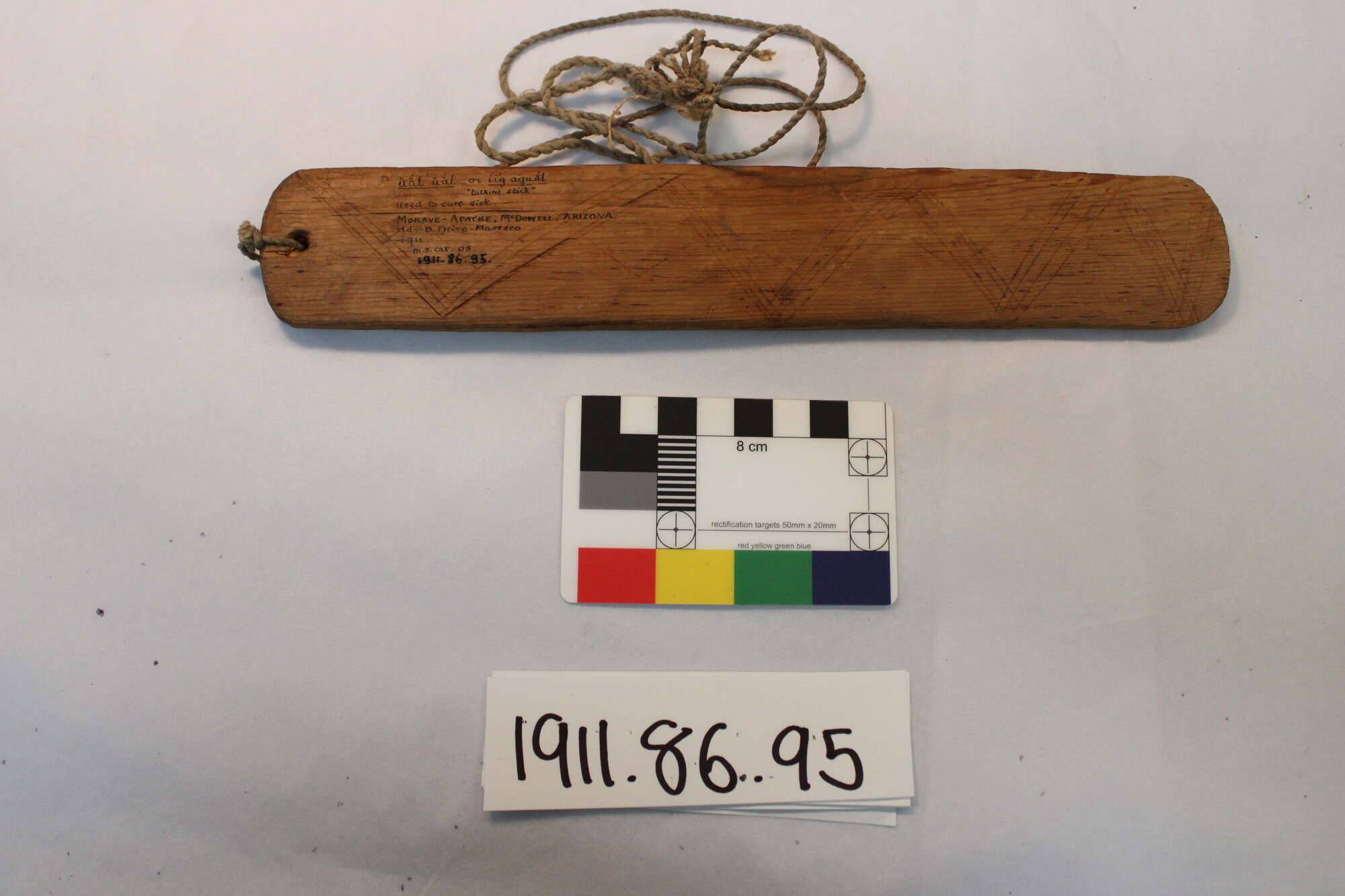
Source term: bull-roarer
The bullroarer, George Turner insisted, was a toy the Mohave had only recently taken up. Among the Mohave of the lower Colorado River, religious knowledge came through dreaming, and there was no initiation society for such an instrument to serve. Turner, a sixty-six-year-old man of Mohave Valley, placed the whirring blade among the playthings.
All myths that are at all of sacred character are believed not to be handed down by tradition, but to be dreamed by each narrator.
A. L. Kroeber, The Religion of the Indians of California (1907), Mohave section
Particulars
- Object
- Bull-roarer of the Mohave (Mojave), in the collection of Smithsonian NMNH (NMNH Anthropology).
- Function
- A toy, recently adopted by the Mohave.
Sources
- Smithsonian National Museum of Natural History E277950-0 (Mohave); collected by John P. Harrington, 1913 View
- Philip Drucker, “Culture Element Distributions: XVII—Yuman-Piman,” Anthropological Records 6(3) (1941), pp. 92, 188 View · archived
- A. L. Kroeber, “The Religion of the Indians of California,” UC Publications in American Archaeology and Ethnology 4(6) (1907) View · archived