No. HAD1898-014
Wihoewiketeke, the red-zigzag Pima blade
United States · North America · Southwest
Function not recorded
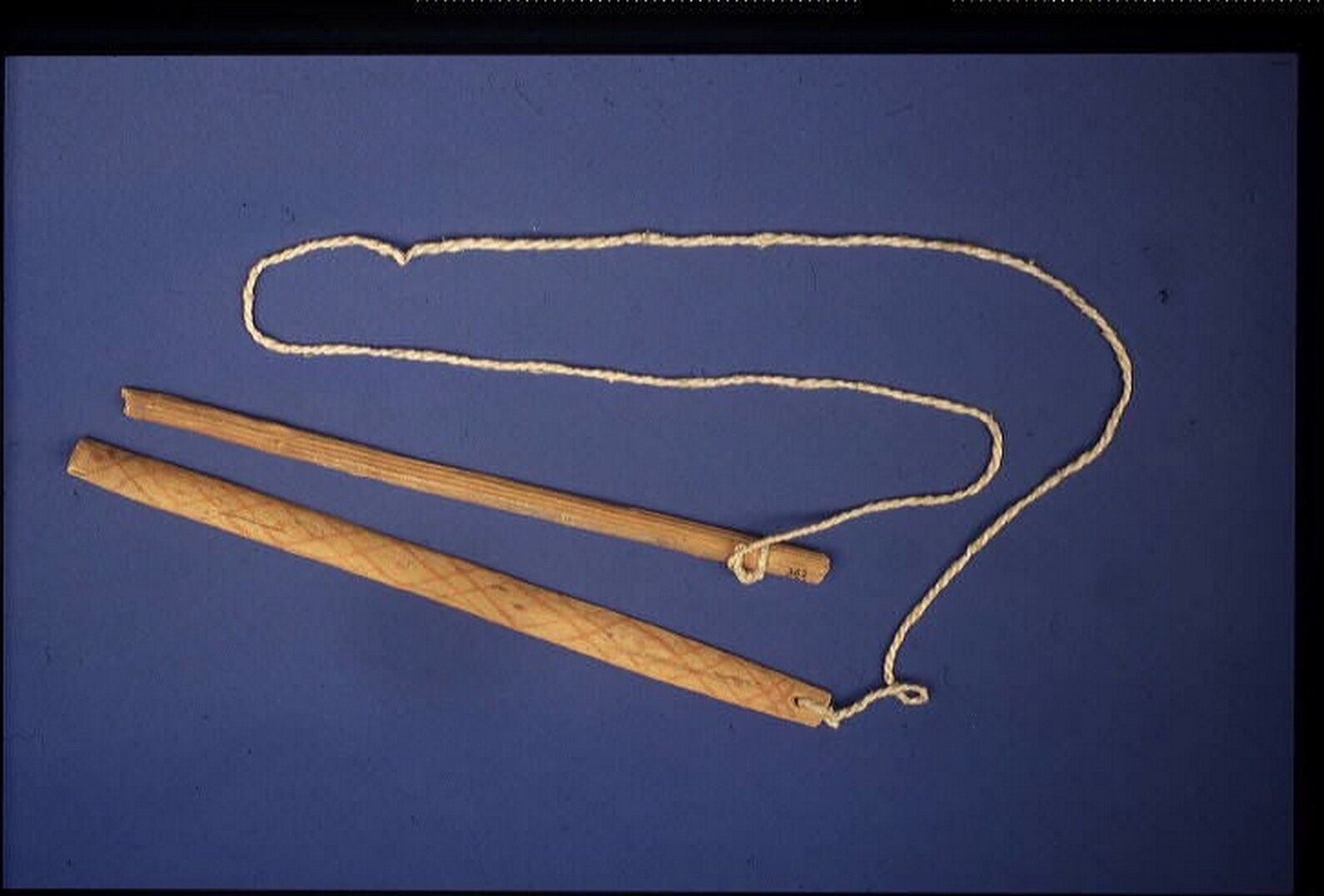
Wihoewiketeke
Source term: bull-roarer
Wihoewiketeke: the name given both for this Pima blade and for a Papago blade collected with it; both were whirled with a stick.
Red zigzags cross the long Pima blade; beside it lie the cord and wooden handle that once drove it through the air. H. Ten Kate collected the rig in the 1880s, and Schmeltz figured it in 1896 under the name Wihoewiketeke. The celebrated label, 'It makes a humming sound and is used to drive away evil spirits,' belongs to the Papago blade collected with it; Haddon, citing the pair together, let it spread to both, and the Pima blade has carried the borrowed story ever since.
Das zweite (Fig. 25; Inv.-No. 362/54) von den Pima zeigt scharfe Ränder und gerade abgeschnittene Enden, es ist 39,4 cm lang, 2,4 cm breit und 1 cm dick, die Zeichnung besteht auf beiden Seiten aus einander kreuzenden rothen Zickzackstreifen und einzelnen rothen Flecken ohne weisse Untermalung.
The second of the pair (Fig. 25; Inv.-No. 362/54), from the Pima, has sharp edges and straight-cut ends; it is 39.4 cm long, 2.4 cm wide and 1 cm thick, the design on both sides consisting of crossing red zig-zag stripes and scattered red spots without white underpainting.
Schmeltz 1896, "Das Schwirrholz," p. 121 (Pima specimen, Inv.-No. 362/54)
Particulars
- Object
- Wereldmuseum RV-362-54: a 39 cm Pima wooden slat with sharp edges, crossing red zigzags and spots, preserved with its long cord and separate 34.5 cm handle.
- Function
- Function not recorded for this Pima object; Schmeltz documents its name, painted form, cord, and whirling handle.
Source
Schmeltz 1896:120-121, fig. 25; Haddon 1898:294-295, fig. 40 no. 4