No. MUS2026-006
Jemez roarer kept in silence
United States · Jemez Pueblo, New Mexico · North America · Southwest
Function not recorded
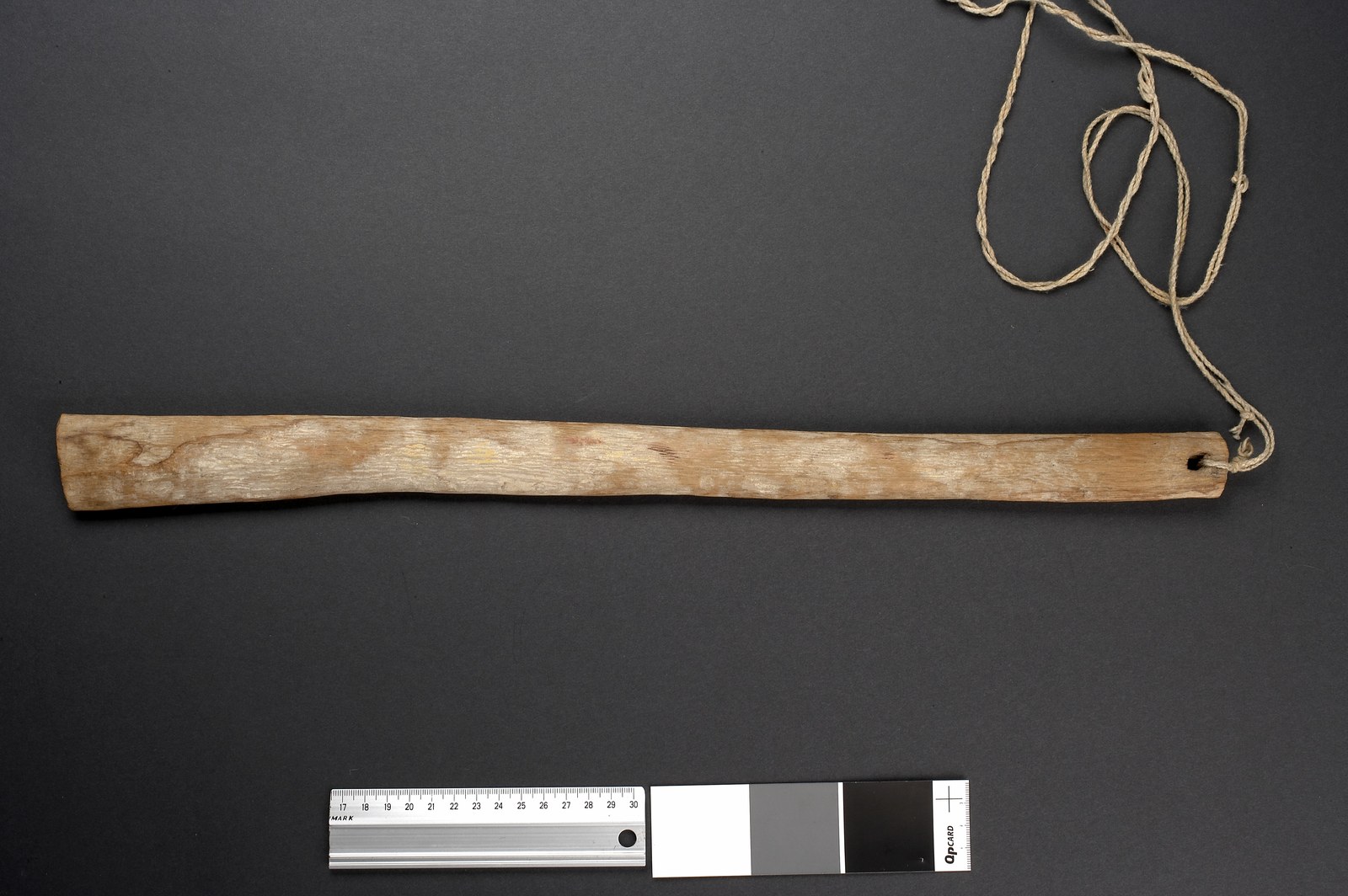
Source term: bull-roarer
Whirled on its cord, a bullroarer makes a low, carrying moan — and at Walatowa it is forbidden to photograph, record or even sketch a ceremony. This one survives as words alone: the National Museum of the American Indian withholds its picture. Albert Reagan, a government schoolteacher, probably collected it around 1901–1902 and sold it to the museum in 1919; his published study of Jemez dancing never mentions a bullroarer. When Elsie Clews Parsons gathered tales at Jemez in 1925, one narrator left his deliberately unfinished, so no outsider would ever hold the whole.
Particulars
- Object
- Carved wood and hide bull-roarer of the Jemez (Walatowa), NMAI catalog no. 9/4632, collected by the Indian Service teacher Albert B. Reagan probably in 1901-02 and sold by him to the Museum of the American Indian in 1919. The museum withholds the image as culturally sensitive.
- Function
- Not recorded.
Sources
- National Museum of the American Indian, Smithsonian Institution, catalog no. 9/4632 (collected by Albert B. Reagan; purchased 1919) View
- Albert B. Reagan, 'Dances of the Jemez Pueblo Indians,' Transactions of the Kansas Academy of Science 20 (1906): 241-272 View
- Elsie Clews Parsons, The Pueblo of Jemez (New Haven: Yale University Press, 1925) View