No. LOEB1929-012
Ruk Ruk northern Bougainville warning bullroarer
Papua New Guinea · Northern Bougainville · Oceania · Bismarck Archipelago
Restricted
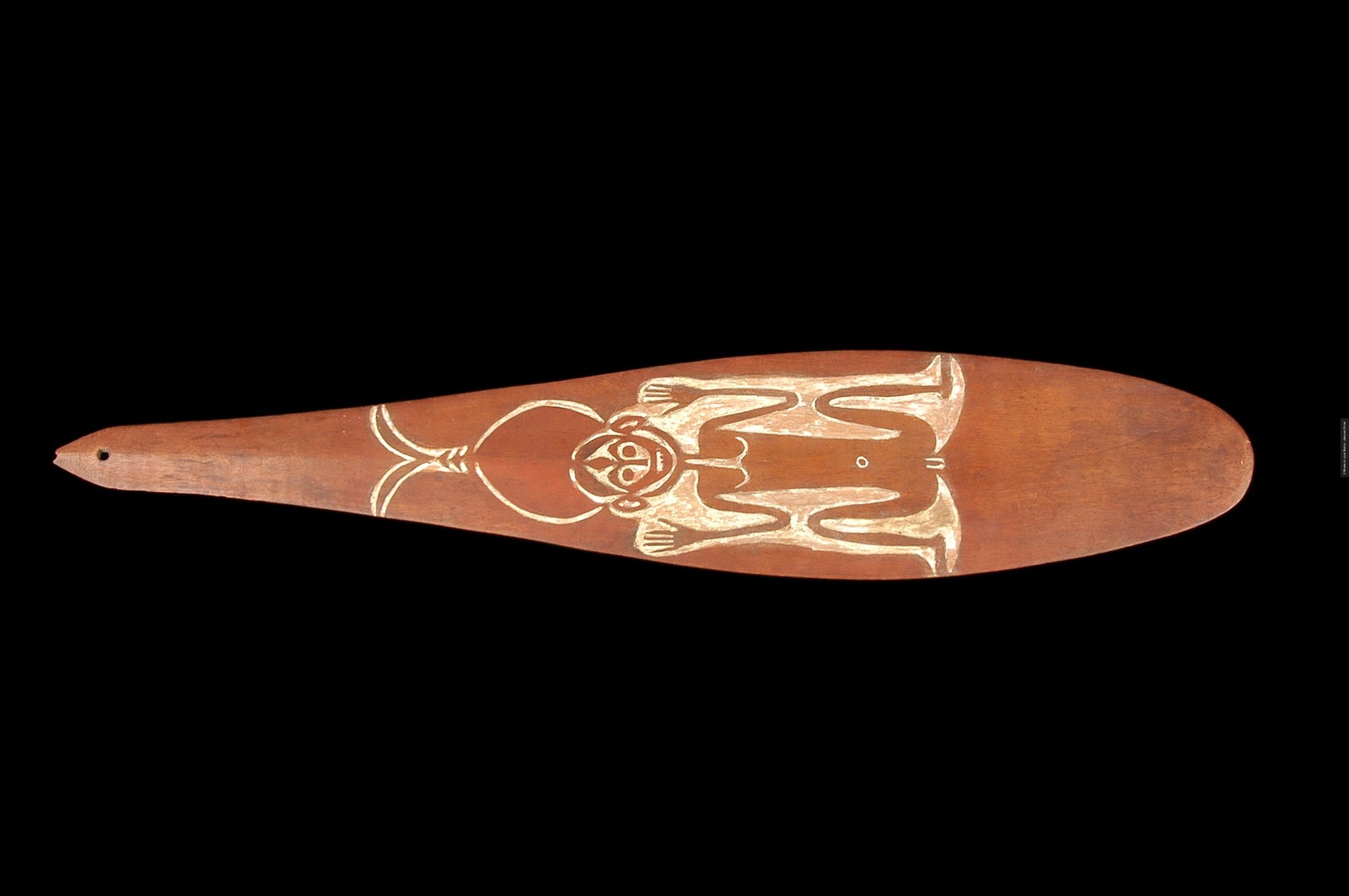
rukruk (also burri)
Source term: bullroarer
During the rukruk seclusion of northern Bougainville, chosen boys lived behind a high fence at a forest camp until their hair grew long enough to fill the balloon-shaped hats they could never be seen without — a woman who entered the enclosure, or who caught a novice bare-headed, was killed. Women were told the novices were consorting with two spirits, the male Ruk a tzon and the female Ruk a tahol, whose noise sounded so dreadful that they threw down their belongings and fled; the men collected what they dropped. The voice, Richard Parkinson reported in 1899, was a harmless bullroarer whirled over the head on a thin cord — so strictly secret that when Parkinson startled a returning novice carrying an odd piece of wood, the youth hid it behind his back and vanished into the bush. Loeb later judged this society the likely parent of the better-known Duk Duk of New Britain.
Das Instrument, welches dasselbe hervorbringt, ist ein Schwirrholz, das an einem dünnen Stricke mit grosser Schnelligkeit über dem Kopf herumgewirbelt wird. Selbstverständlich ist das Schwirrholz ein Geheimniss, das den Weibern aufs strengste verborgen bleibt und das ein Besucher niemals zu Gesicht bekommt.
The instrument that produces it is a bullroarer, whirled about over the head with great speed on a thin cord. Naturally the bullroarer is a secret, kept most strictly hidden from the women - one a visitor never gets to see.
R. Parkinson, Zur Ethnographie der nordwestlichen Salomo Inseln (1899), p. 11.
Particulars
- Function
- Sounded as the voice of the Ruk spirits, a warning that the novices were near.
Source
R. Parkinson, 'Zur Ethnographie der nordwestlichen Salomo Inseln,' Abhandlungen und Berichte des Königlichen Zoologischen und Anthropologisch-Ethnographischen Museums zu Dresden VII/6 (1899), pp. 11-12; Parkinson, Dreissig Jahre in der Südsee (1907), pp. 658-659; Edwin M. Loeb, 'Tribal Initiations and Secret Societies,' University of California Publications in American Archaeology and Ethnology 25(3) (1929): 249-288, at p. 256