No. PNG179
Buin (incl. Telei, Uisai)
Papua New Guinea · Bougainville · Oceania · Sahul
Restricted
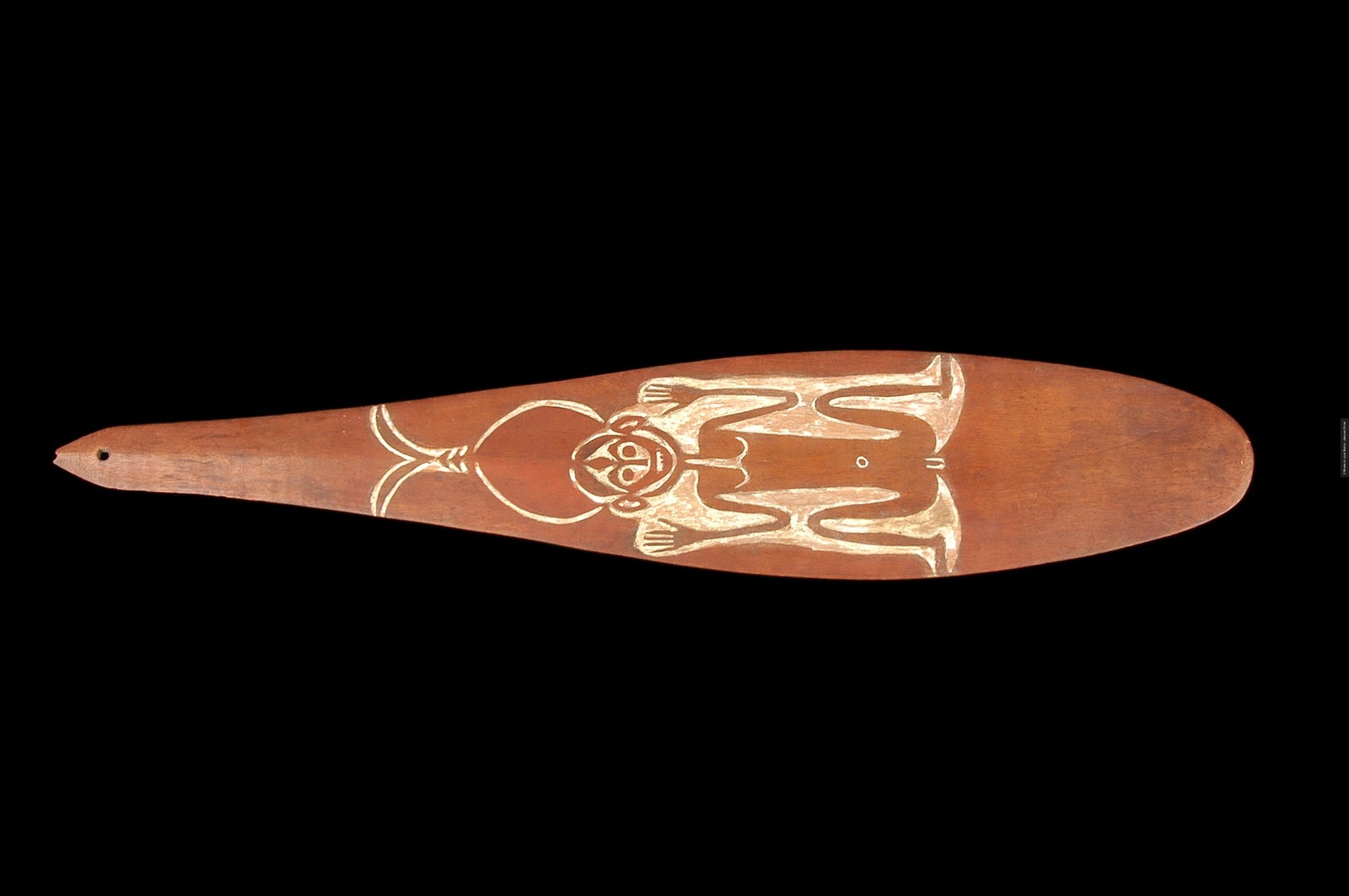
kagepai
Whirled overhead on its cord, the flat blade the Buin of southern Bougainville call kagepai throws out a pulsing roar — a motion their language fixes in a verb all its own, pigu, "to brandish and twirl something around the head." The naturalist Otto Finsch logged the roarer here in 1914, beside the great wooden slit-gong. Its roar belonged to initiation and to the rules that kept the sexes apart.
kagepai n. Bullroarer.
Donald C. Laycock, A Dictionary of Buin, ed. Masayuki Onishi (Pacific Linguistics, 2003), p. 36
Particulars
- Function
- Used in initiation ceremonies held under taboos between the sexes.
Source
K. A. Gourlay, Sound-Producing Instruments in Traditional Society: A Study of Esoteric Instruments and Their Role in Male-Female Relations, New Guinea Research Bulletin 60 (Canberra, 1975), p. 3 and Table 1, p. 10, entry 179; Otto Finsch, Südseearbeiten (Hamburg, 1914), p. 539; Donald C. Laycock, A Dictionary of Buin, ed. Masayuki Onishi, Pacific Linguistics 537 (Canberra, 2003), pp. 36, 267