No. GUPTA1955-001
Nicobar monsoon roarers on sixty-foot poles
India · Central Nicobar Islands · South Asia
Weather / fertility magic
Source term: automatic bull-roarers
automatic bull-roarer — a bull-roarer that sounds itself: a wind-turned plank whose boom is identical to a whirled blade's.
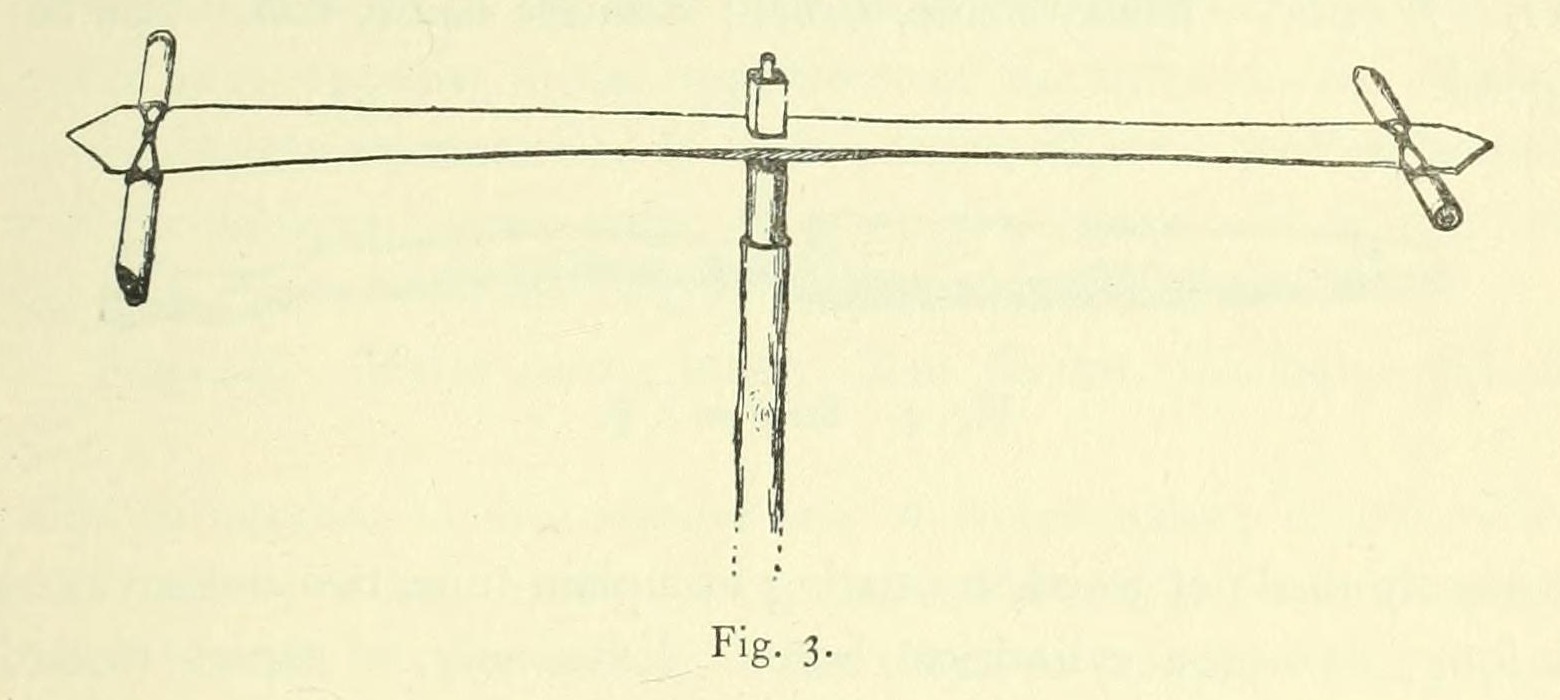
On Katchall and Nancowry the instrument was taken out of human hands and given to the weather. A narrow plank, twisted and cut so the wind turns it on a central pin, carries at each end a node of bamboo facing the opposite way, its mouth part-stopped with rubber or wax; raised on seafront trees and poles forty to sixty feet high, the revolving wood booms exactly as a whirled blade does. The Nicobarese who put them up are sailors and coconut gardeners whose year is cut in two by the monsoons. The installations went up in the first week of November, with ceremony, as the southwest wind gave way to the northeast: a warning to navigators that the season had turned, and a greeting to the incoming monsoon and farewell to the outgoing.
These, of course, are put up with certain ceremonial rites, the weather playing a most important part on the life of these maritime people.
S. K. Gupta, 'The Andaman and Nicobar Islands,' Appendix A in Census of India 1951, Vol. XVII (1955), p. lviii.
Particulars
- Object
- A narrow plank twisted and cut so as to revolve in the wind about a central pin, with oppositely facing bamboo nodes at its ends whose openings are partly blocked with rubber or wax, mounted on seafront trees and poles often forty to sixty feet high in the central Nicobars.
- Function
- Raised in the first week of November to mark the change from the southwest to the northeast monsoon, warn navigators, and ceremonially greet the incoming monsoon.