No. NAGA-001
Konyak Tamlu kampi rain bullroarer
Naga Hills · present Nagaland · South Asia · Northeast India
Weather / fertility magic
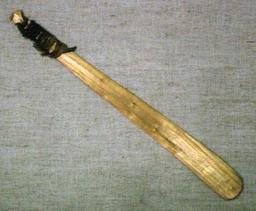
kampi
Source term: Kampi
kampi: the Konyak name for the rain-inducing bull-roarer.
Etymology. kampi is the Konyak name for the bullroarer whirled to bring rain.
Among the Konyak of Tamlu village, in what is now Nagaland, a bull-roarer called kampi was whirled to bring rain. Henry Balfour, first curator of the Pitt Rivers Museum, collected this one in November 1922 on his tour of the Naga Hills; it is a length of wood 45 centimetres long, with the cord lashed to a notch cut in the end rather than passed through a drilled hole, as elsewhere. It was no display piece: this kampi had been swung in earnest.
This one was certainly used and was not symbolic or decorative.
Cambridge Naga Database, catalogue record R10584 (Pitt Rivers Museum 1953.10.109)
Particulars
- Object
- Wood bullroarer with fibre cord attached to notch
- Function
- Swung to induce rain.
Source
University of Cambridge, 'The Nagas' database, record R10584 (Konyak, Tamlu); Pitt Rivers Museum, Oxford, 1953.10.109