No. ASEXP-002
Muria Gond bull-roarer from Markabera, Bastar
Bastar · Central Provinces · South Asia · Central India
Play / practical
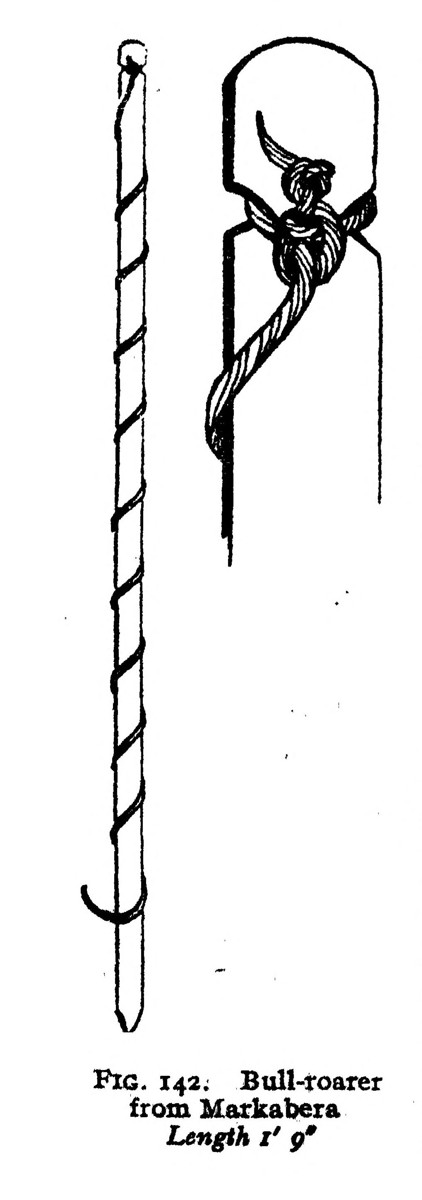
Source term: Bull-roarer
When Verrier Elwin came to the bull-roarer among the Muria Gond of Bastar, he found nothing secret in it. The Jhoria of the western parganas, he wrote, made them for amusement. The Muria cut theirs from bamboo slats twelve to eighteen inches long, notched at one end where a string was tied and sometimes pointed at the other, then whirled them to raise a roaring noise. Elwin printed a drawing of one from Markabera as Figure 142 in his 1947 monograph on the Muria and their ghotul, setting it in the chapter on dance and song — not among the eighteen instruments of the Gond hero Lingo, still full of the love-charms he put into them, but among the few the Muria keep beside them. In a footnote he added that the bull-roarer, common across the world, is rare in India, though S. C. Roy had recorded it in the Uraon dhumkuria and among the Santal, Ho and Munda.
I have not been able to discover any religious or magical significance in them; they are only used as toys.
Elwin 1947, The Muria and Their Ghotul, p. 529 (chap. XX, Dance and Song)
Particulars
- Object
- Bull-roarer illustrated as Figure 142 in Elwin's monograph on the Muria and their ghotul; collected from Markabera village, Bastar.
- Function
- A toy, swung for fun.
Source
Verrier Elwin, The Muria and Their Ghotul (Bombay: Oxford University Press, 1947), p. 529 and fig. 142, 'Bull-roarer from Markabera'