EA-HEIWA-HOKKAIDO-034 - archaeological find
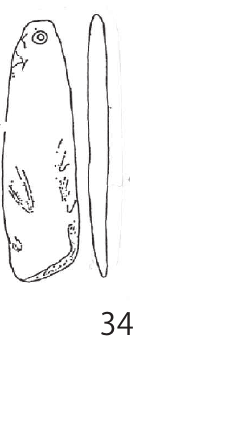
Heiwa site perforated slat no.34
Urahoro, Hokkaido, Japan; Heiwa site no. 34 - East Asia
Function not recorded Candidate only
有孔石斧 Japanese
Source term: 有孔石斧; 石斧型垂飾; possible Hidaka-jade perforated slat
有孔石斧 (yūkō sekifu): 'perforated stone axe'
In August 2000 a small perforated slat from the Heiwa site made the Hokkaido newspapers as a pendant of 'Hidaka jade' — a headline specialists have been walking back ever since, because Hokkaido's greenstones are notoriously deceptive: what looks like nephrite or serpentinite in the hand is often rodingite or tremolite rock. Specimen no. 34 in the modern comparative table is six centimetres long, under two wide, and six millimetres thick, with a single hole worked through its upper end, from an Initial Jōmon context at Urahoro, nine to eight thousand years old. It belongs to the perforated stone axe corpus, and the study that catalogued it makes a striking observation about the class: the holes sit too inconsistently for hafting, but cord-abrasion above the hole shows the objects hung from a line — most likely, it concludes, as portable tools carried at the waist. A thin polished blade, drilled at one end, demonstrably suspended from a cord.
紐ずれが孔の上位にあるのは、吊るされたことを示す。
The cord-wear above the hole shows the piece was suspended.
Tatsuta, 'On perforated stone axes,' Okhotsk Museum Esashi, 2020
- Object
- 有孔石斧; 石斧型垂飾; possible Hidaka-jade perforated slat. Specimens/count: one measured/drawn object no.34 in Esashi comparative table. Material: rhyolite?; table note says possible Hidaka jade. Dimensions: 6.0 x 1.8 x 0.6 cm. Perforation: single upper-end hole visible in line drawing; table notes rubbed-cut traces, not confirmed cord wear. Context: Heiwa site; source attribution to Urahoro town education report vol.1 1960 in Esashi table, but third-wave bibliography confirms the report trail as Urahoro Board of Education 1968 `平和遺跡 - 第1集 -`; Early Jomon Shimokorobe-type context in Esashi table. Date: Initial Jōmon (早期); class bracket 8100–7100 14C BP (~9000–7900 cal BP) per Esashi 2020 — a class-level date, not a specimen measurement.
- Function
- Published within the perforated stone axe (有孔石斧) corpus, with class-level cord-wear evidence for suspension — read as portable hung tools, once reported in the press as a 'Hidaka jade' ornament; the atlas adds the whirred-blade possibility to that open list.
- Map confidence
- low_medium - Approximate locality or municipality/site-cluster anchor from the local dossier; refine before public release.
- Source location
- Esashi 2020 Fig. 3 no. 34; Table 1 rows 34-35