No. EA-HAKE-001
Hake notched jade blade
China · Hailar River, Hulunbuir, Inner Mongolia; Hake culture · East Asia
Function not recorded Candidate only
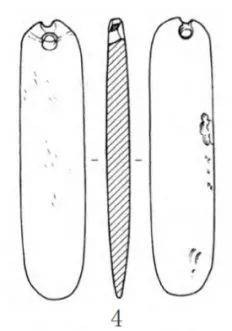
玉匕形器
Source term: yu bixingqi (jade bi-shaped object)
匕形器 (bǐxíngqì): 'bi-shaped object', the Chinese archaeological name for an elongated tongue-shaped blade, after the ancient bi spoon.
On the Hulunbuir grasslands of Inner Mongolia, beside the Hailar River, the people of the Hake culture made their tools from tiny, finely struck flakes of stone, and they also worked jade. One of their graves, M3, held this slender jade blade, long and narrow with rounded ends. A small hole was drilled through it from both faces near one end, and a notch was ground into the tip just above the hole. The same unusual pairing of hole and notch turns up on a jade blade from Xiaonanshan on the Ussuri River, more than a thousand kilometres to the east, among the oldest worked jades in Northeast Asia.
Particulars
- Object
- Slender jade blade, long and narrow with rounded ends, pierced near one end by a circular hole drilled from both faces, with a small notch ground into the end above the hole. The published drawing shows both faces and a flattened profile; dimensions are unpublished.
- Function
- Not recorded.