Atlas Essay —
Before the Compass
Niuheliang, Liaoning · Hongshan China · fourth millennium BCE
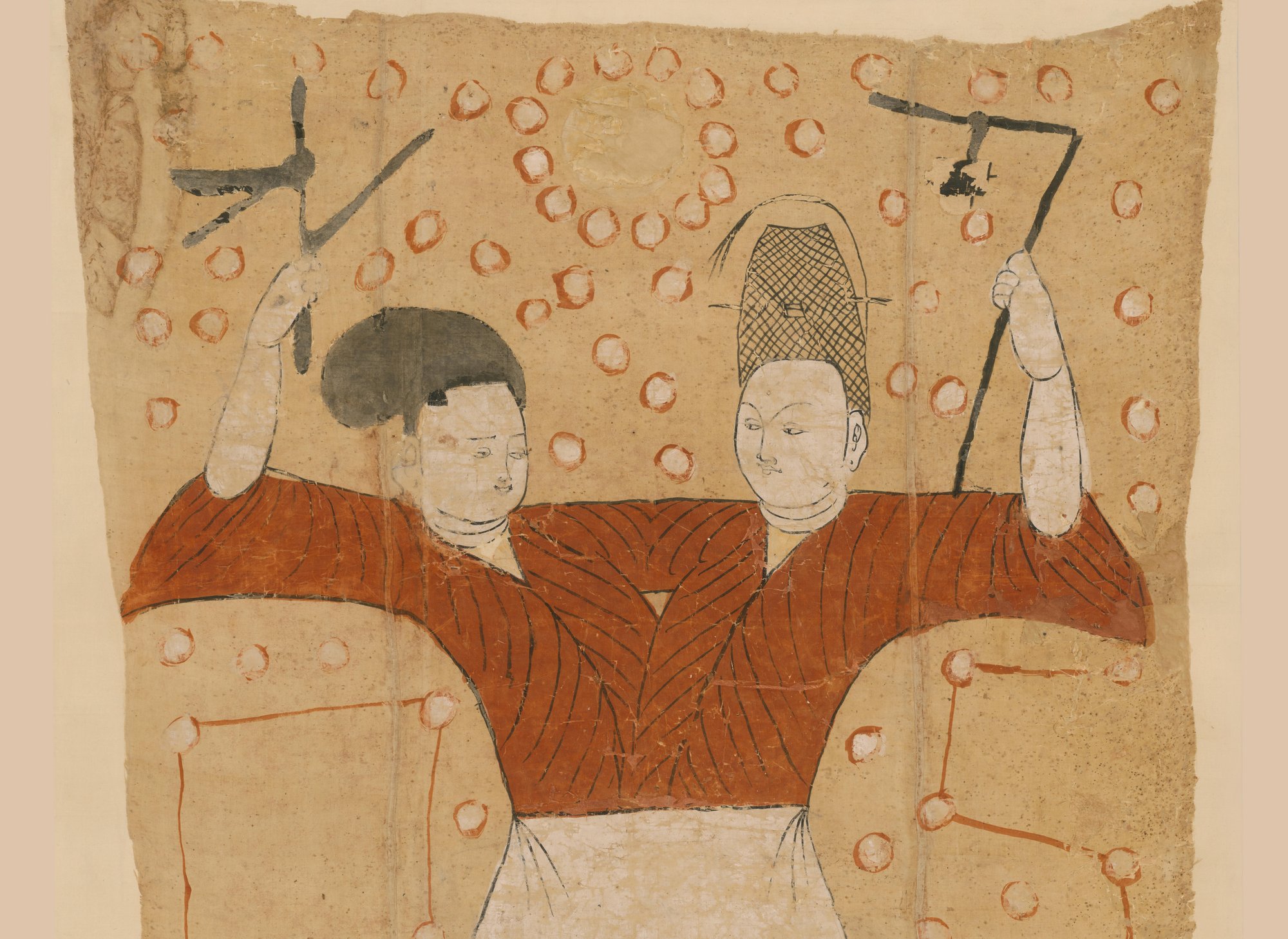
On an eighth-century funerary silk from Astana, Fuxi and Nüwa hang beneath a field of stars. Human above the waist and serpent below, their tails braid into one body. Nüwa opens a pair of compasses. Fuxi lifts a carpenter’s square. Sun, moon, constellations, creators, sex, geometry: the image looks like a complete invention. It is the end of a very long sentence. Four thousand years earlier at Niuheliang, people of the Hongshan culture had already laid that sentence across a sacred landscape in circles and rectangles, given it female ancestors in painted clay, and carried its coiled animal power on their bodies in jade.
The Han square-and-compass couple did not invent a new cosmology. They turned into attributes what Hongshan ritual had already built into a world: serpentine power moving between round heaven and square earth, female ancestry joining birth to death, and technical measure converting both into social order.
In brief
- Niuheliang was a purpose-built sanctuary: a female ancestral temple, circular and square altars, rectangular cairns, processional axes, and a concentric altar whose three diameters form a sequence of successive √2 ratios.
- Hongshan power had a serpent body. Coiled jade pig-dragons lay against the dead, including a pair on one chest at Niuheliang, while a monumental clay version occupied the Goddess Temple itself.
- The serpent-bodied couple precedes the tools in Chinese art. Sun and moon accompany Fuxi and Nüwa in late Western Han tombs; square and compass are a later regional addition that converts cosmic kinship into explicit rule and measure.
- Surviving serpent cults show the same gestalt in motion: snake, season, fertility, initiation, territory, law, and the voice of a whirled blade.
At Niuheliang, the diagram was a place
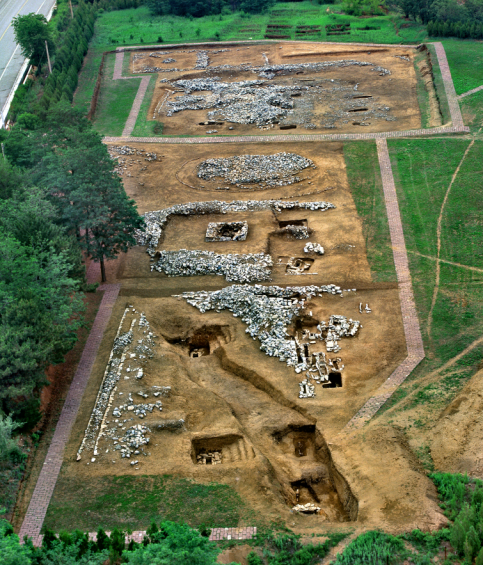
Niuheliang sits in the dry hills of western Liaoning in northeastern China, near the northern margin of the Hongshan world. Between roughly 3800 and 3000 BCE its builders created something unlike a village magnified into importance. Across many separate localities they laid out a sanctuary: the half-subterranean structure known as the Goddess Temple, stone platforms, cairn cemeteries, open-air altars, and routes that made the hills themselves part of the ceremony. The official heritage synthesis describes the zone as a ritual center without an ordinary residential settlement inside the site. People came here to bury, offer, process, and meet powers larger than a household.
The powers were arranged. At the second locality, a circular altar stands between rectangular stone burial cairns. At the fifth, the altar is square. Guo Dashun, who led the excavation, described the second-locality complex as deliberately aligned north–south with the Goddess Temple about 1,050 metres away. The central altar rises through stone rings toward its middle. Pale red columnar stones, carried in from elsewhere, marked the enclosure. The round and the square were not loose motifs applied to objects; they were the two poles of a ceremonial country.
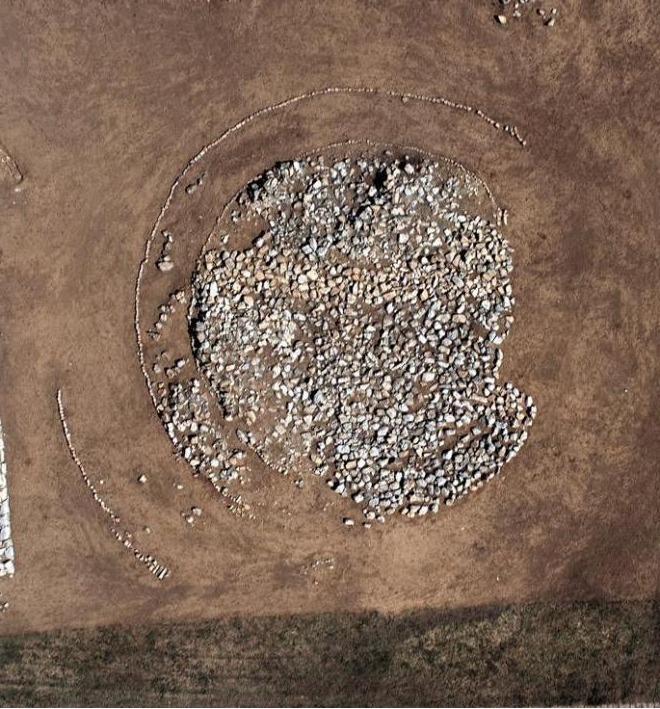
The geometry becomes more exact at the altar itself. Jia Xiaobing, the lead Niuheliang archaeologist, gives the diameters of its inner, middle, and outer stone rings as 11, 15.6, and 22 metres. Each is the preceding diameter multiplied by approximately √2. Jia reconstructs the setting-out method from nested squares: a square supplies the next circle’s diameter through its diagonal, then the new circle receives the next square. Circle comes from square; square generates circle. His reading turns a sequence visible in the excavation plan into a construction ritual: three rounds raised from two squares.
Later Chinese texts give this pairing its durable name: heaven’s way is round, earth’s way square. That maxim describes modes of action as much as shapes — the turning of the sky and the settled directions of the ground. Niuheliang does not need a carved square-and-compass badge to participate in that grammar. Its builders performed the tools’ work at landscape scale: making circles from measured lines, fixing an axis, lifting an ordered centre, and placing the dead where heaven and earth meet.
The serpent was the body of power
If the round and square supplied the frame, Hongshan jade supplied the body that could move through it. The most famous form is conventionally called the pig-dragon: a thick creature curled around a central void, muzzle pressed toward tail, drilled so that it could hang against a living or dead body. The name follows the head. The cosmology follows the torso. The Musée Guimet describes its great example as a magical creature made from a serpentine body wrapped around an orifice
. China’s National Museum is plainer still: this dragon is snake-bodied and beast-headed, its coil capable of evoking both embryo and regeneration.
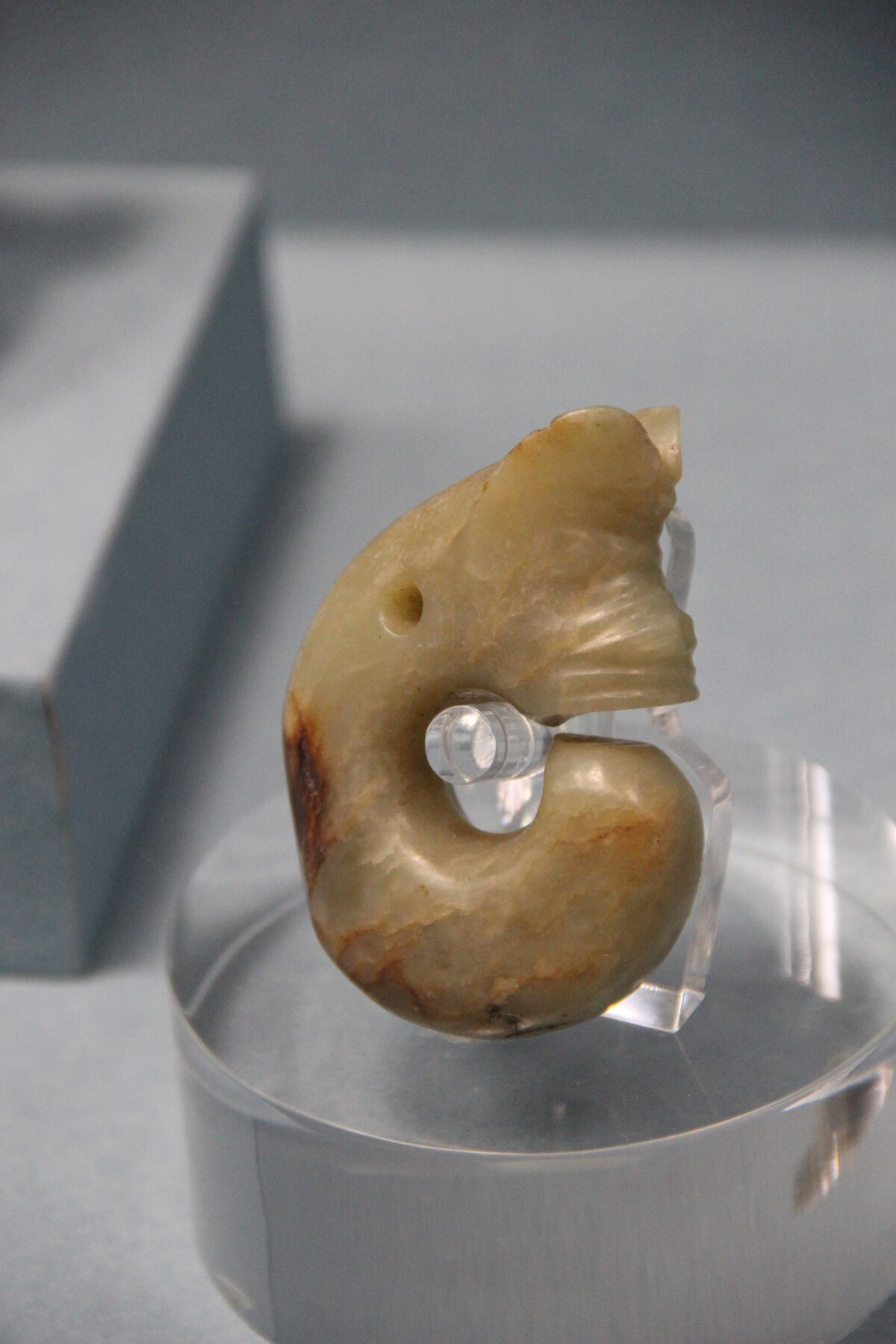
At Niuheliang the form crossed every boundary that mattered. A pair of jade pig-dragons lay on the chest of the dead in tomb N2Z1M4; another excavated example came from N16M14. Inside the Goddess Temple the same hybrid was enlarged into clay: fragments include the lower jaw and body of a monumental pig-dragon, a sanctuary animal no person could wear. The dead carried the small sacred body; the temple housed the great one. Jade condensed divine force into an heirloom-sized object, while clay expanded it into presence.
This is why Hongshan belongs at the northern heart of any East Asian “jade complex.” Jade here was neither treasure alone nor decoration. In the official synthesis prepared for Niuheliang’s World Heritage candidature, it is the medium between human and divine within a system combining ancestor worship, Heaven and Earth, and animal worship led by the dragon. The culture’s most abstract jades — dragon, phoenix, human, tortoise — formed a fixed sacred vocabulary. A ritual elite wore the vocabulary into the grave.
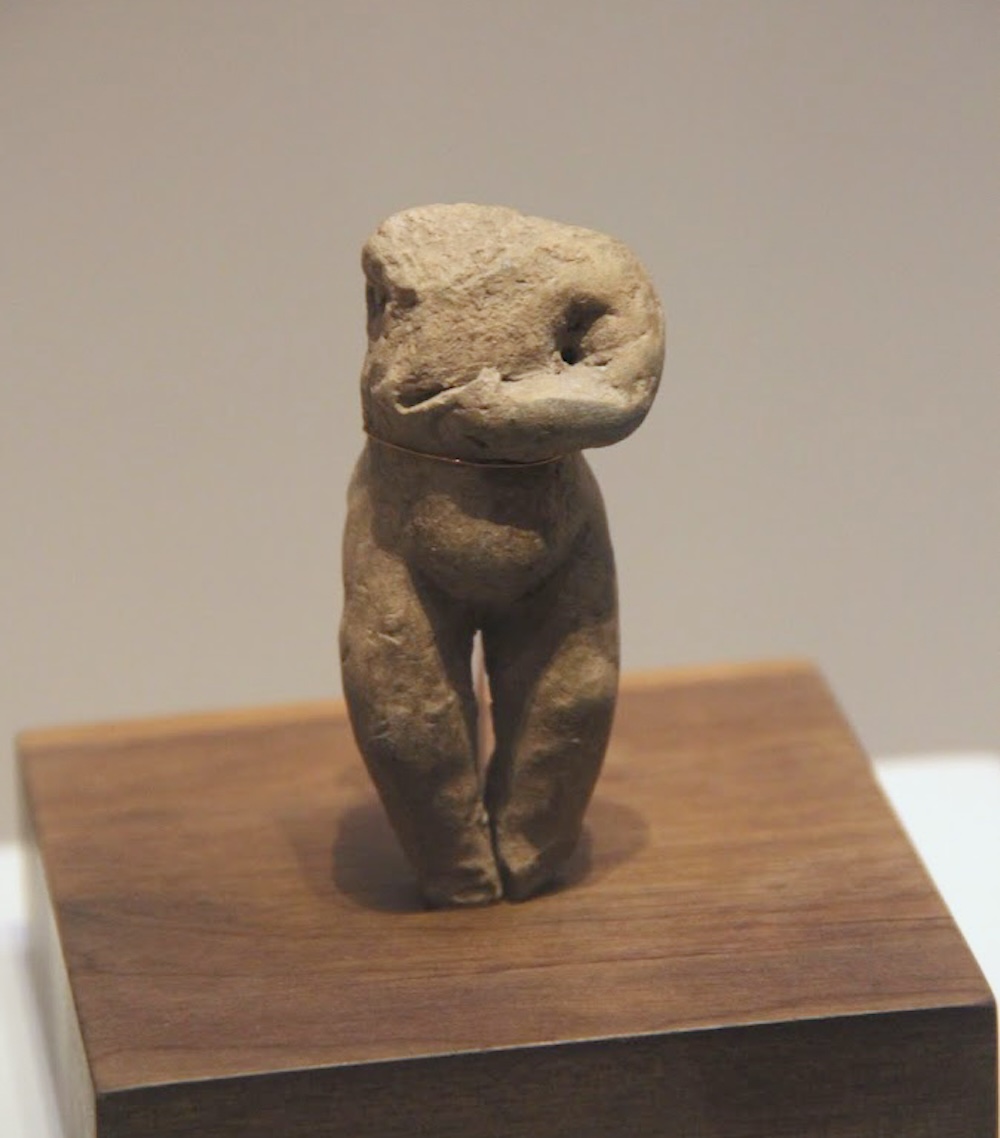
The temple’s other bodies were female. A celebrated painted clay head has inlaid jade eyes. Fragments of breasts, arms, shoulders, and at least one figure several times human size belonged to a company of female beings. The sanctuary made female generation public and monumental. The coiled creature and the female body therefore occupied the same ritual machine: embryo and ancestor, burial and rebirth, animal power and the human line. The later serpent-bodied Nüwa does not emerge from an empty iconographic field. She gives a personal name and a handheld instrument to a conjunction Hongshan ceremony had already made sacred.
The serpent couple came before the tools
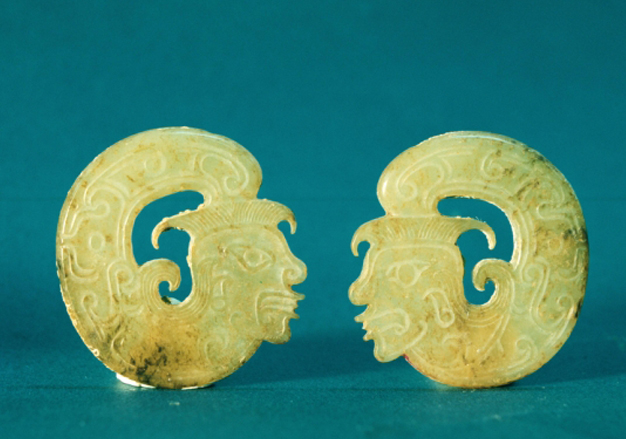
The next surviving stage is not yet the famous Han diagram. In 1983, excavators opened the tomb of Huang Junmeng at Guangshan in southern Henan and found two extraordinarily thin jade ornaments, each only 3.8 centimetres across. They face one another as male and female human heads. Behind each face the body curls into a serpent, patterned like a dragon and pierced by openwork. The Henan Museum identifies them as the earliest material images of Fuxi and Nüwa: not because names are inscribed on the jades, but because the paired sexes, human heads, and coiled snake bodies already form the later couple’s essential anatomy.
Han tomb art unfolds the emblem in stages. Late Western Han tombs around Luoyang show Fuxi and Nüwa separately, each with a long serpent tail and a celestial body: sun for one, moon for the other. Their tails begin to intertwine in Eastern Han art. The geometric instruments arrive later still. Nataša Vampelj Suhadolnik’s survey finds the tool-only form — Fuxi and Nüwa with square and compasses — confined at first to southern Shandong and relatively rare. The fully furnished combination of serpent couple, sun and moon, and both tools develops there afterward and spreads west.
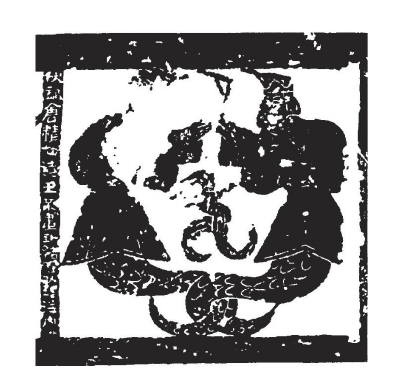
The chronology matters because it reverses the modern reading of the image. We tend to begin with the tools, as if a philosophical diagram had been dressed in mythological bodies. The tombs begin with the bodies. First come serpent, sex, sun, moon, and the bond between two creators. Square and compass are an annotation added to this older cosmic organism. Their late arrival made the inherited grammar legible in the language of imperial order.
The tools make the world governable
The Chinese words are ju, the carpenter’s try square, and gui, the pair of compasses. Both belong to workshops before they belong to gods. The square establishes a right angle and tests the straight; compasses carry a radius around a fixed centre and make the round. Together, gui-ju came to mean the standards by which anything — a board, a ritual, a government, a person — is brought into correct form.
Mencius makes the transfer explicit. Even the legendary eye of Li Lou and the craft of Gongshu could not make circles and squares without compass and square; in the next movement, the instruments become the model for governing a realm. The Huainanzi places the compass in the hand of Taihao, identified with Fuxi, as he governs spring. The tool draws a circle, the season turns, and the creator regulates renewal. Technical action and cosmic action are the same verb.
The sex of the hand was secondary. In surviving Han scenes, Fuxi carries the compass in seven cases and the square in eleven; Nüwa carries the compass in twelve and the square in five. No stable chronology or region fixes the assignment. What matters is that the pair commands both operations together. Their linked serpent body joins what the instruments distinguish: curve and angle, heaven and earth, revolution and station, generation and rule.
Niuheliang’s altar performed the same synthesis without illustrating a carpenter. Its measured axis regulated approach. Its square generated a circle through the diagonal. Its round altar and rectangular cairns placed sky and ground around ancestral bodies. Han art miniaturized these spatial acts into things a god could hold. The square and compass were not the beginning of the symbol. They were the caption later China added to a serpent cosmology already built in stone, clay, and jade.
A blade at the edge of the circle
One Hongshan form brings this world unusually close to the instrument mapped by this atlas. Long, thin Y-shaped jades from Liaoning end in a forked animal face and carry a small transverse hole near the opposite edge. A published Fuxingdi example measures 12.1 centimetres long and only 0.3 centimetres thick. Its animal face and bow-string lines occupy one end; its single suspension hole sits close to the lower edge. Several museum comparanda repeat the same unlikely combination: decorated terminal, flat blade, edge perforation.
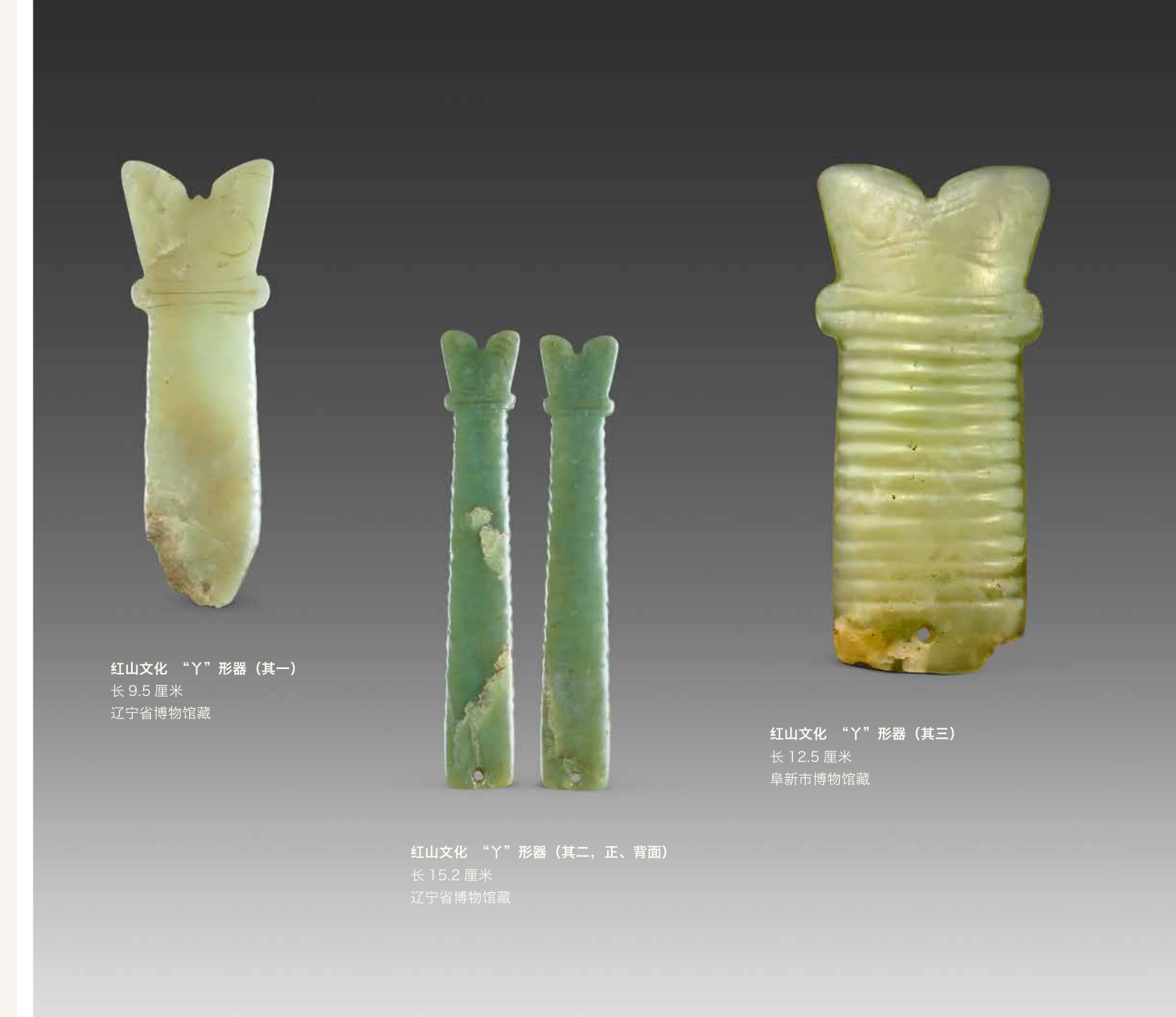
A bullroarer is also a long flat blade animated from an edge hole. That formal match earns the Fuxingdi jade a place in the question, but no excavated Niuheliang jade has yet earned the name bullroarer. The strong fact is narrower and more interesting than a forced identification: Hongshan makers built animal-headed, edge-perforated blades thin enough to raise the question of whirling, inside the same culture that joined serpent bodies to measured sacred space.
How a serpent cult occupies a world
A snake cult is not a room full of snake pictures. It is a system in which the serpent’s body provides a way to connect domains that settled categories hold apart: water and ground, living and dead, male and female, sky and underworld, terror and fertility. Its proof is a cluster, not a logo. At Niuheliang the cluster is unusually dense. Serpentine hybrids guard chest and temple. Female ancestors join pregnancy to burial. Circles turn inside squares. Jade moves between human and divine. Monumental ritual replaces domestic life.
Where such cults survived into ethnography, the same bundle can be watched in motion. In Arnhem Land, the great python Yurlunggur is flood and monsoon, ancestral law, initiation, kinship, and country. The bullroarer associated with him is not merely sounded near the myth: the wooden blade can stand for his body, the hair cord his fangs, and the noise his voice. The instrument makes an unseen serpent spatially present. Rain, sex, death, rebirth, social rule, and roaring sound become one ceremony.
On Kiwai Island in Papua New Guinea, Gunnar Landtman recorded a snake-man named Máigidúbu teaching a woman to swing the first bullroarer so that its voice would wake up the ground
. He then distributed the medicine of sexual generation over banana, sago, sugar cane, and coconut. The episode is a compact model of the whole serpent gestalt: a snake-shaped being, a woman, a whirled voice, awakened earth, crops, and reproductive force. It shows why serpent, female generation, landscape, and the whirled blade belong in the same explanatory frame.
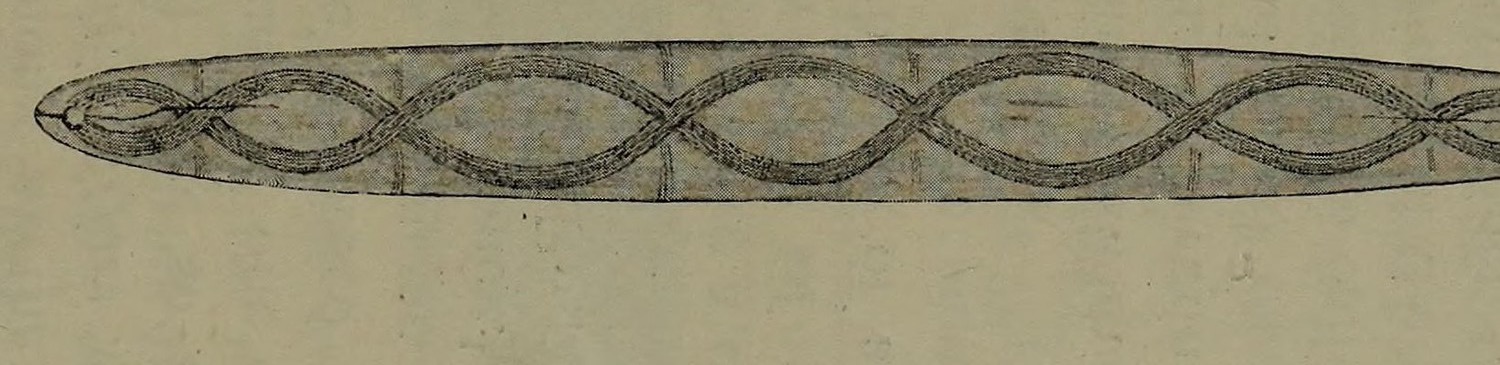
The larger trail runs through the atlas. The serpent’s voice becomes an instrument; in Sahul’s remembered worlds, ancestral beings re-form drowned country; in Arnhem Land and the Kiwai record, the roarer activates the relations that hold a people to land. Hongshan contributes the deep archaeological form of this system. Its sacred centre does not repeat an ethnographic rite in advance. It reveals the same architecture of thought: the serpent is powerful because it crosses the world, and ritual order is the art of directing that crossing.
The symbol was inhabited
The history now reads in the right direction. Niuheliang first organized a sacred landscape through circle, square, axis, centre, burial, female ancestor, and dragon. Hongshan jade gave the system a portable serpentine body, coiled like an embryo and worn against the dead. Spring and Autumn artists split that body into a facing male and female pair. Han artists placed sun and moon beside them, entwined their tails, and finally put workshop instruments in their hands. Tang painters raised the completed couple to the ceiling among the stars.
The Han square-and-compass couple did not invent a new cosmology. They turned into attributes what Hongshan ritual had already built into a world: serpentine power moving between round heaven and square earth, female ancestry joining birth to death, and technical measure converting both into social order.
At Niuheliang, the symbol was not held. It was inhabited.
Key sources
- Jia Xiaobing. “The Circular Altar at Niuheliang and the Earliest Chinese Cosmological Geometry.” National Cultural Heritage Administration / Chinese Archaeology Lecture. Gives the 11, 15.6, and 22 metre diameters and the nested-square reconstruction. Official page.
- Guo Dashun. “New progress in the study of Hongshan culture.” Chinese Academy of Social Sciences. Excavation history, concentric altar, north–south axis, nonlocal red stones, and the institutional ritual system. CASS.
- “Archaeological Sites of the Hongshan Culture: Niuheliang, Hongshanhou and Weijiawopu.” China’s UNESCO World Heritage Tentative List submission. Site layout, round altar at locality 2, square altar at locality 5, and official synthesis of ancestor, Heaven-and-Earth, dragon, and jade ritual. UNESCO record.
- Childs-Johnson, Elizabeth. 1991. “Jades of the Hongshan Culture: The Dragon and Fertility Cult Worship.” Arts Asiatiques 46: 82–95, especially p. 90 and figs. 16–18 for the Goddess Temple, female head, and monumental clay pig-dragon. DOI.
- Lozada, Marcela, Jian Zhu, Yimin Yang, and others. 2023. “Jade for Bones in Hongshan Craftsmanship.” Arts 12.5: 206. Excavated Niuheliang jade contexts, including the paired pig-dragons on the chest in N2Z1M4. Open access.
- National Museum of China. “Ancient Chinese Jade.” Hongshan dragon entry: snake body, beast head, embryo, transformation, regeneration, and ritual mediation. Museum exhibition.
- Musée Guimet. “Pig-dragon (zhulong).” MG 18396, fourth millennium BCE, 15.3 cm. Collection entry.
- Henan Museum. “Pair of human-headed serpent-bodied jade ornaments.” Early Spring and Autumn period, Huang Junmeng tomb, excavated 1983, 3.8 cm diameter and 0.2 cm thick. Object entry.
- Institute of History and Philology, Academia Sinica. “Fuxi and Nüwa, Wu Liang Shrine.” Official collection entry for the intertwined serpent couple, with Nüwa’s compass and Fuxi’s square. Museum entry.
- Vampelj Suhadolnik, Nataša. 2019. “Transmission of Han Pictorial Motifs into the Western Periphery: Fuxi and Nüwa in the Wei-Jin Mural Tombs in the Hexi Corridor.” Asian Studies 7.2: 47–86, especially pp. 59–60 and 67–68 for the sequence of celestial and tool types. Open access.
- Zhao, Jinchao. 2019. “Integration and Transformation: The Fuxi and Nüwa Images in the Han Dynasty Tombs and Their Iconographic Transformation in the Wei-Jin Period.” Asian Studies 7.2: 13–45, especially pp. 28–31 on the tools as a later addition. DOI.
- Lin Xiaoyu. “A Study of the Configuration of Gui and Ju in Han Fuxi-Nüwa Iconography.” Table on p. 44 gives the variable assignment of compass and square between the pair. Institutional PDF.
- Mencius 4A.1, on compass and square as the indispensable standards of craft and government. Chinese Text Project.
- Huainanzi 3, “Tianwen” (“Patterns of Heaven”), on the East, whose god Taihao holds the compass and governs spring. Primary text.
- Da Dai Liji, “Zengzi on Heaven’s Roundness,” distinguishes physical outline from cosmological operation: Heaven’s Way is round and Earth’s Way square. Primary text.
- Expert Committee of the Chinese Society of Cultural Relics, comp. 2019. Collection of Ancient Chinese Cultural Relics, Vol. 1: Primitive Society / The Xia and Shang Dynasties. Translated by Guozhen Wang. ATF Press. P. 14, no. 14, for the Fuxingdi Y-shaped jade: 12.1 cm long, 0.3 cm thick, with a hole close to the lower edge. Catalogue preview.
- Landtman, Gunnar. 1917. The Folk-Tales of the Kiwai Papuans, pp. 316–17, for Máigidúbu, the first bullroarer, awakened ground, and crop fertility. Public-domain scan.
- National Gallery of Victoria. “Mathaman: warrior, artist, songman.” Yurlunggur as flood, law, initiation, and country; the bullroarer as body, fangs, and voice. NGV essay.
The reading of the Han tools as a late graphic caption on Niuheliang’s older serpent-and-geometry ritual grammar is original to this page.