No. STEFOPOULOS1972-001Europe
Chrysi board vourvouna
Greece · Chrysi (Χρυσή), Nestorio municipality, Kastoria regional unit, West Macedonia · Europe · Mediterranean
Play / practical
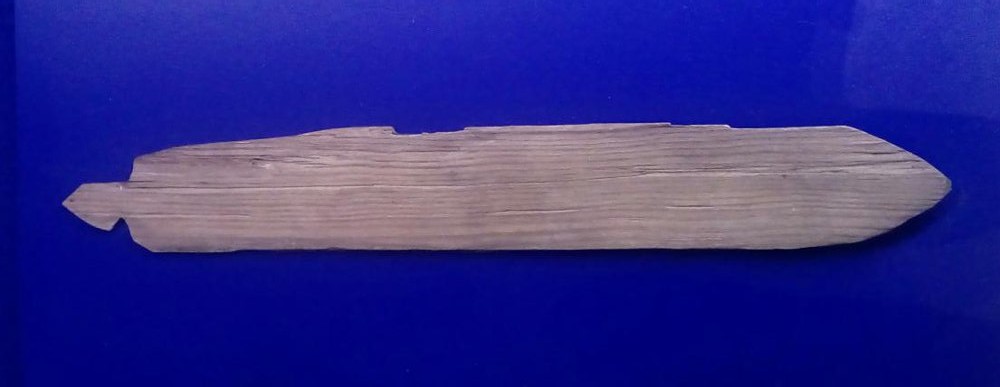
βουρβούνα μὲ σανίδι (vourvoúna me sanídi)
Source term: Βουρβούνα μὲ σανίδι
vourvoúna: a Greek imitative name for a humming whirled toy, shared in Chrysi by the board and the toothed bark disc.
In Chrysi, a village in the Kastoria district of Greek Macedonia, children played from about the age of five until twelve; once primary school was over they went to work beside their parents. Among their games were two kinds of vourvouna. One was a disc of thick pine bark with a toothed rim, spun on a doubled string. The other was a little board, five centimetres by ten, thinned along its edges and tied at one end to half a metre of string with a loop for the hand. Whirled hard, it turned over and over on itself and gave out the characteristic hum from which it took its name.
Αὐτὴ ἡ κίνηση δημιουργεῖ ἕνα χαρακτηριστικὸ βουΐσμα, ποὺ ἀπ᾽ αὐτὸ πῆρε καὶ τὸ ὄνομά της.
This motion makes a characteristic hum, and from it the toy took its name.
Andreas P. Stefopoulos, Makedonika 12 (1972), p. 369
Particulars
- Object
- A small board about 5 by 10 cm, thinned along both sides, with a little hole at the centre of one short end, tied to a string 50–80 cm long that ends in a loop for the hand.
- Function
- Children’s sound toy, whirled hard by the loop until the board spins about itself and hums.
Source
Andreas P. Stefopoulos, “Παιδικά παραδοσιακά παιχνίδια από τη Χρυσή Καστοριάς,” Makedonika 12 (1972): 361–423, pp. 368–369.