No. SAMER-001
Noanamá (Waunana / Wounaan)
Colombia · Isla de Munguidó, San Juan River, Chocó · South America · Northwest
Play / practical
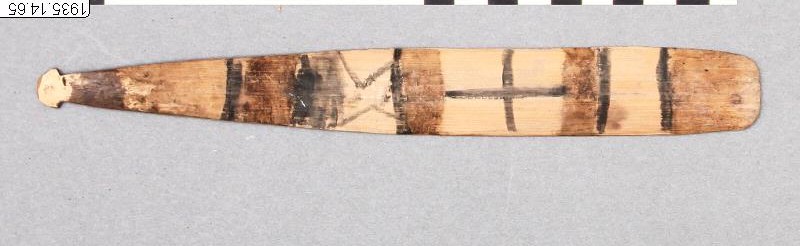
sigur-wauna
Noanamá (Wounaan) name for the bull-roarer, recorded by Wassén on the Isla de Munguidó; his illustrated example (fig. 12 D) was a flat wooden slat about 30 cm long.
Among the Noanamá (Wounaan) of the Isla de Munguidó, on the San Juan River in the Chocó of Colombia, the bull-roarer was a flat slat of wood — bamboo ones occurred too — and chiefly a child's plaything; Henry Wassén noted in 1935 that toy examples were "nowadays often painted with aniline paints and roughly made." But he recorded one exception to its secular use. An Indian who for some reason had to cross the forest at night, from one place to another, might carry a bull-roarer painted red with bija — the annatto dye — to frighten away evil spirits. The example Wassén illustrated, about thirty centimetres long, he called a sigur-wauna.
the bullroarer is used there to scare away evil spirits in the forests ... It is painted red and this colour is said to have a protecting power.
K. G. Izikowitz, Musical and Other Sound Instruments of the South American Indians (1935), p. 210, after Wassén
Particulars
- Object
- A flat slat bull-roarer (wood or bamboo), one example red-painted with bija.
Source
Wassén, Notes on Southern Groups of Chocó Indians, Etnologiska Studier 1 (1935), pp.65-67; via Zerries 1953