The Bullroarer Atlas

EXH2026-028 - ethnographic attestation

Kagaba (Kogi)

Colombia - Sierra Nevada de Santa Marta - South America - Northwest

Play / practical

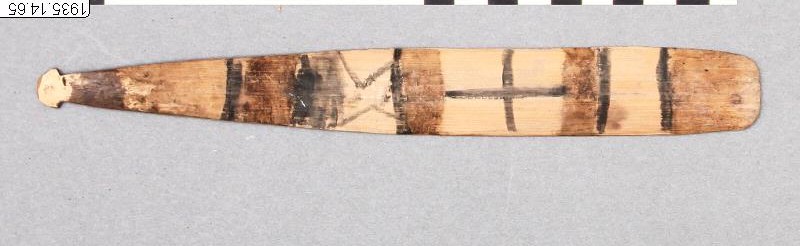
A carved wooden blade ending in a small splayed peg at one tip and a long slender shaft at the other, its face painted with a dotted...
Representative image. A carved wooden blade ending in a small splayed peg at one tip and a long slender shaft at the other, its face painted with a dotted zigzag-and-diamond band: a man-shaped Upper Xingu bullroarer collected by Max Schmidt in 1904, shown for the general Brazilian form, not the Kagaba (Kogi) seibuka documented here. Ethnologisches Museum, Staatliche Museen zu Berlin (V B 5230), coll. Max Schmidt 1904 CC BY-SA 4.0 Image source

seibuka German

Source term: seibuka (das Schwirrholz)

seibuká — Kágaba (Kogi) name for the bullroarer, containing the root ibusi "to sling, throw" (Preuss cites it, with sibuká "the one spinning a thread," to etymologize ábukaj, the powder packet "that throws out the powder").

Etymology. Preuss ties `seibuka` to `ibusi`, to sling or throw, giving a real morphological lead for the term. (high confidence)

No people in South America gave their priests more and their bullroarer less. The Kágaba (Kogi) of the Sierra Nevada de Santa Marta live under the rule of the máma priesthood: future priests are shut away for nine years — the greatest for twice nine — in darkness, without salt, learning the songs of Gauteovan, the Mother of Fire, who bore the sun, the rain, the rivers, the thunders, "the dance and the songs, the festival-implements and the temples, and all things." Their sacred sounds are masked speech to the four directions, flutes, drums, and a wing-conch trumpet the ancestors ordered kept from the seashore. Into all this the seibuká enters Konrad Theodor Preuss's monograph only as a word — built on ibusi, "to hurl" — with a single footnote for its whole ethnography: "used only by boys." In one of the most priest-governed cosmologies on the continent, the whirring board belonged to the children.

Wird nur von Knaben benützt.

Used only by boys.

Preuss, "Forschungsreise zu den Kágaba-Indianern," Anthropos 14–15 (1919/20), p. 1049 n. 1
Object
Bullroarer; name derived by Preuss from ibusi 'to sling/throw' - 'the thing flung through the air'.
Function
Boys' plaything per Preuss's footnote ('Wird nur von Knaben benützt', p. 1049 n. 1); no ritual use recorded anywhere in his Kágaba corpus.
Map confidence
medium - Kogi heartland, Sierra Nevada de Santa Marta
Source location
Anthropos 14-15, p. ~1049

View source Open this point on the interactive map