The Bullroarer Atlas

PNG160 - ethnographic attestation

Nalik

Papua New Guinea - New Ireland - Oceania - Sahul

Function not recorded

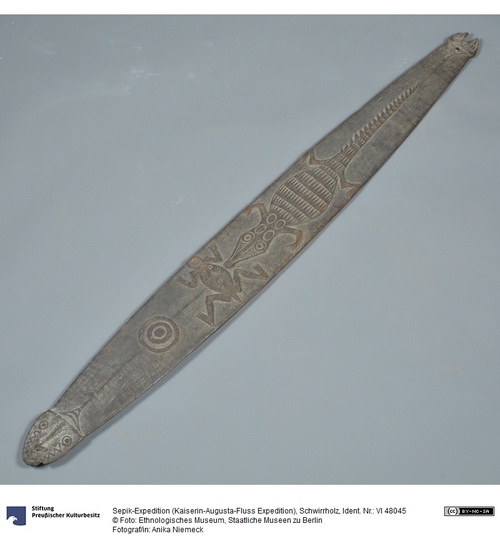
A similarly carved New Guinea bull-roarer with a small animal head at each tip, the upper blade incised with a hatched fish-like panel, a...
Representative image. A similarly carved New Guinea bull-roarer with a small animal head at each tip, the upper blade incised with a hatched fish-like panel, a splay-limbed figure, and a concentric-circle eye; not the Nalik object documented here. Ethnologisches Museum (VI 48045) CC BY-NC-SA Image source

Source term: bullroarer / sacred flute / slit-gong flags

Among the Nalik of northern New Ireland, K. A. Gourlay's 1975 survey of Papua New Guinea's esoteric instruments logged the bullroarer and the slit-gong as present. It is a distribution tick rather than a field record: Gourlay treated the whole of New Ireland as "largely unknown" for his purposes, and although the slit-gong was reported by every informant, he found it carried no esoteric significance except among a small minority, which led him to rate the island "tentatively negative" for the secret, women-excluding cult pattern he was tracking. The Nalik are far better documented for their malagan mortuary carvings, the word itself a Nalik one, than for any bullroarer rite.

New Ireland is likewise largely unknown. While the slit-gong is reported by all informants, its lack of esoteric significance, except for a small minority, makes the area tentatively negative.

Gourlay 1975, Sound-Producing Instruments in Traditional Society (New Guinea Research Bulletin 60): region J, New Ireland
Object
bullroarer occurrence; slit-gong occurrence
Function
Gourlay source-catalog row with bullroarer occurrence; function not stated.
Map confidence
high - geocoded
Source location
Table 1, row 160

View source Open this point on the interactive map