No. PNG154
Sulka
Papua New Guinea · East New Britain · Oceania · Sahul
Restricted
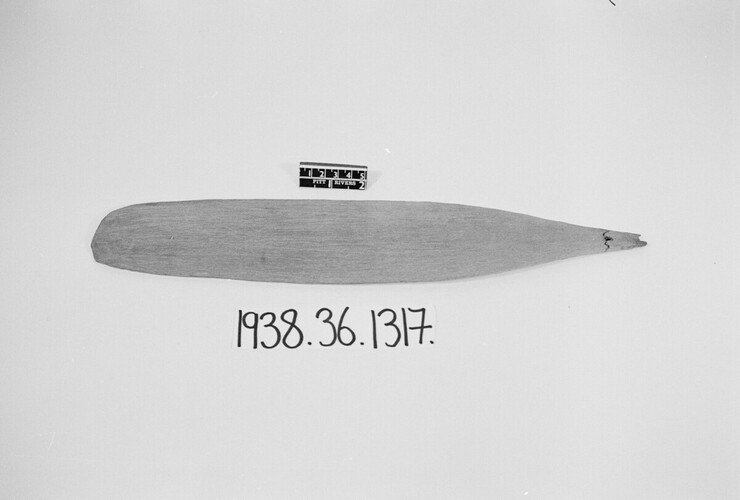
vuvu
"Wind, to blow" — a motion-and-weather word; non-initiates hear the swung instrument as a spirit's voice (Geisterstimme).
Etymology. Vuvu means "wind, to blow" in Sulka — a motion-sound term fitting the whirled, air-roaring instrument, which non-initiates take for a spirit's voice.
When the drone of the vuvu crossed a Sulka village, the women hid at once: they heard a spirit's voice in it, and it meant a mask was near. The Sulka of Wide Bay held their towering masks to be real spirits, o inkuol, which now and then devoured children and women; a woman who set foot on the mask-men's assembly ground would lose the child she carried and remain barren ever after. The masks were built and kept at a vererei, a homestead set apart in the forest, and went out from there to dance in the hamlets at the great rites — a boy's circumcision, a girl's ear- and nose-piercing, a young man's teeth-blackening before marriage. Ahead of them went the warning voice of the vuvu — the Sulka word for wind and for blowing. The final mask, lelwong, carried a snake curling from its belly over its head and down its back; its dance closed the feast.
Um die Weiber zu warnen, wenn eine Maske in der Nachbarschaft ist, schwingt man das Schwirrholz, vuvu, und die Geängstigten, die darin eine Geisterstimme zu erkennen glauben, verstecken sich schleunigst.
To warn the women when a mask is in the neighbourhood, one swings the bullroarer, vuvu, and the frightened women, who believe they recognize a spirit's voice in it, hide themselves at once.
Parkinson 1907, "Dreissig Jahre in der Südsee," p. 636 (chapter "Masken der Sulka")
Particulars
- Function
- Swung to warn the women away when a spirit-mask was near; the women, hearing a spirit's voice in it, hid at once.
Source
K. A. Gourlay, Sound-Producing Instruments in Traditional Society: A Study of Esoteric Instruments and Their Role in Male-Female Relations (New Guinea Research Bulletin 60; Canberra and Port Moresby, 1975), Table 1, entry 154; Richard Parkinson, Dreissig Jahre in der Südsee (Stuttgart, 1907), pp. 635-636 and 638